
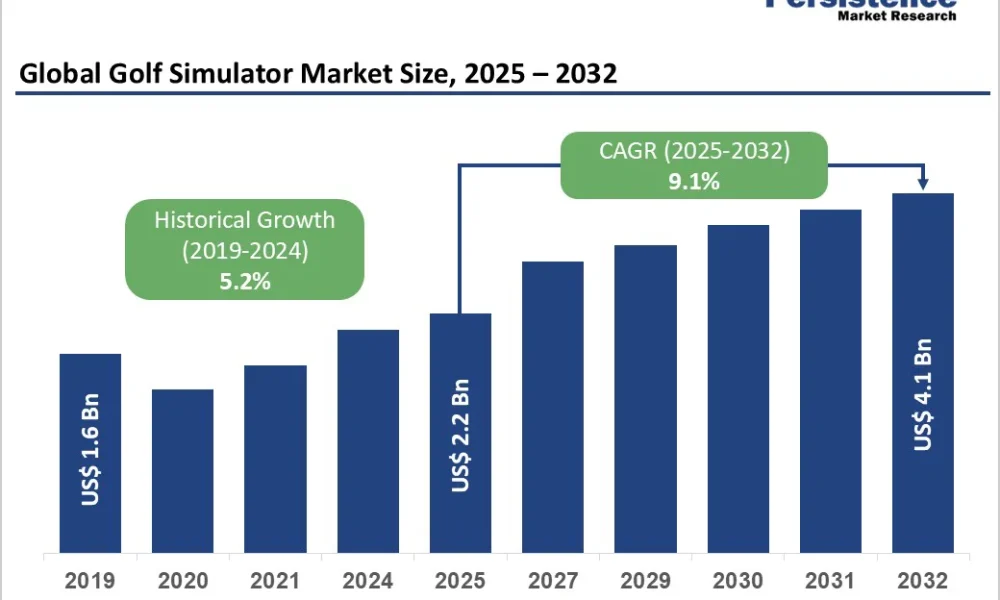
The global golf simulator market has evolved rapidly from a niche training solution into a mainstream sports and entertainment ecosystem. Golf simulators replicate real-world golf environments using advanced sensors, launch monitors, high-speed cameras, and immersive software platforms. These systems allow players to practice, compete, and analyze performance indoors, regardless of weather or space constraints. The convergence of sports technology, data analytics, and experiential entertainment has positioned golf simulators as a critical pillar of modern golf infrastructure.
From a market perspective, the golf simulator market size is estimated at US$2.2 billion in 2025 and is projected to reach US$4.1 billion by 2032, expanding at a CAGR of 9.1% between 2025 and 2032. Growth is primarily driven by rising urban participation in golf, the need for year-round play, and increasing investments in indoor sports facilities. Commercial venues dominate demand, while residential adoption is rising steadily as simulator costs decline and realism improves.
Key Growth Drivers, Leading Segments, and Regional Dominance
Several structural and technological factors are accelerating golf simulator market growth. Advancements in AI-driven swing analysis, real-time ball tracking, and cloud-based performance analytics have transformed simulators into professional-grade training tools. At the same time, changing consumer preferences toward experiential leisure and social sports entertainment are driving simulator adoption in malls, lounges, hotels, and corporate spaces. Urbanization and limited access to outdoor golf courses further reinforce the shift toward indoor simulation.
In terms of segmentation, full swing simulators emerged as the leading product type, accounting for 44.7% market share in 2025, due to their high accuracy and use in professional training academies. On the application side, commercial installations dominated with 59.8% of total revenue, reflecting the rapid expansion of indoor golf lounges and entertainment chains. Regionally, North America led the market with over 41% revenue share in 2025, supported by strong golf culture, high disposable incomes, and early adoption of sports technology, particularly in the United States.
Key Highlights from the Golf Simulator Market Report
- The golf simulator market is projected to grow at a robust CAGR of 9.1% through 2032.
- Commercial applications remain the largest revenue contributor globally.
- Full swing simulators dominate due to professional and premium usage.
- North America leads the market, while Asia Pacific shows the fastest growth.
- AI and data analytics are reshaping simulator functionality and user engagement.
- Rising urbanization is accelerating indoor golf adoption worldwide.
Golf Simulator Market Segmentation Analysis
The golf simulator market is segmented by product type, application, and end user, each playing a critical role in shaping demand patterns. By product type, the market includes full swing simulators, driving range simulators, and putting simulators. Full swing systems lead the segment due to their ability to replicate real-course conditions and provide comprehensive swing metrics, making them essential for professional golfers and training institutions.
By application, the market is broadly divided into commercial and residential segments. Commercial installations dominate, driven by indoor golf centers, sports bars, entertainment hubs, and resorts integrating simulators to enhance customer engagement. Residential demand is expanding steadily as affluent consumers invest in home-based golf entertainment and training setups, particularly in urban regions where outdoor play is limited.
Regional Insights and Global Market Trends
North America continues to represent the most mature and technologically advanced golf simulator market. The region benefits from a deeply ingrained golf culture, strong presence of simulator manufacturers, and widespread adoption across commercial venues. The U.S. leads regional growth due to high investments in sports tech and the popularity of indoor golf leagues.
Asia Pacific is the fastest-growing regional market, fueled by rising disposable incomes and the rapid spread of “screen golf” culture, particularly in South Korea. Countries such as China, Japan, and India are witnessing increased investments in premium indoor golf facilities, positioning the region as a future growth engine for the global golf simulator industry.
Elevate your business strategy with comprehensive market data. Request a sample report now: https://www.persistencemarketresearch.com/samples/35802
Market Drivers: Factors Fueling Industry Growth
One of the primary market drivers is the growing demand for realistic and data-driven golf training solutions. Advanced launch monitors, AI-powered analytics, and immersive simulation software enable players to improve performance with precision. Additionally, the increasing popularity of golf as a lifestyle sport among younger demographics is boosting simulator adoption.
Another key driver is the expansion of commercial indoor entertainment venues. Golf simulators are being integrated into sports lounges, hotels, and corporate recreation spaces, transforming golf into a social and accessible activity. The ability to play year-round, regardless of climate, further strengthens market demand.
Market Restraints: Challenges Impacting Growth
Despite strong growth prospects, the golf simulator market faces several restraints. High initial installation costs remain a barrier, particularly for small businesses and residential users. Premium simulators with advanced sensors and software require significant upfront investment, limiting adoption in price-sensitive markets.
Technical complexity and maintenance requirements also pose challenges. Accurate calibration, software updates, and space requirements can deter potential users. Additionally, the lack of standardized performance metrics across different simulator brands can affect user confidence and comparability.
Market Opportunities: Future Growth Potential
The market presents substantial growth opportunities through technological innovation and geographic expansion. Integration of virtual reality (VR), augmented reality (AR), and multiplayer cloud platforms is expected to redefine user engagement. Subscription-based software models and performance analytics services also open new revenue streams for manufacturers.
Emerging markets in Asia Pacific, the Middle East, and Latin America offer untapped potential as urban infrastructure develops and interest in golf rises. Partnerships with hospitality chains, sports academies, and corporate wellness programs are likely to accelerate simulator adoption globally.
Reasons to Buy the Golf Simulator Market Report
✔ Gain detailed insights into current and future market size and growth trends.
✔ Understand key drivers, restraints, and opportunities shaping the industry.
✔ Analyze market segmentation by product type, application, and region.
✔ Identify leading companies and their competitive strategies.
✔ Support strategic planning with data-backed forecasts through 2032.
Frequently Asked Questions (FAQs)
How big is the global golf simulator market today?
Who are the key players in the global golf simulator market?
What is the projected growth rate of the golf simulator market?
What is the market forecast for golf simulators by 2032?
Which region is estimated to dominate the industry through the forecast period?
Company Insights: Key Players in the Golf Simulator Market
- Golfzon Co., Ltd.
- TrackMan A/S
- TruGolf Inc.
- Foresight Sports
- SkyTrak Golf
- Uneekor Inc.
- Full Swing Golf
- AboutGolf
Recent Developments:
Golfzon has expanded its AI-enabled simulator software ecosystem and increased manufacturing capacity in Vietnam to support global demand. TrackMan recently enhanced its cloud analytics platform, integrating advanced shot-tracking algorithms for professional and commercial users.
Conclusion
The global golf simulator market is undergoing a structural transformation, driven by technological innovation, urban lifestyle changes, and the commercialization of indoor sports entertainment. As simulators become more accurate, accessible, and socially engaging, they are redefining how golf is played, practiced, and experienced worldwide. With strong growth momentum, expanding applications, and rising investments, the golf simulator industry is well-positioned to become a cornerstone of the future golf ecosystem.
Related Reports:




