
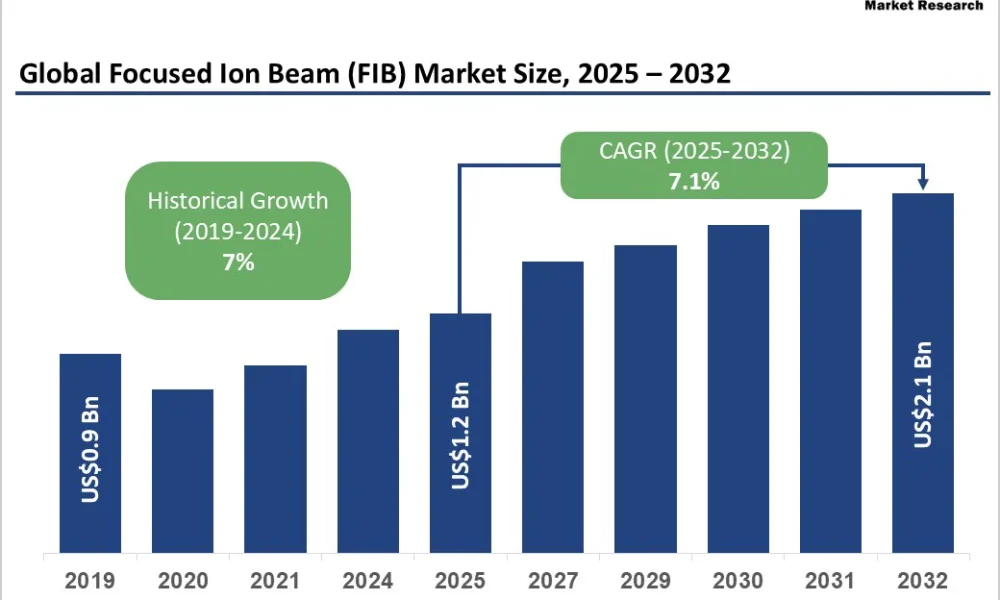
The global Focused Ion Beam (FIB) market is entering a decisive growth phase as semiconductor complexity, nanoscale research, and bioscience innovation accelerate worldwide. Once considered a niche analytical tool, FIB systems are now indispensable across semiconductor fabrication, materials science, and advanced biological research. As chip architectures shrink and research moves deeper into atomic-level manipulation, the role of FIB technology continues to expand.
In 2025, the global FIB market is expected to reach US$1.2 billion, with forecasts indicating a rise to US$2.1 billion by 2032, reflecting a compound annual growth rate (CAGR) of 7.1% during the forecast period. This growth trajectory is underpinned by strong investments in semiconductor manufacturing, rapid adoption of dual- and multi-beam systems, and the emergence of novel bioscience applications.
Understanding Focused Ion Beam (FIB) Technology
Focused Ion Beam systems use a finely focused beam of ions—traditionally gallium, and increasingly helium or neon—to image, mill, deposit, or modify materials at the nanoscale. FIB technology allows researchers and engineers to precisely manipulate samples with exceptional spatial resolution, making it vital for applications that demand atomic-level control.
FIB systems are often integrated with scanning electron microscopes (SEM), forming dual-beam FIB-SEM platforms that combine high-resolution imaging with precise ion-beam milling. These hybrid systems have become the industry standard in semiconductor failure analysis, materials research, and nanofabrication.
The technology’s versatility—ranging from circuit editing to biological sample preparation—positions FIB as a cornerstone tool in advanced R&D environments.
Global Focused Ion Beam Market Overview
The FIB market has demonstrated consistent historical growth, recording a 7% CAGR between 2019 and 2024. This steady expansion reflects increasing reliance on advanced characterization tools across electronics and scientific research sectors.
By 2025, the market is projected to achieve a value of US$1.2 billion, driven by growing semiconductor fab investments, demand for higher-resolution imaging, and adoption of FIB in emerging research domains. Looking ahead, the market is expected to reach US$2.1 billion by 2032, supported by technology innovations and expanding end-user industries.
The combination of mature semiconductor applications and fast-growing bioscience use cases is reshaping the market’s long-term structure.
Key Growth Drivers Shaping the FIB Market
Rising Semiconductor Manufacturing Complexity
One of the primary drivers of FIB market growth is the escalating complexity of semiconductor devices. Advanced nodes, 3D architectures, and heterogeneous integration require ultra-precise failure analysis and defect localization. FIB systems enable engineers to cross-section, analyze, and repair integrated circuits with unmatched accuracy.
As global semiconductor manufacturers continue to invest heavily in new fabrication facilities, demand for advanced FIB-SEM systems is rising steadily.
Adoption of Multi-Beam and Helium Ion Technologies
Traditional gallium-based FIB systems are increasingly complemented by multi-beam platforms that incorporate helium and neon ion sources. These systems offer higher resolution, reduced sample damage, and enhanced imaging capabilities—critical for next-generation semiconductor and bioscience applications.
Multi-beam FIB systems are emerging as the fastest-growing segment through 2032, reflecting a shift toward higher-performance tools that support advanced nanoscale research.
Expanding Bioscience Applications
Beyond electronics, FIB technology is gaining traction in bioscience fields such as connectomics, tissue engineering, and cellular imaging. Researchers increasingly rely on FIB for ultra-thin sectioning and precise sample preparation, enabling detailed three-dimensional biological analysis.
The bioscience segment is expected to grow at a high CAGR, signaling a gradual diversification of FIB market demand away from its traditional semiconductor base.
Elevate your business strategy with comprehensive market data. Request a sample report now: https://www.persistencemarketresearch.com/samples/35860
System Type Analysis: Dual-Beam Dominance
Among system types, dual-beam FIB-SEM systems dominate the global market, accounting for approximately 55% of total market share in 2025. Their ability to combine real-time imaging with ion-beam processing makes them indispensable in semiconductor failure analysis and advanced materials research.
These systems support rapid diagnosis of manufacturing defects, allowing fabs to reduce downtime and improve yield rates. Their widespread adoption across academic and industrial research labs further strengthens their market leadership.
However, the fastest growth is expected from multi-beam systems, particularly those integrating helium and neon ion sources. These next-generation platforms are increasingly favored for applications requiring ultra-high resolution and minimal sample disruption.
Application Trends: Failure Analysis Leads, Bioscience Accelerates
Failure Analysis as the Core Application
Failure analysis remains the largest application segment, accounting for approximately 43% of global FIB demand in 2025. Semiconductor manufacturers rely on FIB systems to identify process defects, analyze interconnect failures, and support advanced node development.
As chip architectures become more intricate, failure analysis workflows increasingly depend on AI-enhanced FIB-SEM platforms to accelerate diagnostics and reduce testing times.
Growing Role of Bioscience and Research Applications
While failure analysis dominates today, bioscience applications are emerging as a powerful growth driver. FIB systems are increasingly used in life sciences to study neural networks, cellular structures, and biomaterials with nanoscale precision.
This shift indicates a gradual transformation of the FIB market, with future growth increasingly influenced by healthcare, pharmaceutical research, and interdisciplinary scientific applications.
Regional Market Dynamics
Asia Pacific: Market Leader in Growth
The Asia Pacific region leads global FIB market growth, holding an estimated 35% market share in 2025. This dominance is driven by the region’s strong semiconductor manufacturing base, particularly in countries investing heavily in advanced fabs and packaging technologies.
Additionally, expanding bioscience research initiatives and government-supported R&D programs further fuel demand for high-performance FIB systems across Asia Pacific.
North America: Innovation-Driven Expansion
North America accounts for approximately 32% of global market share, supported by a robust innovation ecosystem and strong regulatory backing for scientific research. The region benefits from significant investments in semiconductor manufacturing, materials science, and healthcare R&D.
North America also plays a key role in the development of AI-driven failure analysis tools, enhancing the value proposition of next-generation FIB platforms.
Europe and Other Regions
Europe continues to contribute steadily to global demand, driven by advanced research institutions and specialized manufacturing sectors. Meanwhile, emerging markets are gradually adopting FIB technology as access to advanced research infrastructure improves.
Competitive Landscape and Industry Developments
The competitive landscape of the FIB market is shaped by strategic mergers, technology partnerships, and continuous product innovation. Leading manufacturers are focusing on integrating artificial intelligence, automation, and advanced ion sources to differentiate their offerings.
In May 2025, Czech electron microscope manufacturer TESCAN announced its expansion into advanced semiconductor packaging through a planned Taiwan subsidiary. This move aims to address rising Asia Pacific demand by leveraging AI-driven failure analysis and integrated FIB-SEM systems to significantly reduce testing times.
Such strategic expansions highlight the increasing importance of regional presence and application-specific solutions in a highly competitive market.
Role of Regulation and R&D Investment
Regulatory support for advanced manufacturing and healthcare research is playing a crucial role in accelerating FIB adoption. Governments worldwide are funding semiconductor innovation, materials science research, and life-science initiatives—creating a favorable environment for FIB market growth.
In parallel, expanding R&D budgets across academia and industry are driving demand for high-precision analytical tools capable of supporting cutting-edge experimentation and product development.
Future Outlook: Where the FIB Market Is Headed
Looking ahead to 2032, the Focused Ion Beam market is expected to evolve beyond its traditional semiconductor roots. While electronics manufacturing will remain a core demand driver, bioscience and interdisciplinary research applications are likely to account for a growing share of market revenues.
Technological advancements such as multi-beam architectures, helium ion sources, and AI-powered analysis workflows will define competitive advantage. Vendors that can deliver higher resolution, faster throughput, and lower sample damage will be best positioned to capture future growth.
The convergence of semiconductor innovation, healthcare research, and materials science ensures that FIB technology will remain a critical enabler of next-generation discovery and manufacturing.
Key Market Snapshot
- Market Size (2025E): US$1.2 billion
- Market Forecast (2032F): US$2.1 billion
- Projected CAGR (2025–2032): 7.1%
- Historical CAGR (2019–2024): 7%
Conclusion
The global Focused Ion Beam (FIB) market is on a strong upward trajectory, driven by technological innovation, expanding applications, and sustained investment across semiconductor and bioscience sectors. With Asia Pacific leading regional growth and North America driving innovation, the market reflects a dynamic balance between manufacturing demand and research-driven exploration.
As multi-beam systems, helium ion sources, and AI-enabled workflows reshape performance expectations, FIB technology is set to play an increasingly strategic role in shaping the future of nanoscale science and advanced manufacturing. By 2032, the FIB market will not only be larger—but significantly more diverse, sophisticated, and impactful across global industries.
Related Reports:




