
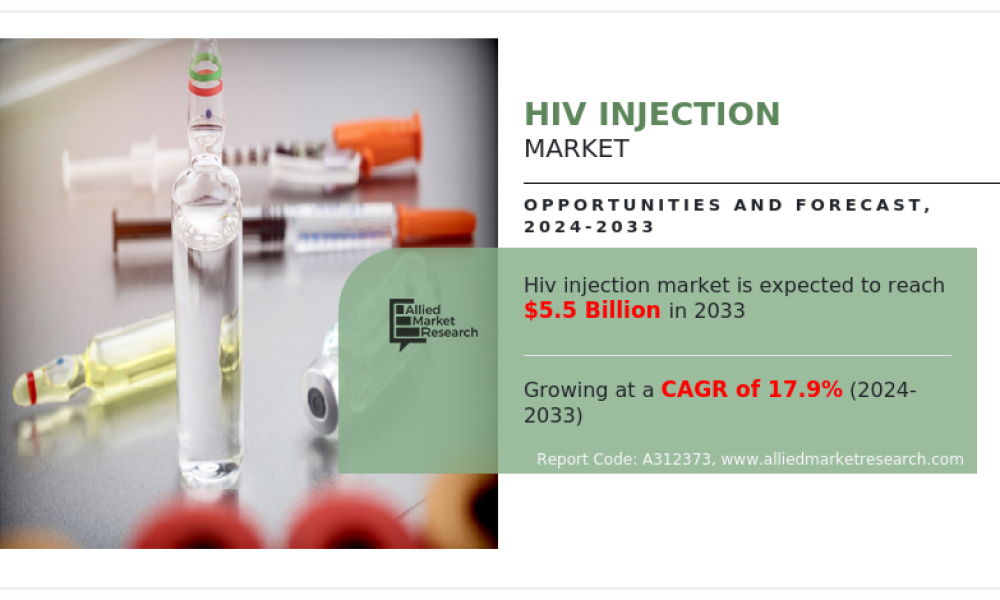
The global HIV injection market is undergoing a transformative shift, driven by rising awareness, increasing cases of HIV, and continuous innovation in injectable therapies. Valued at $1 billion in 2023, the market is projected to reach $5.5 billion by 2033, expanding at a robust CAGR of 17.9% from 2024 to 2033. This remarkable growth underscores the critical role of injectable antiretroviral therapies (ARTs) in managing and preventing HIV globally.
According to the Centers for Disease Control and Prevention (CDC), the U.S. recorded an estimated 1.2 million HIV-positive individuals by the end of 2021, with 87% of them aware of their HIV status. Meanwhile, the U.S. Department of Health and Human Services reported that 39 million people worldwide were living with HIV in 2022. The UNAIDS program further highlighted that 29.8 million individuals accessed antiretroviral therapy in 2022, demonstrating the rising demand for effective and accessible HIV treatments—including long-acting injectable options.
Get a Sample Copy of this Report: https://www.alliedmarketresearch.com/request-sample/A312373
Market Dynamics
The HIV injection market is witnessing a surge in demand owing to multiple interconnected factors. One of the most influential drivers is the growing preference for injectable formulations over oral medications. Unlike daily pills, injectable HIV treatments provide long-acting release mechanisms, reducing the frequency of administration, boosting adherence, and improving overall patient outcomes. This shift helps reduce the risk of drug resistance, a critical concern in HIV management.
Government bodies, non-profit organizations, and pharmaceutical leaders are also shaping the market through partnerships, subsidies, and global awareness campaigns. Initiatives like Gilead Sciences’ COMPASS Initiative, launched in collaboration with the Wake Forest University School of Divinity, highlight how public-private collaborations are strengthening HIV care access—especially in underserved regions.
At the same time, the pharmaceutical sector is investing heavily in research and development (R&D). Companies are conducting extensive clinical trials to test innovative formulations, longer-acting regimens, and combination therapies. These investments are not only creating better treatment outcomes but are also paving the way for breakthrough innovations in HIV care.
However, the market faces challenges. Stringent regulatory approval processes, high treatment costs, and healthcare budget constraints in low-resource settings can limit adoption. Economic downturns also risk delaying patient treatment due to affordability concerns. Despite these obstacles, the critical and urgent nature of HIV care ensures continued government and private investment in HIV injection therapies.
Segmental Overview
The HIV injection market is segmented by distribution channel and region.
By Distribution Channel
Others Segment Dominates: In 2022, the “others” segment, including online pharmacies and specialized healthcare services, captured the largest market share. Their accessibility, digital integration, and patient-centric convenience are fueling their rapid adoption. This segment is also projected to register the highest CAGR during the forecast period.
Hospital Pharmacies and Retail Pharmacies continue to play a significant role, particularly in developed markets where patient monitoring and clinical oversight are critical.
By Region
North America Leads: With major players such as GlaxoSmithKline plc, Johnson & Johnson, Gilead Sciences, and F. Hoffmann-La Roche Ltd operating in the region, North America dominated the global market in 2022. High healthcare expenditure, strong regulatory support, and a robust pipeline of HIV therapies are strengthening regional growth.
Asia-Pacific to Grow Fastest: The Asia-Pacific region is projected to record the highest CAGR through 2033, fueled by increasing HIV awareness, rising healthcare investments, and supportive government policies. Collaborations between governments, non-profits, and pharma companies are improving treatment access, creating vast opportunities for injectable therapies.
Europe and LAMEA (Latin America, Middle East, and Africa) are also significant contributors. Europe’s established healthcare infrastructure and LAMEA’s urgent need for affordable HIV treatments make these regions crucial for market expansion.
Recent Developments
The HIV injection market has seen a wave of regulatory approvals, partnerships, and clinical breakthroughs, accelerating its momentum:
Oct 2023: ViiV Healthcare (majority-owned by GSK) gained approval from China’s NMPA for Vocabria (cabotegravir injection) in combination with Johnson & Johnson’s Rekambys, expanding treatment availability.
Sep 2023: The European Commission authorized Apretude (cabotegravir long-acting) for HIV prevention, strengthening Europe’s prevention strategies.
May 2022: Japan’s MHLW approved Vocabria with Janssen’s Rekambys and Edurant, marking the world’s first complete long-acting HIV regimen.
Mar 2022: The FDA approved Cabenuva (cabotegravir + rilpivirine) for HIV-positive adolescents, broadening treatment access.
Feb 2023: Gilead released clinical data showing the promise of lenacapavir + broadly neutralizing antibodies as a twice-yearly injectable regimen.
Jan 2022: ImmunityBio’s Anktiva (N-803) demonstrated potential in activating immune responses to target hidden HIV reservoirs.
These advancements highlight how next-generation injectable therapies are transforming HIV management into more patient-friendly, long-acting solutions.
Competitive Landscape
Key players in the HIV injection industry include:
GlaxoSmithKline plc (ViiV Healthcare)
Johnson & Johnson (Janssen Pharmaceuticals)
Gilead Sciences, Inc.
F. Hoffmann-La Roche Ltd
ImmunityBio, Inc.
Theratechnologies Inc.
AbbVie Inc.
Shionogi & Co., Ltd.
Brii Biosciences
Viriom, Inc.
These companies are focusing on product launches, clinical trials, global expansion, and collaborations to strengthen their market presence.
Outlook and Opportunities
The HIV injection market presents significant opportunities for stakeholders:
Rising global HIV prevalence ensures sustained demand for advanced therapies.
Long-acting injectable formulations address critical challenges of adherence and resistance.
Expanding healthcare access in Asia-Pacific and Africa will create new growth avenues.
Strategic partnerships between governments, NGOs, and pharmaceutical giants will accelerate market penetration.
Despite challenges such as regulatory hurdles and healthcare cost pressures, the market’s strong growth trajectory reflects the urgency of combating HIV globally. Innovations in injectable ARTs promise not only to improve treatment outcomes but also to enhance prevention strategies, ultimately transforming the fight against HIV.
Conclusion
The HIV injection market is at the forefront of innovation, with a projected growth from $1 billion in 2023 to $5.5 billion by 2033. Backed by rising demand, patient-friendly long-acting therapies, and strong collaborations across sectors, injectable HIV treatments are redefining global HIV care. With continued advancements in drug development and strategic efforts to expand treatment access, the next decade will mark a pivotal era in managing and preventing HIV infections worldwide.




