
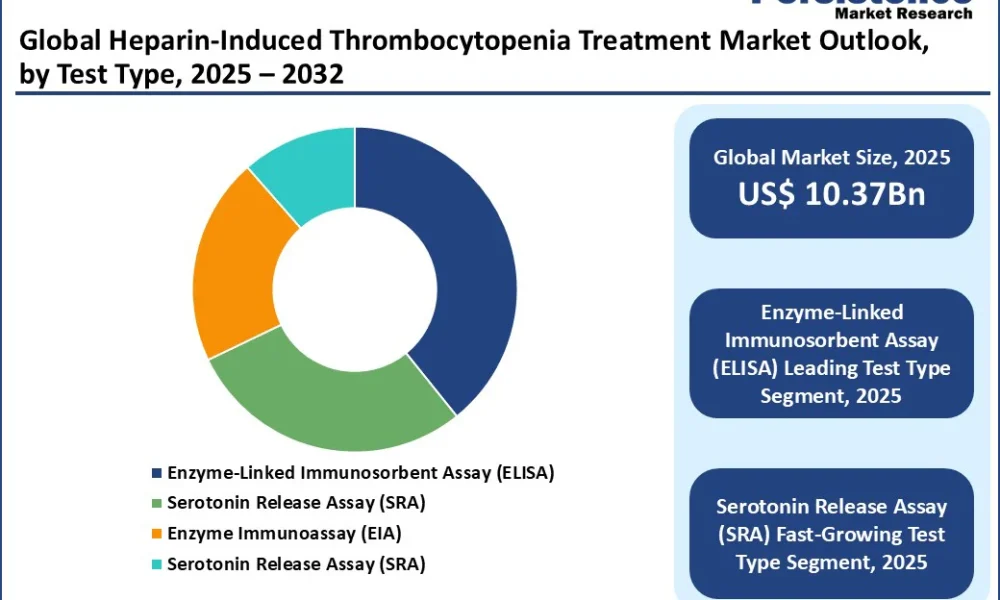
The global Heparin-Induced Thrombocytopenia (HIT) treatment market is poised for steady growth in the coming years. HIT is a severe immune-mediated reaction to heparin therapy, resulting in platelet activation and increased thrombotic events, including deep vein thrombosis (DVT) and pulmonary embolism (PE). The treatment for HIT requires specialized, non-heparin anticoagulants such as Argatroban, as well as diagnostic assays to detect the presence of antibodies associated with the condition. As healthcare systems globally continue to evolve, there is a heightened demand for effective management strategies to handle HIT cases, particularly in high-risk surgical environments.
The global Heparin-Induced Thrombocytopenia treatment market size is forecast to reach US$14.9 billion by 2032, up from US$10.37 billion in 2025, reflecting a compound annual growth rate (CAGR) of 5.3% during the forecast period from 2025 to 2032. Key growth drivers include increasing surgical volumes, growing use of heparin as an anticoagulant in cardiac and vascular surgeries, and advancements in diagnostic technologies. Leading drug types, such as Argatroban, are driving market share, particularly in hospitals where critical care and emergency treatment protocols are heavily reliant on fast and effective anticoagulation management.
Among the key geographical regions, North America holds the largest market share, projected at 42.5% in 2025, owing to a robust healthcare infrastructure, high clinical awareness, and a large volume of hospital and diagnostic procedures. Meanwhile, the Asia Pacific region is expected to emerge as the fastest-growing market, fueled by healthcare infrastructure growth, increasing surgical volumes, and government initiatives aimed at expanding critical care services.
Download Your Free Sample & Explore Key Insights: https://www.persistencemarketresearch.com/samples/27295
Key Highlights from the Report
• The global Heparin-Induced Thrombocytopenia treatment market is expected to reach US$14.9 billion by 2032.
• North America holds the largest market share, accounting for 42.5% in 2025.
• Asia Pacific is the fastest-growing region, driven by improving healthcare infrastructure and rising surgical volumes.
• Argatroban is the dominant drug type, with a market share of 43.8% in 2025.
• Hospitals represent the leading end-use segment, contributing over 40.2% of market revenue.
• Diagnostic test types like ELISA and SRA are driving the growth in the market’s diagnostic segment.
Market Segmentation
The global Heparin-Induced Thrombocytopenia treatment market can be segmented based on product type, test type, end-user, and region. Among drug types, Argatroban is the most widely used treatment for acute HIT cases, commanding a significant portion of the market share due to its safety profile and rapid onset of action. It is especially effective in hospitals and emergency care settings. Danaparoid, another key anticoagulant, has seen growth due to its efficacy in patients who may be allergic to heparin or require more targeted therapy. It is expected to emerge as the fastest-growing drug segment, particularly in specialized clinics.
Diagnostic tests are equally important in managing HIT. The Enzyme-Linked Immunosorbent Assay (ELISA) remains the leading test type due to its high sensitivity and affordability in hospital diagnostics. However, Serotonin Release Assay (SRA) is gaining traction as the fastest-growing test type, favored for its superior specificity in confirming HIT diagnosis. As the demand for precise diagnostics increases, especially in specialized clinics, the SRA segment is poised for rapid expansion.
The market’s end-use segments are dominated by hospitals, which account for over 40% of market revenue. This is due to the high volume of heparin-related procedures performed in surgical and intensive care settings. However, specialized clinics are emerging as the fastest-growing segment, driven by a focus on outpatient care and precision medicine for managing high-risk patients with HIT.
Regional Insights
North America
North America is expected to maintain its leadership position in the global HIT treatment market, primarily due to the presence of advanced healthcare infrastructure, particularly in the United States and Canada. The U.S. healthcare industry, valued at $4.9 trillion in 2023, invests heavily in medical technologies, including diagnostic assays and advanced therapies for treating HIT. The U.S. also leads in the volume of surgeries, particularly coronary artery bypass grafts (CABG) and percutaneous coronary interventions (PCI), which use heparin as an anticoagulant, thus driving the demand for HIT treatments. Canada’s healthcare system also supports the demand for efficient diagnostics and therapies for HIT, further strengthening the market presence in North America.
Asia Pacific
The Asia Pacific region is experiencing rapid market growth due to significant improvements in healthcare infrastructure and an increasing volume of surgical procedures, particularly in countries like China and India. Both nations are making strides in expanding critical care services, with China’s National Health Commission planning a significant increase in intensive care unit (ICU) beds by 2025. This infrastructure growth supports the rising demand for HIT treatments, especially in surgical and ICU settings. India’s National Health Mission also continues to expand access to critical care, further driving the need for effective anticoagulants and diagnostic tools to manage HIT. As healthcare manufacturing capabilities rise, so does the availability and adoption of HIT treatments in the region.
Europe
Europe represents the second fastest-growing market for HIT treatments, with key countries like Germany and France driving demand due to a combination of regulatory standards, healthcare developments, and rising hospital and specialized clinic needs. The European Union’s Horizon Europe program is fostering research and development in precision medicine, which includes therapies for managing HIT. The European market benefits from stringent regulatory requirements, ensuring the adoption of high-quality anticoagulants and diagnostics. Germany, with its well-established hospital sector, is a major consumer of advanced assays, while France’s healthcare reforms are bolstering demand for efficient, cost-effective HIT treatments.
Get Custom Insights Designed for Your Business: https://www.persistencemarketresearch.com/request-customization/27295
Market Drivers
Several key factors are propelling the growth of the Heparin-Induced Thrombocytopenia treatment market. One of the primary drivers is the increasing number of surgical procedures performed globally, which often require the use of heparin as an anticoagulant. This has led to a rising number of HIT cases, particularly in high-risk surgeries such as cardiac bypass surgeries, vascular procedures, and dialysis treatments. With more than 600,000 percutaneous coronary interventions (PCIs) performed annually in the U.S. alone, and the growing need for cardiac and vascular surgeries, the demand for HIT treatments is expected to increase significantly. Additionally, the growing healthcare infrastructure in emerging economies such as China and India, as well as government-led initiatives, is boosting the use of heparin and, consequently, the need for HIT management.
Market Restraints
Despite strong growth prospects, the heparin-induced thrombocytopenia treatment market faces significant restraints. One of the major challenges is the high costs associated with advanced diagnostic tools like the Serotonin Release Assay (SRA) and Enzyme-Linked Immunosorbent Assay (ELISA). These tests require specialized equipment, skilled professionals, and may be cost-prohibitive in resource-constrained regions, limiting their widespread adoption. Additionally, direct oral anticoagulants (DOACs), such as rivaroxaban, are increasingly being used as alternatives to traditional anticoagulants due to their easier administration and fewer monitoring requirements. The growing adoption of these alternatives presents competition for traditional HIT treatments, especially in markets that are price-sensitive or lack advanced diagnostic capabilities.
Market Opportunities
The growing emphasis on precision medicine and the development of novel anticoagulants present significant opportunities in the HIT treatment market. Personalized therapies, including next-generation direct thrombin inhibitors, are likely to gain traction as healthcare providers seek more tailored and effective management strategies for high-risk patients. Additionally, ongoing research and government-backed programs such as Horizon Europe are driving innovation in the development of advanced HIT treatments. Companies focused on expanding their portfolios to include precision therapies will likely benefit from rising demand for personalized treatments. The market also stands to benefit from expanding healthcare systems in emerging economies, where there is an increased focus on critical care and specialized treatment options.
Checkout Now & Download Complete Market Report: https://www.persistencemarketresearch.com/checkout/27295
Company Insights
Key players in the global Heparin-Induced Thrombocytopenia treatment market include:
• ACG Group, Inc.
• Korber AG
• Romaco Group
• Marchesini Group S.p.A.
• Coesia S.p.A.
• Multivac Group
• Syntegon Technology GmbH
• Bausch + Strobel
• OPTIMA industries GmbH & Co. KG
• Industria Machine Automatiche S.p.A.
Market Segmentation
By Drug Type
- Lepirudin
- Danaparoid
- Argatroban
By Test Type
- Enzyme Immunoassay (EIA)
- Serotonin Release Assay (SRA)
- Enzyme-Linked Immunosorbent Assay (ELISA)
- Heparin-Induced Platelet Activation (HIPA) Test
By End-use
- Hospitals
- Diagnostic Centers
- Specialized Clinics
- Hospital Pharmacy
- Mail Order Pharmacy
By Region
- North America
- Europe
- East Asia
- South Asia and Oceania
- Latin America
- Middle East and Africa
Recent Developments:
• In May 2025, Sanofi acquired DR-0201, a targeted bispecific myeloid cell engager from Dren Bio, which may have implications for treating autoimmune diseases such as HIT.
• In June 2024, Veralox Therapeutics launched VLX-1005, a promising next-generation direct thrombin inhibitor for HIT treatment, with an FDA fast-track designation.
Conclusion
The Heparin-Induced Thrombocytopenia treatment market is expected to witness significant growth over the next decade, fueled by increasing surgical procedures, expanding healthcare infrastructure, and the rising prevalence of heparin-related complications. With North America leading the market, driven by its advanced healthcare systems, and Asia Pacific emerging as a rapidly growing region, the landscape for HIT treatments is becoming increasingly dynamic. While challenges such as high diagnostic costs and competition from alternative anticoagulants persist, opportunities for innovation in precision medicine and novel anticoagulants present new avenues for market expansion.




