
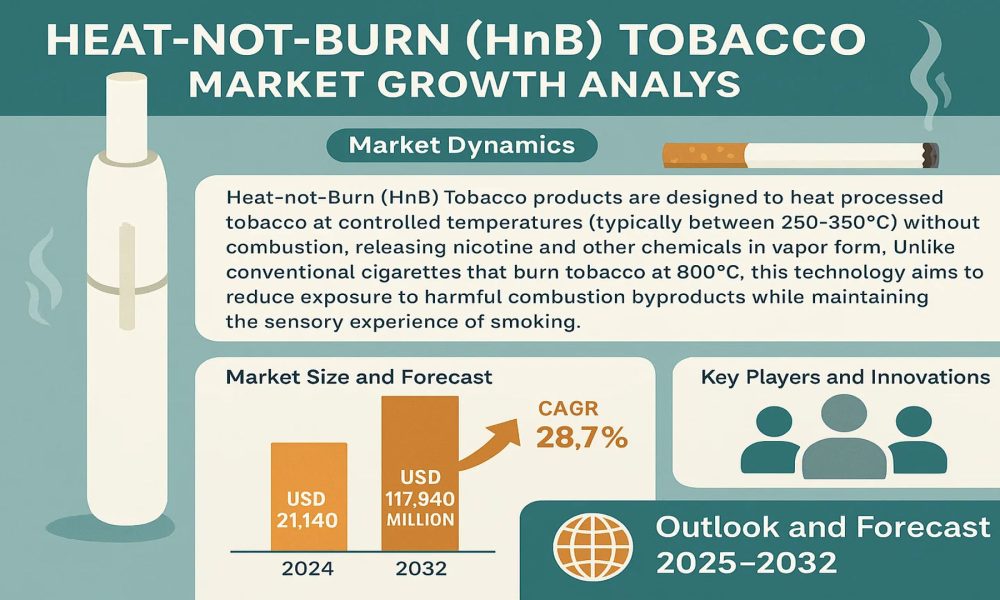
Global Heat-not-Burn (HnB) Tobacco market was valued at USD 21,140 million in 2024 and is projected to reach USD 117,940 million by 2032, exhibiting a robust CAGR of 28.7% during the forecast period.
Heat-not-Burn (HnB) Tobacco products are designed to heat processed tobacco at controlled temperatures (typically between 250-350°C) without combustion, releasing nicotine and other chemicals in vapor form. Unlike conventional cigarettes that burn tobacco at 800°C, this technology aims to reduce exposure to harmful combustion byproducts while maintaining the sensory experience of smoking.
The market growth is primarily driven by increasing consumer preference for potentially reduced-risk products (PRRPs) and stricter regulations on traditional cigarettes. However, the industry faces challenges regarding product acceptance and varying regulatory frameworks across regions. Key players like Philip Morris International (with their IQOS system) and British American Tobacco (glo) are actively expanding their HnB portfolios and geographic presence to capitalize on this emerging sector.
Access Your Free Sample Report Now- https://www.intelmarketresearch.com/download-free-sample/4273/heat-not-burn-tobacco-2025-2032-404
MARKET DYNAMICS
MARKET DRIVERS
Growing Consumer Preference for Reduced-Risk Products Accelerates Market Expansion
The global Heat-not-Burn (HnB) tobacco market is experiencing significant growth due to shifting consumer preferences towards perceived reduced-risk alternatives to traditional cigarettes. Unlike combustible cigarettes that burn tobacco at temperatures reaching 900°C, HnB devices heat tobacco to approximately 350°C, significantly reducing the production of harmful chemicals. While comprehensive long-term health studies are still underway, preliminary research indicates these products generate 90-95% fewer harmful constituents than conventional cigarettes. This harm reduction potential is driving adoption among health-conscious smokers seeking alternatives, particularly in developed markets where smoking cessation programs are prevalent.
Technological Advancements in Heating Systems Enhance Product Appeal
Continuous innovation in heating technology represents a key driver for HnB adoption. Modern devices now incorporate precision temperature control systems that maintain optimal heating ranges to extract nicotine while minimizing combustion byproducts. Leading manufacturers have introduced induction heating technologies that provide more consistent flavor profiles and longer device lifespans compared to earlier resistive heating models. For instance, recent product iterations have achieved temperature variances of less than ±5°C across the heating chamber, significantly improving user experience. These technological improvements, coupled with sleek device designs mimicking premium electronics, are helping position HnB products as sophisticated alternatives to traditional tobacco products.
Expanding Retail Distribution Channels Drive Market Penetration
The HnB market is benefiting from strategic expansion across multiple retail channels, with convenience stores emerging as particularly crucial touchpoints. In Japan—the world’s largest HnB market—over 60% of sales occur through convenience store networks, making products widely accessible to adult consumers. Simultaneously, manufacturers are strengthening e-commerce platforms with subscription models and auto-replenishment features, particularly targeting younger demographics. This omnichannel distribution strategy, combined with in-store product demonstrations and trial programs, is significantly lowering barriers to first-time adoption while building brand loyalty among existing users.
MARKET OPPORTUNITIES
Emerging Markets Present Significant Untapped Potential
Developing economies represent the next frontier for HnB expansion, with countries across Asia and Eastern Europe showing increasing openness to alternative nicotine products. While these markets currently account for less than 15% of global HnB sales, their rapidly growing middle classes and evolving regulatory landscapes create substantial growth opportunities. Manufacturers can leverage lessons from mature markets to develop region-specific products—such as localized flavor profiles and compact device designs—that align with cultural preferences and usage patterns. Successful market entry strategies will need to combine consumer education initiatives with strategic pricing models tailored to local economic conditions.
Technological Convergence Creates New Product Categories
The intersection of HnB technology with digital health platforms offers compelling opportunities for market differentiation. Next-generation devices incorporating bluetooth connectivity and usage tracking enable personalized nicotine management and smoking reduction programs. Some prototypes in development feature integrated health metrics monitoring, potentially positioning HnB systems as part of broader wellness ecosystems. This technological convergence could help rebrand HnB products from tobacco alternatives to customizable nicotine delivery platforms, appealing to health-conscious consumers seeking greater control over their habits.
Strategic Partnerships Accelerate Market Expansion
Collaborations between tobacco companies and technology firms are unlocking new growth avenues in the HnB space. Recent partnerships have focused on combining core tobacco expertise with cutting-edge hardware engineering to develop superior heating systems and consumables. Additionally, cross-industry alliances with retail chains and hospitality groups are creating novel distribution models, such as HnB product pairing programs with coffee and alcoholic beverages. These synergistic relationships allow manufacturers to access new customer segments while sharing the substantial R&D costs associated with continuous product innovation.
Segment Analysis:
By Type
Tobacco Stick Segment Leads the Market Due to Convenience and Brand Standardization
The market is segmented based on type into:
- Use Tobacco Stick
- Use Loose-leaf
By Application
Tobacco Store Segment Dominates with Strong Brand Presence and Consumer Familiarity
The market is segmented based on application into:
- Supermarket
- Tobacco Store
- Official Website
- Third-party Shopping Platform
- Other
By Technology
Advanced Heating Systems Drive Market Growth Through Precise Temperature Control
The market is segmented based on technology into:
- Carbon Heating
- Electric Heating
- Combustion-based Heating
By Distribution Channel
Retail Partnerships Gain Traction Through Convenience Store Collaborations
The market is segmented based on distribution channel into:
- Specialty Stores
- Convenience Stores
- Online Retail
- Wholesale Distributors
List of Key Heat-not-Burn (HnB) Tobacco Companies Profiled
- Philip Morris International (Switzerland)
- British American Tobacco (U.K.)
- Japan Tobacco International (Japan)
- Imperial Brands (U.K.)
- Altria Group, Inc. (U.S.)
- KT&G Corporation (South Korea)
- China Tobacco Group (China)
- Compaq Tobacco (Germany)
- Smoke Frog Technology (U.S.)
- Korea Tobacco & Ginseng Corporation (South Korea)
HEAT-NOT-BURN TOBACCO MARKET TRENDS
Accelerated Growth Driven by Consumer Preference for Reduced-Risk Products
The global Heat-not-Burn (HnB) tobacco market has demonstrated remarkable expansion, with projections indicating a surge from $21.1 billion in 2024 to $117.9 billion by 2032, driven by a 28.7% CAGR. This rapid adoption is largely attributed to shifting consumer preferences toward alternatives perceived as less harmful than traditional cigarettes. Unlike conventional smoking, HnB devices heat tobacco to approximately 350°C—significantly lower than combustion temperatures—reducing the release of harmful chemicals such as tar and carbon monoxide by an estimated 90–95% compared to combustible cigarettes. Leading manufacturers like Philip Morris International (IQOS) and British American Tobacco (glo) have capitalized on this trend, leveraging advanced heating technologies that balance nicotine delivery with minimized health risks. While regulatory approvals for reduced-risk claims remain limited, increasing awareness among health-conscious smokers continues to fuel demand.
Other Trends
Regulatory Landscapes and Standardization Efforts
The evolving regulatory environment for HnB products presents both opportunities and challenges. The World Health Organization (WHO) and regional bodies are actively assessing frameworks to classify and regulate these products, with some markets like the EU and Japan implementing strict testing and labeling requirements. For instance, Japan’s HnB sector now accounts for nearly 30% of the total tobacco market, partly due to favorable policies that permitted early adoption. Meanwhile, the U.S. FDA’s Modified Risk Tobacco Product (MRTP) pathway has seen applications from major players, though approvals remain selective. Harmonizing global standards could further accelerate market growth while addressing public health concerns.
Technological Innovations and Product Diversification
Advancements in HnB technology are reshaping product offerings. Next-generation devices now incorporate precision temperature control (PTC) systems, which optimize aerosolization while minimizing toxicant formation. Hybrid designs combining loose-leaf tobacco with e-liquid capsules are gaining traction, particularly in Europe. Additionally, strategic collaborations—such as PMI’s partnership with South Korea’s KT&G—are expanding R&D capabilities. The integration of IoT-enabled features, like Bluetooth connectivity for usage tracking, reflects the industry’s push toward smart, personalized experiences. These innovations not only enhance user satisfaction but also position HnB products as a bridge between traditional smoking and nicotine cessation therapies.
Access Your Free Sample Report Now- https://www.intelmarketresearch.com/download-free-sample/4273/heat-not-burn-tobacco-2025-2032-404
Recent Developments in the Heat-not-Burn (HnB) Tobacco Market
- Product Innovations & Technology Advancements
Major tobacco companies like Philip Morris International, British American Tobacco, and Japan Tobacco International are continuously enhancing their HnB devices with improved heating systems, longer battery life, and smart connectivity features. For example, PMI’s latest IQOS ILUMA series uses induction heating technology for a cleaner and more consistent tobacco experience. - Geographical Expansion
Companies are expanding HnB availability in Asia-Pacific, Europe, and Latin America, targeting regions with strong demand for reduced-risk alternatives. In 2025, Japan and South Korea remain leading markets, while new launches are gaining traction in Eastern Europe and the Middle East. - Regulatory Updates
Governments are actively reviewing regulatory frameworks for HnB products, with some regions like the EU and the U.S. FDA conducting safety assessments. The U.S. FDA has already authorized IQOS as a Modified Risk Tobacco Product (MRTP), paving the way for broader adoption. - Mergers, Partnerships, and Investments
Leading players are forming strategic partnerships with retailers, e-commerce platforms, and distributors to strengthen their sales channels. Investment in R&D and sustainable materials for device manufacturing is also increasing to align with ESG goals. - Consumer Adoption & Market Growth
Growing health-conscious consumer preferences for reduced-risk tobacco alternatives and smoke-free environments are boosting HnB adoption. Surveys show younger adult smokers are more likely to switch to HnB compared to traditional cigarettes.
About Intel Market Research
Intel Market Research delivers actionable insights in technology and infrastructure markets. Our data-driven analysis leverages:
- Real-time infrastructure monitoring
- Techno-economic feasibility studies
Competitive intelligence across 100+ countries
Trusted by Fortune 500 firms, we empower strategic decisions with precision.
International: +1(332) 2424 294 | Asia: +91 9169164321
Website: https://www.intelmarketresearch.com
Follow us on LinkedIn: https://www.linkedin.com/company/intel-market-research




