
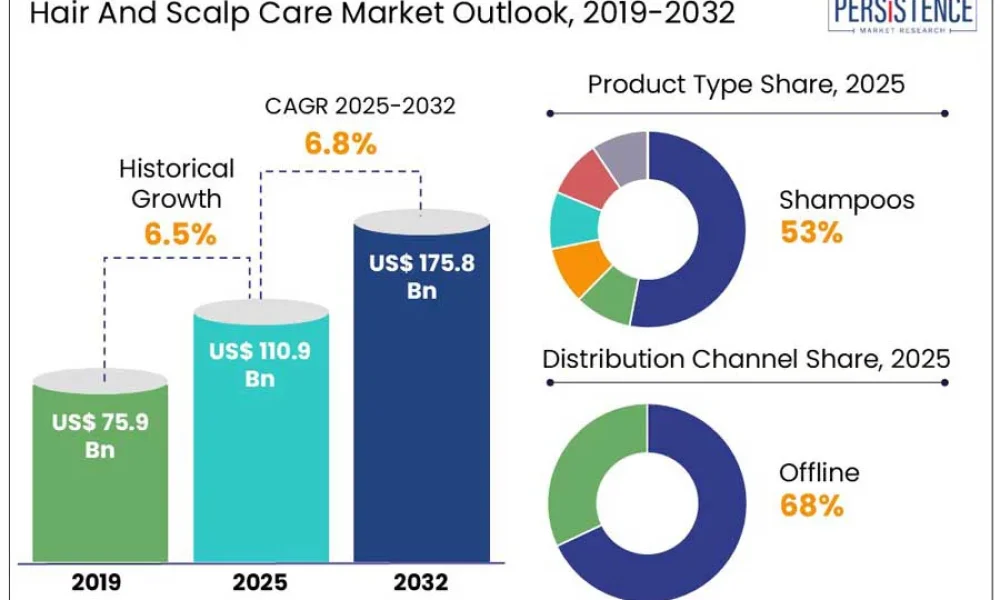
The global hair and scalp care market is experiencing strong growth as consumers increasingly prioritize personal grooming, hair health, and scalp wellness. Modern consumers are no longer limited to basic hair cleansing products but are actively seeking specialized solutions such as anti-dandruff treatments, scalp serums, hair fall control products, and nourishing oils. The growing awareness around scalp health as the foundation for healthy hair has significantly transformed purchasing behavior, encouraging brands to innovate with targeted formulations and natural ingredients.
According to Persistence Market Research, the global hair and scalp care market size is anticipated to rise from US$ 110.9 Bn in 2025 to US$ 175.8 Bn by 2032, witnessing a CAGR of 6.8% from 2025 to 2032. This expansion is driven by increasing disposable incomes, rising urbanization, and growing consumer inclination toward premium and organic hair care products. Shampoos remain the leading segment due to their widespread daily usage, while Asia-Pacific dominates the global market owing to its large population base, rising middle-class spending, and strong demand for herbal and traditional hair care solutions.
Download Your Free Sample & Explore Key Insights : https://www.persistencemarketresearch.com/samples/35355
Key Highlights from the Report
➤ The hair and scalp care market is projected to grow from US$ 110.9 Bn in 2025 to US$ 175.8 Bn by 2032 at a CAGR of 6.8%.
➤ Rising consumer awareness regarding scalp health and hair nourishment is boosting product demand globally.
➤ Increasing demand for natural, organic, and herbal formulations is reshaping product innovation strategies.
➤ Growth in premium and salon-grade hair care products is contributing significantly to market revenue.
➤ Expansion of e-commerce and digital marketing channels is enhancing product accessibility and brand reach.
➤ High demand for anti-hair fall, anti-dandruff, and scalp treatment products is driving segment growth.
Market Segmentation
The hair and scalp care market is segmented based on product type, application, and distribution channels. Product categories include shampoos, conditioners, hair oils, serums, masks, and scalp treatments. Among these, shampoos dominate the market due to their essential role in daily hygiene routines. However, scalp-specific products such as exfoliating scrubs, serums, and medicated treatments are gaining traction as consumers become more aware of underlying scalp conditions like dryness, dandruff, and sensitivity. The demand for multi-functional products that combine cleansing with nourishment is also rising.
Based on distribution channels, the market includes supermarkets, specialty stores, pharmacies, salons, and online platforms. Supermarkets and retail chains continue to lead due to their extensive product availability and consumer trust. Meanwhile, e-commerce platforms are rapidly expanding as consumers prefer convenience, product variety, and access to international brands. The influence of digital marketing, beauty influencers, and online reviews has further accelerated the growth of online sales channels in the hair and scalp care market.
Customize This Report for Your Exact Requirements : https://www.persistencemarketresearch.com/request-customization/35355
Regional Insights
Asia-Pacific dominates the hair and scalp care market due to its large population and strong cultural emphasis on hair care traditions. Countries such as India, China, and Japan have a long history of using herbal oils and natural ingredients, which continues to influence modern product development. The region is also witnessing increased adoption of premium and branded products as disposable incomes rise. The presence of local and international players further intensifies competition and innovation in this region.
North America and Europe also hold significant market shares, driven by high consumer awareness and demand for premium and organic products. In these regions, consumers are more inclined toward dermatologically tested, sulfate-free, and eco-friendly formulations. The growing popularity of scalp treatments and customized hair care solutions is contributing to steady growth. Additionally, the presence of established brands and advanced retail infrastructure supports consistent market expansion in these developed regions.
Market Drivers
The primary driver of the hair and scalp care market is the increasing awareness of hair health and scalp hygiene. Consumers are becoming more informed about the importance of maintaining a healthy scalp to prevent issues such as hair fall, dandruff, and thinning hair. This awareness has led to higher demand for specialized products that address specific concerns. As a result, manufacturers are introducing innovative solutions such as scalp detox products, medicated shampoos, and nutrient-rich hair oils to meet evolving consumer needs.
Another significant driver is the rising demand for natural and organic hair care products. Consumers are shifting away from chemical-based formulations and opting for products that contain herbal ingredients, essential oils, and plant extracts. This trend is particularly strong among younger consumers and environmentally conscious buyers. Brands are responding by launching clean-label products that are free from sulfates, parabens, and artificial fragrances, thereby boosting market growth.
Market Restraints
Despite strong growth prospects, the hair and scalp care market faces challenges related to high product costs and premium pricing. Many advanced and organic products are priced higher than conventional alternatives, which may limit their adoption among price-sensitive consumers. This is particularly evident in developing regions where affordability remains a key purchasing factor. As a result, companies must balance innovation with cost-effectiveness to ensure broader market penetration.
Another restraint is the presence of counterfeit and low-quality products in the market. These products not only affect brand reputation but also pose potential risks to consumer health. The lack of strict regulatory frameworks in certain regions can make it difficult to control the distribution of such products. This challenge highlights the need for stronger quality standards and consumer education to ensure product safety and authenticity.
Market Opportunities
The growing demand for personalized and customized hair care solutions presents significant opportunities for market players. Consumers are increasingly seeking products tailored to their specific hair types, scalp conditions, and lifestyle preferences. Advances in technology and data analytics are enabling brands to offer personalized recommendations and formulations, enhancing customer satisfaction and brand loyalty.
Another major opportunity lies in the expansion of emerging markets and digital retail channels. As internet penetration increases and online shopping becomes more accessible, companies can reach a wider audience through e-commerce platforms. Additionally, the rising popularity of subscription-based beauty services and direct-to-consumer models is creating new avenues for growth. By leveraging these channels, brands can strengthen their presence and capture untapped market potential.
Get Instant Access – Complete Your Purchase : https://www.persistencemarketresearch.com/checkout/35355
Company Insights
Key players operating in the hair and scalp care market include:
- Procter & Gamble (P&G)
- Unilever
- L’Oréal Group
- Johnson & Johnson
- Henkel AG
- Kao Corporation
- Shiseido Company
- Amorepacific Corporation
- Wella Company
- Revlon, Inc.
- Estee Lauder Companies
- Moroccanoil
- Oriflame Cosmetics
- Briogeo Hair Care
- The Ordinary (DECIEM)
Recent Developments
- January 2024: L’Oréal launched advanced scalp care solutions focusing on microbiome balance and hair strengthening.
- October 2023: Unilever expanded its portfolio of natural and sulfate-free hair care products to meet rising consumer demand.
Future Opportunities and Growth Prospects
The hair and scalp care market is poised for sustained growth as consumers continue to invest in premium and specialized products. Innovations in natural formulations, scalp-focused treatments, and personalized solutions are expected to drive the next phase of market expansion. Companies that prioritize sustainability, transparency, and product efficacy will gain a competitive advantage in the evolving landscape.
Furthermore, the integration of digital technologies, including AI-driven product recommendations and virtual consultations, will enhance customer engagement and satisfaction. The continued expansion of emerging markets, coupled with rising consumer awareness, will create new growth opportunities for industry players, ensuring a strong future outlook for the global hair and scalp care market.




