

Green Hydrogen Market Overview
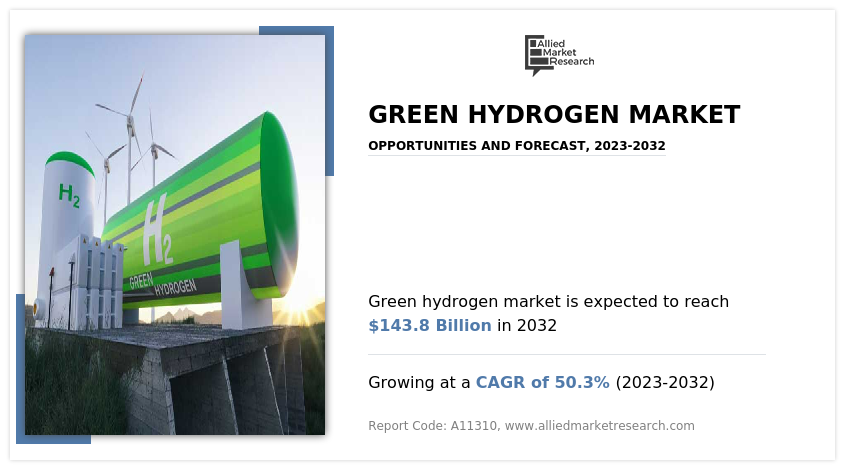
According to a new report published by Allied Market Research, the Green Hydrogen Market size was valued at $2.5 billion in 2022 and is projected to reach $143.8 billion by 2032, registering a remarkable CAGR of 50.3% from 2023 to 2032. The growing global focus on decarbonization, increasing renewable energy capacity, and rising demand for sustainable fuels are key factors driving the expansion of the Green Hydrogen Market worldwide.
Understanding Green Hydrogen and Its Production
Green hydrogen, also referred to as renewable hydrogen, is produced using renewable energy sources such as solar, wind, or geothermal power. The process typically involves electrolysis, where water is split into hydrogen and oxygen using electricity generated from renewable sources.
Unlike conventional hydrogen production methods that rely on fossil fuels, green hydrogen generates minimal greenhouse gas emissions, making it a critical component of future sustainable energy systems. The rising adoption of advanced electrolyzer technologies is expected to further accelerate the growth of the Green Hydrogen Market.
Download PDF Brochure: https://www.alliedmarketresearch.com/request-sample/11675
Role of Electrolyzer Technologies in Market Growth
Electrolyzer technologies play a vital role in the development of the Green Hydrogen Market, particularly proton exchange membrane (PEM) electrolyzers and alkaline electrolyzers. These systems convert electricity into hydrogen efficiently, enabling the production of renewable hydrogen at large scale.
Alkaline electrolyzers are widely used due to their mature technology, cost-effectiveness, and high reliability. They offer operational efficiencies of around 60–70%, allowing efficient utilization of renewable electricity for hydrogen production.
Meanwhile, proton exchange membrane electrolyzers are gaining popularity because of their ability to operate with variable renewable energy sources. As renewable power generation increases globally, demand for electrolyzers is expected to rise, further strengthening the Green Hydrogen Market.
Rising Industrial Demand Driving Market Expansion
The rapid expansion of industries such as food and beverages, chemicals, petrochemicals, and healthcare is contributing significantly to the growth of the Green Hydrogen Market. These industries require large amounts of energy for operations including processing, packaging, refrigeration, and transportation.
Green hydrogen offers a sustainable alternative to fossil fuels for meeting these energy requirements while reducing carbon emissions. In particular, industries where direct electrification is challenging are increasingly adopting hydrogen-based energy solutions.
The food and beverage sector is expected to witness notable growth during the forecast period, registering a CAGR of 51.6%. The energy-intensive nature of food processing operations makes green hydrogen an attractive option for companies seeking cleaner and more efficient energy solutions.
Transportation Sector Leading Application Segment
Based on application, the transportation segment held the largest share of the Green Hydrogen Market in 2022, accounting for nearly half of the total market revenue. The segment is expected to maintain its leading position throughout the forecast period.
Rising urbanization, population growth, and economic development have significantly increased the demand for efficient transportation systems worldwide. Hydrogen fuel cells are increasingly being adopted in buses, trucks, trains, and other heavy-duty vehicles as a cleaner alternative to conventional fuels.
The push to decarbonize the transportation sector and reduce greenhouse gas emissions is further strengthening the adoption of hydrogen-powered mobility solutions. As a result, transportation remains a major driver of the Green Hydrogen Market.
Growing Demand for Power Generation
The electrification of transportation and heating sectors is increasing global electricity demand, creating new opportunities for the Green Hydrogen Market. As traditional energy sources struggle to meet growing demand while maintaining environmental sustainability, green hydrogen is emerging as a flexible energy carrier.
Hydrogen can be used for electricity generation through fuel cells or turbines, providing reliable power while reducing carbon emissions. This versatility makes hydrogen a valuable component of integrated renewable energy systems.
The relationship between rising electricity demand and the need for cleaner energy solutions is expected to accelerate the adoption of hydrogen technologies in power generation.
Government Policies and Investments
Government policies and investments are playing a critical role in shaping the growth of the Green Hydrogen Market. Many countries are introducing ambitious hydrogen strategies aimed at reducing carbon emissions and strengthening energy security.
For example, the U.S. Department of Energy has set ambitious targets for clean hydrogen production. The department aims to produce 10 million tons of clean hydrogen annually by 2030, 20 million tons by 2040, and 50 million tons by 2050.
To support these goals, the U.S. government plans to invest approximately $8 billion in hydrogen hubs across the country by 2026. These investments are expected to significantly expand hydrogen production capacity and strengthen the Green Hydrogen Market.
Current Hydrogen Production Landscape
Despite the growing interest in green hydrogen, its current share in global hydrogen production remains relatively small. According to data from Carbon Solutions, less than 1% of the 10 million metric tons of hydrogen produced in the United States currently qualifies as green hydrogen.
Approximately 76% of hydrogen production is derived from natural gas or coal, while 23% is produced as a by-product of petroleum refining or chemical processes. Globally, hydrogen production is estimated at around 96 million metric tons annually.
At present, there are only 42 operational electrolyzers in the U.S., with a combined production capacity of approximately 3,000 tons of hydrogen per year. These statistics highlight the immense growth potential for the Green Hydrogen Market in the coming years.
Market Segmentation Overview
The Green Hydrogen Market is segmented based on technology, application, end-use industry, and region.
By Technology
The market includes proton exchange membrane electrolyzers, alkaline electrolyzers, and solid oxide electrolyzers. Among these, the proton exchange membrane electrolyzer segment accounted for more than half of the total market share in 2022.
By Application
Based on application, the market is categorized into power generation, transportation, and other sectors. The transportation segment dominated the market in 2022 due to rising adoption of hydrogen-powered vehicles.
By End-Use Industry
The market is segmented into food and beverages, medical, chemical, petrochemicals, glass, and other industries. The chemical sector accounted for a significant portion of the market in 2022.
By Region
Regionally, the Green Hydrogen Market is analyzed across North America, Europe, Asia-Pacific, and LAMEA. In 2023, Asia-Pacific held the largest market share, followed by Europe and North America. Rapid industrialization, supportive government policies, and growing renewable energy investments are driving regional growth.
Get a Customized Research Report: https://www.alliedmarketresearch.com/request-for-customization/11675
Competitive Landscape
Key players operating in the Green Hydrogen Market include Green Hydrogen Systems, Air Liquide, Shell plc, Enapter, Plug Power, Ballard Power Systems, Linde plc, Reliance Industries, GAIL (India) Limited, and Adani Green Energy.
These companies are focusing on partnerships, technology development, and large-scale hydrogen projects to strengthen their market position.
Conclusion
The Green Hydrogen Market is expected to witness exponential growth as governments, industries, and energy companies transition toward low-carbon energy systems. Rising investments in renewable energy infrastructure, technological advancements in electrolyzers, and increasing demand for sustainable fuels are expected to drive market expansion. As countries intensify efforts to achieve climate goals, green hydrogen is poised to play a central role in building a cleaner, more resilient global energy ecosystem.
Other Trending Reports:-
About Us
Allied Market Research (AMR) is a full-service market research and business-consulting wing of Allied Analytics LLP based in Portland, Oregon. Allied Market Research provides global enterprises as well as medium and small businesses with unmatched quality of “Market Research Reports” and “Business Intelligence Solutions.” AMR has a targeted view to provide business insights and consulting to assist its clients to make strategic business decisions and achieve sustainable growth in their respective market domain.
Pawan Kumar, the CEO of Allied Market Research, is leading the organization toward providing high-quality data and insights. We are in professional corporate relations with various companies and this helps us in digging out market data that helps us generate accurate research data tables and confirms utmost accuracy in our market forecasting. Each and every data presented in the reports published by us is extracted through primary interviews with top officials from leading companies of domain concerned. Our secondary data procurement methodology includes deep online and offline research and discussion with knowledgeable professionals and analysts in the industry.




