
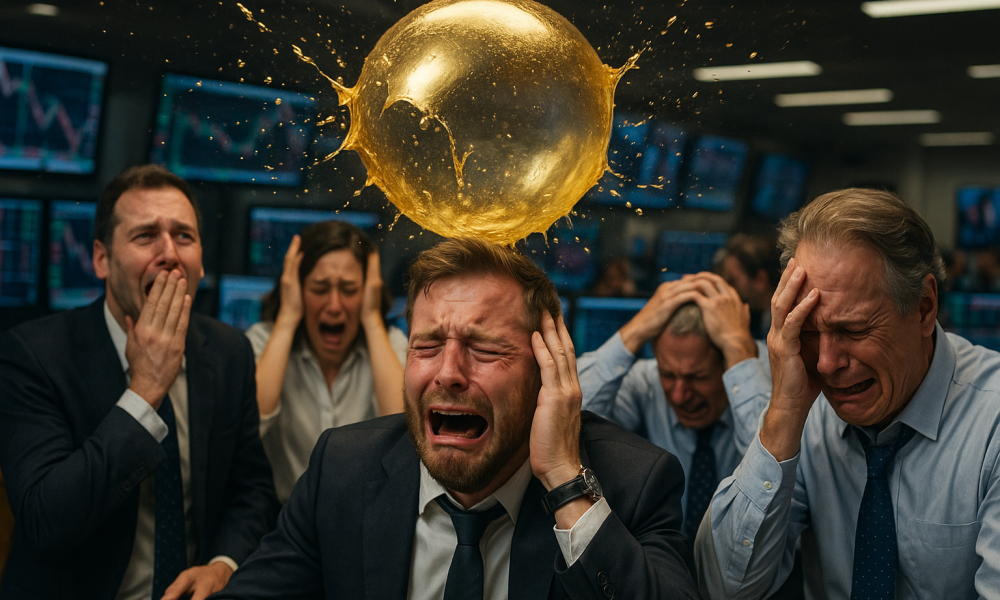
Gold has long been marketed as the one true safe haven—an asset above speculation, beyond politics, and immune to the failures of governments and markets. Its supporters repeat the same refrain in every crisis: currencies fail, empires collapse, but gold always survives. Yet the past 12 months have seen an astonishing surge in gold prices, not driven by new industrial applications, technological demand, or any expansion in economic utility. Instead, the rise appears propelled by accelerating fear narratives, central-bank anxiety, and retail investors reinforcing one another in closed-loop belief systems.
This is precisely the dynamic that turns a safe haven into a speculative engine. Rather than rising because of increased productivity, innovation, or value creation, gold’s ascent has been sustained by expectation alone—by the conviction that others will continue to buy at even higher levels. Gold has become the purest form of price-through-belief investing: its valuation depends not on what it does, but on what people feel. When the foundation of an asset’s price is sentiment and identity rather than cash flow or economic output, what emerges is the structure of a bubble, not a hedge.
What makes this especially dangerous is that the gold thesis has stopped evolving. It is no longer about economic analysis. It has become a worldview, complete with its own spokesmen, myths, and apocalyptic expectations. In a world where investors need clear thinking, gold has become a psychological monument to fear.
The Structural Pattern of a Bubble: How Gold Fits the Classic Profile
Economists generally agree that bubbles are not defined by high prices alone, but by the underlying behavioral and market dynamics that drive those prices. The question is whether the factors sustaining the price of gold today resemble the structural elements that have historically driven well-known bubbles like dot-com equities, 1980s Japanese real estate, or cryptocurrencies during speculative surges.
When we analyze the past ten years of gold’s price behavior and investor flows, the pattern becomes clear: gold exhibits the same psychological and market characteristics that define a bubble. Its appreciation has not consistently aligned with real yields, inflation, or industrial demand. Instead, sentiment, narrative continuity, and belief amplification have played the dominant roles.
Gold has not behaved like a commodity responding to supply and demand constraints—it has behaved like an asset whose value accelerates primarily when fear accelerates. That is the hallmark of a bubble thesis, not a productive investment thesis.
Classic Bubble Indicators Compared Against Gold (10-Year Lens)
| Bubble Indicator | Description in Market Psychology | Gold’s Behavior (10-Year Performance Context) | Assessment |
|---|---|---|---|
| Narrative-Based Value | Price depends on a dominant belief instead of measurable output | Gold prices over 10 years tracked shifts in fear narratives more than economic fundamentals | Strong correlation to bubble pattern |
| Absence of Yield or Cash Flow | Asset does not produce income; value comes only from price appreciation | Gold produced no yield while equities compounded; holding gold relied on expectation of rising prices | Matches bubble structure |
| Emotional Identity Investing | Investors see holding the asset as a personal philosophy or worldview | Gold ownership became tied to distrust of institutions and “collapse awareness” identity | Identity attachment is high |
| Price Justification via Catastrophe Claims | Expected returns require crisis, not stability | Bullish cases repeatedly depend on systemic breakdown, inflation spirals, or currency failure | Bubble behavior reinforced |
| Strong Retail Evangelism | Promotion relies on charismatic advocates and media repetition | Gold demand narratives amplified by collapse commentators and alternative media cycles | Consistent with bubble dynamics |
| Lack of Internal Valuation Anchor | No agreed methodology to determine fair value | Analysts justify prices via sentiment, geopolitical events, and historical symbolism, not fundamentals | No intrinsic price floor exists |
| Price Sensitivity to Sentiment Shocks | Small changes in sentiment cause large price swings | Gold experienced sharp spikes during global stress events and flat/declining periods during stability | Sentiment-driven volatility |
Interpretation
Over the past decade, gold generated periods of strong price appreciation, but nearly all major surges aligned with geopolitical stress, recession fears, interest-rate uncertainty, and currency devaluation narratives. Between those episodes, gold stagnated or declined relative to equities, which continued compounding.
This pattern demonstrates that gold’s price dynamics are governed by collective emotional response, not expanding economic productivity or intrinsic growth. The asset functions best when pessimism deepens. It requires belief reinforcement to sustain valuation. This is the behavior of a bubble sustained by sentiment rather than value.
The conclusion is not merely that gold can rise dramatically—bubbles can rise far beyond rational benchmarks—but that gold depends on a self-reinforcing system of belief, where the investment thesis requires continued anxiety to justify itself.
Gold’s story has replaced gold’s utility.
That is why today’s gold market fits the structural profile of the ultimate bubble.
What Warren Buffett Actually Said
Warren Buffett’s critique of gold is widely quoted but poorly understood. He did not say that gold cannot rise in price, nor that investors are irrational for owning it. His point is structural: gold is an unproductive asset. It generates no earnings, pays no dividends, produces no cash flow, and contributes nothing to economic growth. If farmland produces crops, businesses produce innovation and value, and bonds produce yield, gold produces only the hope that someone will value it more later.
In his 2011 Berkshire Hathaway shareholder letter, Buffett wrote that gold “will not do anything between now and then except look at you.” This statement was not dismissive—it was precise. Gold’s return is based entirely on price appreciation. That means the investor must believe that the future brings greater fear, greater distrust, and greater instability.
Source for original quote (non-promotional primary document):
https://www.berkshirehathaway.com/letters/2011ltr.pdf
Once you understand this, the modern gold thesis becomes clear: the investor must hope the world gets worse. This is not a hedge. This is a bet against progress.
Gold as Identity, Not Strategy
The core of the gold narrative is no longer financial—it is psychological. Gold buyers often position themselves as more realistic, more cautious, more “awake” to the fragility of modern finance. The asset becomes a symbol of being smarter than the crowd.
This identity-driven ownership changes everything. When a portfolio position becomes a moral stance, exiting the position becomes a betrayal. Investors stop evaluating what gold does and start defending what gold means. At this point, gold is no longer an asset—it is an ideology.
Once ideology is involved, bubbles can inflate far beyond rational valuation because the goal is no longer return—it is belonging.
The Preachers of Perpetual Collapse
Every bubble has its evangelists. In the gold world, one consistent voice is Peter Schiff, who has predicted a collapse of the U.S. dollar for over fifteen years. His messaging has not meaningfully changed, regardless of inflation regimes, interest rate cycles, or productivity trends. Gold is always the solution. Collapse is always imminent. The timeline is always extended.
His commentaries can be reviewed here in his own archives:
https://schiffgold.com/commentaries/
Another prominent voice in this camp is Jim Rickards, who similarly argues that global monetary systems are approaching breakdown and that gold will return to the center of international finance. While both raise valid concerns about debt and geopolitical instability, their investment case depends on extreme systemic failure.
A hedge that requires global collapse to justify its thesis is not a hedge. It is a catastrophe wager.
The Counterposition: Clear-Eyed Rationalists
There are thinkers and investors who agree with Buffett and have consistently challenged the gold narrative:
Charlie Munger dismissed gold as a “barbaric” asset because it does not compound value. His philosophy is that compounding—not preservation—is the driver of lasting wealth.
Aswath Damodaran, the leading authority on valuation, classifies gold as a “pricing asset,” meaning its value cannot be derived from fundamentals. It is worth what the market believes it is worth, not what it can produce.
Kenneth Rogoff has argued that gold’s role as a reserve instrument is mostly symbolic in the modern financial system, and that belief—not necessity—keeps it relevant.
These perspectives converge on one message: gold is psychological, not economic.
The Opportunity Cost Problem: Gold vs. Compounding Assets
Even if an asset is not productive, it can still hold a role in wealth preservation. The problem emerges when large allocations to gold displace exposure to assets that do compound, such as equities, private businesses, infrastructure, or even broad index funds. Compounding is the single most powerful force in wealth-building; it multiplies value through reinvested returns.
Gold, having no yield, can only match or outperform these assets if their growth stalls. That means gold investors must implicitly assume that innovation slows, productivity does not improve, and global economic development stagnates. The thesis requires not just fear—it requires a long-term decline in human progress.
This is not a hedge. It is a macro-level bet against invention, adaptation, and problem-solving.
Compounding vs. non-compounding assets diverge dramatically over time. The longer the timeframe, the more punishing the opportunity cost of holding gold becomes—even if gold rises.
10-Year Performance Comparison: Gold vs. Compounding Asset Classes
| Asset Category | Nature of Return | Average 10-Year Growth Behavior | Effect on Real Wealth Accumulation | Interpretation |
|---|---|---|---|---|
| Gold | Price appreciation only | Gains occur mainly during high uncertainty; flat in stable periods | No reinvestment → growth does not accelerate over time | Value requires fear to sustain momentum |
| S&P 500 Index | Continuous reinvestment of earnings & dividends | Benefits from corporate innovation, productivity, and buybacks | Compounding drives exponential value increase | Outperforms in environments of stability or moderate growth |
| Global Equity Index Funds | Diversified ownership of business output worldwide | Gains distributed across sectors and regions | Compounding spreads across global growth engines | Reduces single-country economic risk |
| Real Estate (High-Quality Core Markets) | Rental income + appreciated land value | Dual income drivers: rents and scarcity | Compounding occurs through reinvestment of rental surplus | Produces both yield and residual value growth |
| Infrastructure Assets (Energy, Utilities, Transit) | Regulated cash flows + inflation linkage | Stable, contract-driven revenue streams | Compounding reinforced by predictable payouts | Protects purchasing power without requiring crisis |
Interpretation
The comparison shows that gold is not merely an alternative store of value — it represents an entirely different economic logic.
Every compounding asset class in the table increases real wealth even if conditions improve. Their return mechanisms are regenerative. They scale with time.
Gold does not scale.
Gold only holds value if:
Fear persists
Confidence erodes
Investors continue to distrust productive systems
This means long-term gold holders are forgoing exponential growth in exchange for a defensive stance that only pays if the future gets worse.
The question is not: “Can gold rise?”
The question is: “What did you lose by waiting for the world to fail?”
This is the true economic cost of the gold bubble—not the price of gold, but the price of optimism forfeited.
Why Gold Fits the Definition of a Bubble
A bubble is not defined by price. It is defined by why price goes up. Gold displays the core traits:
Gold produces no yield, so price increases cannot be justified by expanded output or cash flows.
Demand is heavily narrative-driven, fueled by distrust and identity rather than utility.
There is no internal valuation anchor; the market cannot determine a “fair price.”
The success of the investment thesis requires pessimism to intensify indefinitely.
A gold investor must believe in more chaos, more breakdown, more fear.
That belief is not just speculative. It is self-reinforcing.
The Central Bank Accumulation Misreading
Gold advocates frequently point to central bank purchases as evidence of gold’s “return” to global monetary status. But the central banks accumulating gold most aggressively are not the monetary anchors of global finance—they are states hedging geopolitical vulnerability. This is political diversification, not a reversion to gold-backed currency.
The global financial system still runs on sovereign credit, taxation authority, and regulatory trust—not on metal scarcity.
The Performance Reality
The performance gap between gold and productive assets over any meaningful time horizon remains significant. Even during periods where gold spikes, equities and reinvested business earnings surpass it through compounding.
See long-term visual performance comparisons:
https://www.macrotrends.net
To choose gold over productive assets is not to hedge—it is to reject the engine of global wealth creation.
Notable Voices Who Challenge the Gold Narrative
Skepticism toward gold is not fringe. Many of the most respected figures in economics, valuation, and long-term investing have openly questioned gold’s role as a wealth-building asset. These critiques do not deny that gold can rise in price—they challenge the logic behind counting on gold as a primary store of wealth or a long-term investment strategy.
Below is a curated selection of negative perspectives on gold, each from a credible and widely recognized public figure.
Critical Quotes About Gold
| Speaker | Quote |
|---|---|
| Warren Buffett | “Gold will not do anything between now and then except look at you.” |
| Charlie Munger | “Civilized people don’t buy gold. They invest in productive businesses.” |
| John Maynard Keynes | “The gold standard is a barbarous relic.” (Often summarized simply as “Gold is a barbarous relic.”) |
| Aswath Damodaran | “Gold is an asset where value is in the eye of the beholder, not in expected cash flows.” |
| Kenneth Rogoff | “The obsession with gold is a return to a medieval mindset. Modern economies do not need it to function.” |
| John Bogle (Founder of Vanguard) | “I have never thought highly of gold. It’s a speculation on someone else paying more later.” |
| Paul Samuelson (Nobel Prize Economist) | “Investing in gold is like investing in a mattress. It stores but does not create.” |
| Nouriel Roubini | “Gold has no yield, no dividends, and no productivity. It is a speculative vehicle of fear.” |
| Larry Summers | “Gold is a sixth-century asset in a twenty-first century economy.” |
| Bill Gates | “I would rather own businesses. They create value. Gold just sits there.” |
Why These Quotes Matter
Each of these voices comes from a different intellectual background—value investing, macroeconomics, monetary theory, portfolio strategy—yet their conclusions converge:
Gold does not compound.
Gold does not produce.
Gold does not generate value.
Its worth depends on continuing belief, fear, and the expectation that the future will not deliver progress. That is precisely the emotional and structural core of a bubble asset.
This chorus of criticism is not emotional—it is analytical. These thinkers are united by one principle:
Wealth grows through creation, not storage.
Gold stores belief, not value.
Conclusion: The Bubble Is in the Belief System
Gold today is not a hedge. It is a worldview.
It is the conviction that progress fails.
It is the expectation that systems unravel.
It is the belief that fear endures forever.
Gold does not rise when humanity thrives. It rises when humanity fears.
That is why gold has become the ultimate bubble:
because the market for fear is infinite.
And bubbles based on fear do not burst gradually—they shatter.
Disclaimer: This article reflects the author’s opinion and is provided for informational purposes only. It is not financial advice, nor a recommendation to buy or sell any asset. Readers should conduct their own research or consult a licensed financial advisor before making investment decisions. Market conditions change, and no forecast or viewpoint is guaranteed.




