
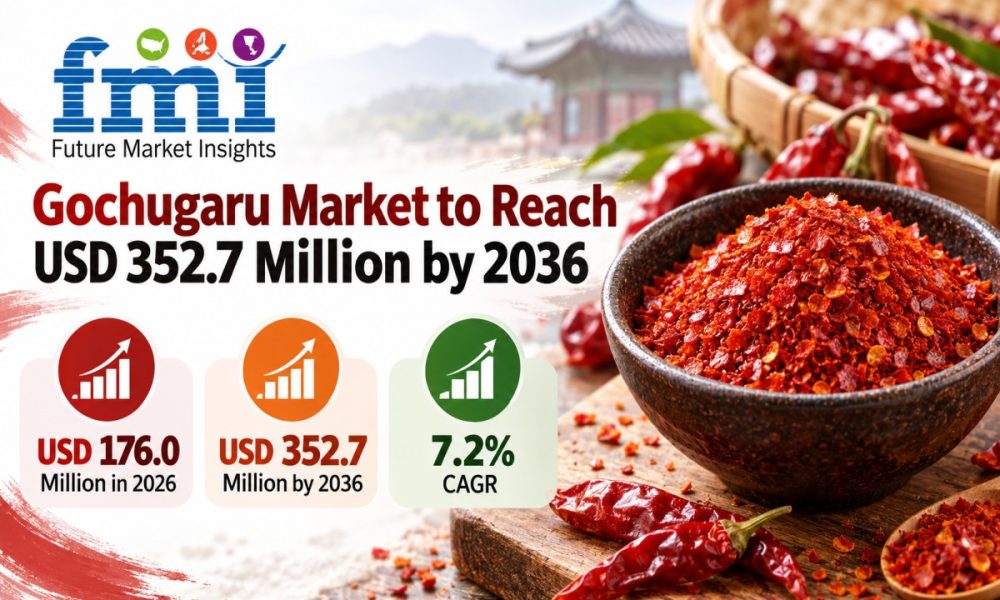
The global Gochugaru Market is projected to reach USD 352.7 million by 2036, up from approximately USD 176.0 million in 2026, expanding at a 7.2% CAGR during the forecast period, according to the latest analysis by Future Market Insights (FMI).
Market expansion is being supported by the wider adoption of Korean cuisine across retail and foodservice channels. Gochugaru remains an important ingredient for Korean recipes, providing characteristic color, heat and flavor in kimchi, sauces, marinades and seasoning applications. Growing international demand for Korean spicy flavors is also creating additional opportunities for suppliers.
Get Detailed Market Forecasts, Competitive Benchmarking, and Pricing Trends:
https://www.futuremarketinsights.com/reports/sample/rep-gb-34554
Kimchi and Fermented Foods Continue to Anchor Application Demand
Kimchi and fermented foods are expected to account for 36.0% of application demand in 2026, making the segment the leading application category. Gochugaru is incorporated into kimchi seasoning before fermentation, making grind, color and heat important production inputs.
Recurring commercial kimchi production requires consistent pepper specifications across batches. Changes in particle size or heat intensity can affect seasoning coverage and may require recipe adjustments. The continued international movement of Korean foods is therefore supporting repeat demand for gochugaru that meets defined quality requirements.
Korean-Grown Peppers Strengthen Provenance-Based Demand
Korean-grown peppers are expected to represent 43.0% of pepper source demand in 2026, making them the leading source category.
Korean-grown pepper provides manufacturers with a direct provenance connection for products positioned around Korean culinary authenticity. However, domestic cultivation conditions and seasonal supply can influence availability. Korea’s chili pepper cultivation area declined to 25,759 hectares in 2025, creating potential supply constraints and encouraging suppliers to maintain seasonal buffers and alternative farm arrangements.
Mild Gochugaru Holds a Significant Share
Mild gochugaru is projected to account for 24.0% of heat-level demand in 2026.
The mild category benefits from broader tolerance across household and foodservice recipes. Products with moderate heat can be incorporated into a wider range of Korean dishes while allowing consumers and commercial kitchens to adjust overall spice intensity through other ingredients.
Asian Grocery Retail Leads Sales Channels
Asian grocery retail is forecast to account for 34.0% of sales channel demand in 2026.
Asian grocery stores bring together consumers already familiar with Korean pantry products and reduce the education required when introducing gochugaru. Shelf placement alongside kimchi ingredients, Korean sauces and other pantry staples can encourage trial and repeat purchasing.
The expansion of Korean food products through mainstream retail is also increasing exposure to Korean ingredients. CJ Foods, for example, installed bibigo display zones at approximately 200 Don Quijote stores in Japan during July 2025, with plans to expand beyond 600 locations.
Global Korean Foodservice Expands Repeat Ingredient Use
Overseas Korean restaurants represent an important recurring demand source because standardized menus require consistent ingredients across commercial kitchens.
According to the source, Korean foodservice companies operated 4,644 overseas outlets across 56 countries at December 2025. The expanding restaurant network increases the number of professional kitchens using Korean red-pepper ingredients in kimchi, sauces and other Korean-style dishes.
Food-Safety Requirements Can Raise Qualification Costs
Imported red-pepper products can face microbiological testing, supplier verification and documentation requirements before distributors approve recurring purchases.
Food-safety failures can delay new listings and increase qualification costs because importers need hazard analysis, source records and other supporting documentation. This makes consistent safety records an important commercial requirement for suppliers targeting international markets.
South Korea Leads Country Growth
Among the highlighted countries, South Korea is projected to record a 6.9% CAGR through 2036, followed by Australia at 6.8%, the USA at 6.5%, Japan at 6.4% and the United Kingdom at 6.3%.
South Korea benefits from established kimchi consumption, domestic pepper use and established gochugaru applications. Australia is supported by growing Korean-food availability across supermarkets and specialty channels. In the USA, expanding Korean cuisine adoption across retail and foodservice is supporting demand.
Competitive Landscape
The Gochugaru Market includes Korean food specialists, ingredient processors and broader spice companies. Key companies profiled by FMI include CJ CheilJedang Corp., Sempio Foods Company, Daesang Corporation, Nongshim Taekyung Co., Ltd., Samjin Globalnet Co., Ltd., McCormick & Company, Incorporated, Frontier Co-op and Spiceology.
Competition is influenced by origin control, milling consistency, heat profile, food-safety documentation, packaging and distribution reach. Korean specialists differentiate through application expertise and provenance, while mainstream spice companies extend gochugaru availability across retail and professional culinary channels.
Key Industry Developments
In October 2025, Sempio Foods Company presented its Kimchi@Home kit at Anuga 2025, featuring gochugaru as a separately packaged ingredient for overseas kimchi preparation.
In August 2025, CJ CheilJedang Corp. began distributing kimchi cooking sauce in 12 countries for Asian restaurants, expanding exposure to Korean food applications.
In July 2026, Sempio Foods Company launched a recurring bimonthly “Cook Korean Live” online cooking program in the United States in partnership with Asian supermarket chain H Mart, featuring Korean dishes including bibimbap, tteokbokki and bulgogi.
Analyst Perspective
“Gochugaru suppliers earn repeat business by controlling color and particle size across crop seasons without weakening the heat profile expected in Korean recipes. Commercial advantage comes from pairing those specifications with importer-ready safety records, pack formats suited to kimchi production and foodservice use.” — Nandini Roy Choudhury, Principal Consultant, Future Market Insights
Exclusive Discounts on Full Report :
https://www.futuremarketinsights.com/reports/gochugaru-market
Report Scope
The FMI study covers the Gochugaru Market by product type, pepper source, heat level, application, sales channel and region. Product categories include coarse gochugaru flakes, fine gochugaru powder, kimchi-grade gochugaru, organic gochugaru and smoked/specialty gochugaru. Pepper sources include Korean-grown peppers, Chinese-grown peppers, blended-origin peppers and other Asian origins. Heat levels include mild, medium and hot. Applications include kimchi and fermented foods, sauces and marinades, seasoning blends, foodservice cooking and retail household use. Sales channels include Asian grocery retail, e-commerce, ingredient/bulk supply and foodservice distributors.
Key Executive Benefits
- Decision-Ready Insights
- Reduced Strategic Risk
- Market Entry Confidence
- Competitive Advantage
- Faster Growth Decisions
- Primary Market Validation
To explore how FMI Custom Research can support your strategic priorities, connect with our team at [email protected].
About Future Market Insights (FMI)
Future Market Insights, Inc. is an ESOMAR-certified, ISO 9001:2015 market research and consulting organization trusted by Fortune 500 companies. With a global presence across the U.S., UK, India and Dubai, FMI delivers data-driven insights across 30+ industries and 1,200 markets worldwide.



