
Definition
Non-contact passive sensors are advanced detection devices designed to sense environmental changes or physical parameters without physical interaction with the target object or requiring external power sources. These sensors function by leveraging ambient physical properties such as temperature gradients, electromagnetic fields, humidity variations, or mechanical vibrations to generate measurable signals.
The passive nature and contactless operation make these sensors ideal for applications where minimal interference, energy efficiency, or hazardous environment monitoring is critical. For example:
- Industrial Automation: Passive sensors monitor machinery without introducing electrical loads, reducing wear and maintenance requirements.
- Automotive Applications: Tire pressure monitoring, occupancy detection, and collision avoidance systems increasingly employ passive sensors to enhance reliability while minimizing battery dependence.
- Medical Applications: Passive RFID temperature sensors and glucose monitoring devices allow continuous patient health tracking with minimal intervention.
- Environmental Monitoring: Sensors that operate in remote or hard-to-access locations leverage passive technologies to collect data without continuous power supply.
Technological advances in material science, wireless protocols, and miniaturization have expanded the applicability of passive sensors, particularly in IoT ecosystems, smart cities, and autonomous systems.
Recent Developments
The non-contact passive sensor market is experiencing significant growth and innovation, largely driven by the expansion of the Internet of Things (IoT) and the increasing demand for automation across various industries. A major trend is the miniaturization and improved energy efficiency of these sensors, which enables their integration into a wider range of compact, battery-powered devices. The market is also seeing the convergence of sensor technology with artificial intelligence (AI) and machine learning (ML), which allows for more sophisticated data analysis and real-time insights, leading to a reduction in false positives. In the automotive sector, passive sensors are crucial for advanced driver-assistance systems (ADAS) and vehicle safety. In healthcare, passive sensors are being integrated into devices for wound healing and remote patient monitoring, while in smart buildings, they are used for occupancy sensing to optimize lighting and energy consumption.
Major Distribution
The distribution of non-contact passive sensors is primarily a business-to-business (B2B) process, with a diverse range of channels serving a wide variety of end-users. Direct sales from manufacturers to large-scale industrial and automotive companies are a key channel, as these clients often require custom solutions and extensive technical support. For a broader market reach, manufacturers rely on a network of specialized distributors, wholesalers, and value-added resellers who provide localized sales, technical expertise, and support to smaller businesses and system integrators. The distribution network is heavily concentrated in regions with strong manufacturing and technology sectors, such as North America, Europe, and Asia-Pacific. Additionally, with the rise of industrial automation and smart devices, online B2B platforms and e-commerce are becoming increasingly important for distributing standard, off-the-shelf sensor modules to a global customer base.
Market Size
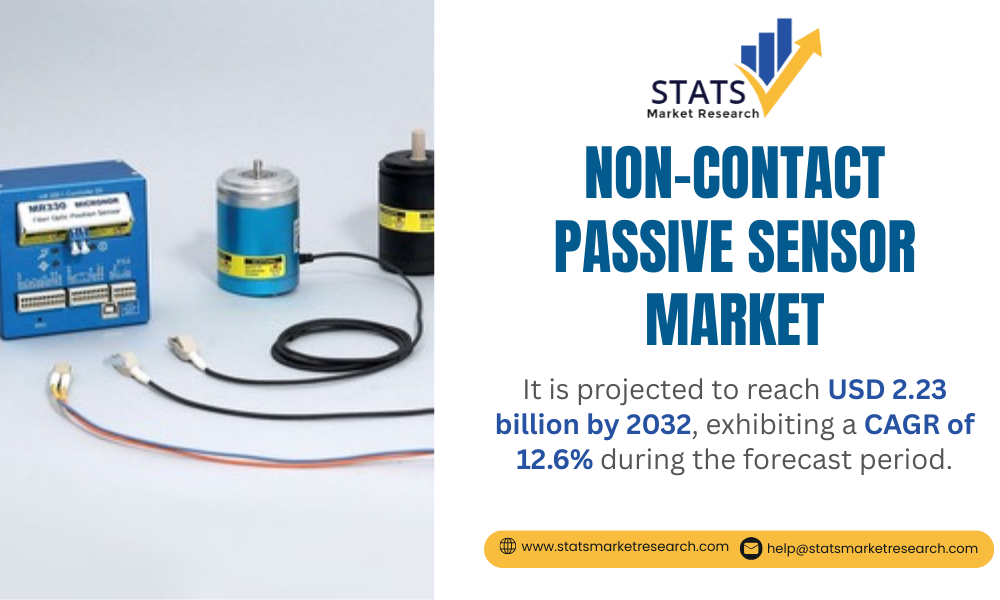
Global non-contact passive sensor market was valued at USD 993 million in 2023. The market is projected to reach USD 2.23 billion by 2030, growing at a compound annual growth rate (CAGR) of 12.6% during the forecast period.
Download FREE Sample of this Report @ https://www.statsmarketresearch.com/download-free-sample/8059972/global-noncontact-passive-sensor-forecast-market
Key factors contributing to market growth include:
- Industrial Automation: The shift towards smart factories and predictive maintenance increases demand for battery-free, contactless sensing solutions.
- Automotive Safety Systems: Leading automakers integrate over 200 passive sensors per vehicle, reducing electrical system complexity by 18% compared to active alternatives.
- IoT Integration: By 2025, over 50% of industrial IoT implementations are expected to utilize passive sensors, enabling real-time monitoring across distributed environments.
- Healthcare Innovation: Passive glucose and temperature sensors are increasingly adopted in implantable devices and pharmaceutical logistics. The medical passive sensor market alone is projected to grow at 14.2% CAGR through 2030.
Technological innovations reducing sensor size, improving accuracy, and enabling longer-range detection are expected to further expand adoption across sectors.
Market Dynamics (Drivers, Restraints, Opportunities, and Challenges)
Drivers
Integration with IoT and Smart Technologies
- Passive sensors provide real-time environmental monitoring without power constraints, ideal for large-scale IoT deployments.
- Automotive systems, such as tire pressure and occupancy detection, transition to passive solutions for improved reliability and lower maintenance.
Energy-Efficient Solutions in Manufacturing
- Industrial sustainability initiatives drive adoption of passive sensors that eliminate battery replacements.
- Passive temperature and vibration sensors have grown 35% annually since 2021, supporting predictive maintenance while complying with energy efficiency regulations in Europe and North America.
Medical Industry Innovation
- Digital transformation in healthcare creates opportunities for passive sensors in implantable devices and pharmaceutical monitoring.
- Passive glucose monitoring systems and other wearable sensors demonstrate the potential for continuous health tracking.
Restraints
Sensing Range and Precision Limitations
- Effective detection range for many passive sensors remains under 10 cm, limiting use in aerospace, energy, and long-distance industrial applications.
Environmental Interference
- Performance can degrade in environments with electromagnetic noise or metallic obstructions, resulting in up to 15% higher failure rates compared to wired systems.
Standardization Challenges
- Over 40 communication protocols exist for passive RFID sensors, creating interoperability and integration issues.
Material Sensitivity
- Passive sensors may show inconsistent detection when monitoring non-metallic objects or through complex media, affecting chemical and food processing applications.
Opportunities
Emerging 5G Networks
- 5G infrastructure enables millimeter-wave passive sensors with battery-free long-range detection.
- Early trials in smart cities demonstrate potential detection distances exceeding 50 meters, useful for traffic monitoring and structural health assessment.
Energy Harvesting Technologies
- Sensors can operate reliably on as little as 10 μW, enabling deployment in previously inaccessible areas.
- Ambient energy harvesting from RF, thermal, and vibrational sources expands passive sensor applications in remote environmental monitoring.
Autonomous Vehicle Development
- Automotive shift toward autonomous systems increases demand for passive LiDAR and radar alternatives.
- Passive systems reduce complexity and maintenance while meeting safety standards for self-driving vehicles.
Challenges
High Development Costs
- Custom passive sensor systems for harsh industrial environments can cost $500,000+ in engineering development, limiting SME adoption.
Data Security Concerns
- Wireless passive systems are susceptible to cybersecurity threats, with RFID systems experiencing 22% higher attempted breaches than wired networks.
Regulatory Compliance
- Changing RF emissions regulations and spectrum requirements add 10-15% to product development cycles.
Workforce Training
- Installation and maintenance require specialized skills; 65% of industrial teams lack training for passive sensor systems troubleshooting.
Regional Analysis
- North America: Dominates industrial applications, leveraging early IoT adoption and industrial automation.
- Europe: Focus on precision measurement technologies and regulatory compliance.
- Asia-Pacific: Cost-optimized solutions for consumer electronics and automotive sectors drive adoption, especially in China, Japan, and South Korea.
- Latin America & Middle East/Africa: Gradual adoption in industrial and environmental monitoring applications.
Get the Complete Report & TOC @ https://www.statsmarketresearch.com/global-noncontact-passive-sensor-forecast-market-8059972
Competitor Analysis
The global non-contact passive sensor market is semi-consolidated, with established technology leaders and emerging innovators:
- Honeywell International Inc.: 18.2% revenue share in 2023; diversified industrial sensor solutions; IoT partnerships.
- Texas Instruments & STMicroelectronics: Dominate core analog IC-based sensing technologies.
- Omron Corporation & Murata Manufacturing: Miniaturized solutions for medical and automotive sectors.
- TE Connectivity: Heavy R&D investments for high-accuracy sensors in Industry 4.0 applications.
- Sensirion AG: Focus on environmental monitoring, strengthened through strategic acquisitions.
Regional specialization creates competition and collaboration opportunities: North America excels in industrial applications, Europe in precision sensing, and Asia in cost-effective consumer solutions.
Global Non-Contact Passive Sensor: Market Segmentation Analysis
This report provides a deep insight into the global Non-Contact Passive Sensor market, covering all its essential aspects. This ranges from a macro overview of the market to micro details of the market size, competitive landscape, development trend, niche market, key market drivers and challenges, SWOT analysis, value chain analysis, etc.
The analysis helps the reader to shape the competition within the industries and strategies for the competitive environment to enhance the potential profit. Furthermore, it provides a simple framework for evaluating and assessing the position of the business organization. The report structure also focuses on the competitive landscape of the Global Non-Contact Passive Sensor market. This report introduces in detail the market share, market performance, product situation, operation situation, etc., of the main players, which helps the readers in the industry to identify the main competitors and deeply understand the competition pattern of the market.
In a word, this report is a must-read for industry players, investors, researchers, consultants, business strategists, and all those who have any kind of stake or are planning to foray into the Non-Contact Passive Sensor market in any manner.
Market Segmentation (by Application)
- Manufacturing Industry
- Automotive Industry
- Medical Industry
- Environmental Monitoring
- Others
Market Segmentation (by Type)
- Temperature Sensors
- Light Sensors
- Humidity Sensors
- Magnetic Field Sensors
- Others
Key Company
- Honeywell International Inc. (U.S.)
- Texas Instruments (U.S.)
- STMicroelectronics (Switzerland)
- Omron Corporation (Japan)
- TE Connectivity (Switzerland)
- Panasonic Corporation (Japan)
- Sensirion AG (Switzerland)
- Murata Manufacturing Co., Ltd. (Japan)
- Emerson Electric Co. (U.S.)
- Analog Devices, Inc. (U.S.)
- Saifoneng Technology (China)
Geographic Segmentation
- North America – U.S., Canada, Mexico
- Europe – Germany, Switzerland, UK
- Asia-Pacific – China, Japan, South Korea
- Latin America – Brazil, Argentina
- Middle East & Africa – UAE, South Africa
FAQ
Q1: What is the current market size of the Non-Contact Passive Sensor market?
A1: The market was valued at USD 993 million in 2023 and is projected to reach USD 2.23 billion by 2030, growing at a CAGR of 12.6%.
Q2: Which are the key companies operating in the Non-Contact Passive Sensor market?
A2: Key players include Honeywell, Texas Instruments, STMicroelectronics, Omron, TE Connectivity, Panasonic, Sensirion, Murata Manufacturing, Emerson Electric, Analog Devices, and Saifoneng Technology.
Q3: What are the key growth drivers in this market?
A3: Growth is driven by IoT integration, energy-efficient manufacturing, automotive safety systems, and medical industry adoption.
Q4: Which regions dominate the market?
A4: North America leads industrial applications, Europe excels in precision technologies, and Asia-Pacific focuses on cost-optimized solutions.
Q5: What are the emerging trends in the Non-Contact Passive Sensor market?
A5: Emerging trends include 5G-enabled long-range passive sensing, energy-harvesting sensors, miniaturization, and applications in autonomous vehicles.
About Us
☎️ International: +1 (332) 2424 294
📄 Website: www.statsmarketresearch.com
Join us on LinkedIn:- https://www.linkedin.com/company/statsmarketresearch




