
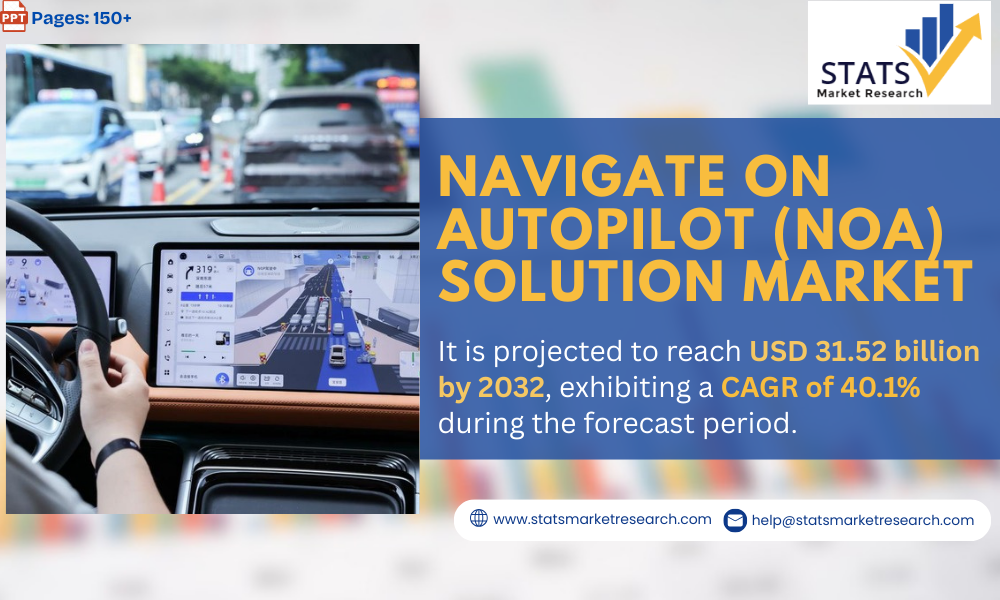
Definition
The Global Navigate on Autopilot (NOA) Solution Market refers to the market for advanced driver-assistance systems (ADAS) designed to enable semi-autonomous driving. NOA systems combine high-definition mapping, artificial intelligence, GPS positioning, and sensor fusion technologies (including cameras, radar, and LiDAR) to provide automated driving functionalities.
Key features of NOA solutions include:
- Lane centering and keeping
- Adaptive speed control based on traffic conditions
- Automated lane changes
- Highway interchange navigation
These capabilities enhance driving comfort while significantly reducing human error, improving road safety. NOA acts as a bridge between traditional ADAS and fully autonomous vehicles, providing highly reliable semi-autonomous navigation for both highways and urban environments.
Adoption is driven by increasing consumer demand for safety, regulatory mandates for vehicle safety features, and automakers’ strategic investments in autonomous vehicle development. While Highway NOA currently dominates, Urban NOA is gaining traction as city mapping technologies evolve. Major markets such as North America, Europe, and China are witnessing rapid adoption, fueled by technological innovation from leading companies like Mobileye, Bosch, and emerging Chinese tech firms.
Market Size
Global Navigate on Autopilot (NOA) Solution Market was valued at USD 2.97 billion in 2023 and is projected to reach USD 31.52 billion by 2030, growing at an extraordinary CAGR of 40.1% during the forecast period.
Download FREE Sample of this Report @ https://www.statsmarketresearch.com/download-free-sample/8059189/global-navigate-on-autopilot-solution-forecast-market
Historical Trends and Key Statistics
- The exponential growth reflects accelerating adoption of ADAS and the automotive sector’s shift toward semi-autonomous and autonomous vehicles.
- Highway NOA solutions dominate the market, primarily due to long-distance commuting requirements and controlled highway environments.
- Urban NOA solutions are increasingly supported by smart city infrastructure, V2X communications, and AI-powered urban navigation systems.
Market Insights
- Consumer adoption: Over 40% of new car buyers now consider ADAS capabilities as a key purchase factor.
- Technological advancements: Modern NOA solutions integrate multi-sensor data fusion with AI-driven decision-making, achieving over 99% object detection accuracy.
- Industry benchmarks: NOA systems can reduce driver fatigue by up to 60% on highways and lane departure incidents by approximately 45%.
The market size is expected to expand rapidly, driven by urban mobility innovations, regulatory mandates, and automaker investments in AI-driven semi-autonomous technologies.
Market Dynamics (Drivers, Restraints, Opportunities, and Challenges)
Drivers
- Rising Demand for Advanced Driver-Assistance Systems (ADAS):
NOA is emerging as a critical intermediary between traditional ADAS and fully autonomous vehicles. Consumer preference for enhanced safety and convenience, coupled with regulatory mandates for features like automatic emergency braking and lane-keeping assist, is propelling adoption. Automakers are increasingly integrating NOA across premium to mid-range vehicle lineups. - Technological Advancements in Sensor Fusion and AI:
Modern NOA systems integrate high-resolution cameras, LiDAR, radar, and ultrasonic sensors with sub-20ms latency, enabling real-time environment interpretation. AI-driven neural networks and edge computing allow vehicles to navigate complex scenarios without constant cloud connectivity. - Growing Investments in Smart City Infrastructure:
Urban NOA adoption is supported by V2X communications, intelligent traffic management systems, and real-time traffic data, enhancing performance in urban environments. Pilot programs show 30-35% improvements in traffic flow efficiency when NOA-equipped fleets interact with smart city infrastructure.
Restraints
- High Development and Implementation Costs:
Sophisticated NOA systems require expensive sensor suites, HD mapping, and redundant computing platforms, limiting availability primarily to premium vehicles. Maintenance of HD maps and over-the-air (OTA) update infrastructure further adds to costs. - Regulatory Fragmentation:
Different regional regulations on autonomous driving, data privacy, and liability frameworks require customized implementations, increasing development overhead and slowing global deployment. - Consumer Trust Deficit:
Despite technological advancements, surveys indicate that 60% of drivers remain skeptical of autonomous features in complex scenarios. High-profile incidents involving semi-autonomous vehicles reinforce safety concerns.
Challenges
- Edge Case Scenarios and Unpredictable Environments:
NOA systems struggle with rare driving situations, such as extreme weather, construction zones, or unpredictable pedestrian behavior. Urban NOA must account for nearly infinite interaction permutations, requiring continuous refinement of AI perception and decision-making models. - Cybersecurity Vulnerabilities:
Connectivity introduces potential cyber-attack vectors, including adversarial road markings or malicious data manipulation. The industry must implement robust encryption, authentication protocols, and secure OTA updates to maintain system safety and consumer confidence.
Opportunities
- Emergence of Mobility-as-a-Service (MaaS):
NOA can optimize ride-hailing and shared mobility fleets, improving efficiency, reducing operational costs, and enhancing passenger experience. Pilot programs demonstrate 20-25% improvements in fleet efficiency metrics with semi-autonomous integration. - Advancements in Explainable AI (XAI):
Explainable AI frameworks enable systems to communicate decision-making processes in human-understandable terms, building regulatory and consumer trust. Integration with driver monitoring systems can further accelerate adoption by providing transparency and safety assurance.
Regional Analysis
- North America: Early adoption driven by automaker investments, regulatory incentives, and infrastructure readiness.
- Europe: Rapid integration in premium and mid-range vehicles, supported by stringent safety regulations and urban mobility programs.
- Asia-Pacific: Fast-growing market with emphasis on smart cities, urban NOA deployment, and government-backed autonomous vehicle initiatives.
- China: Significant market growth driven by local tech players and supportive regulatory frameworks.
- Rest of the World: Emerging markets face slower adoption due to cost sensitivity, infrastructure limitations, and regulatory gaps.
Get the Complete Report & TOC @ https://www.statsmarketresearch.com/global-navigate-on-autopilot-solution-forecast-market-8059189
Competitor Analysis (in brief)
The NOA solution market is highly competitive, featuring automotive suppliers, AI firms, and technology conglomerates.
- Mobileye (Intel): Vision-based ADAS leader with partnerships across BMW, Volkswagen, and Ford, processing 125 million EyeQ chips in 2023.
- Bosch: Specializes in radar-dominated NOA solutions, leveraging automotive component expertise.
- Huawei: Integrates 5G-enabled V2X communications for urban NOA deployments.
- Chinese AI startups: Momenta, Horizon Robotics, SenseTime, and Maxieye offer agile, government-supported solutions for smart city integration.
- DJI: Adapted autonomous navigation algorithms from drones to commercial vehicle applications, targeting niche automation segments.
Global Navigate on Autopilot (NOA) Solution Market: Market Segmentation Analysis
This report provides a deep insight into the global Navigate on Autopilot (NOA) Solution Market, covering all its essential aspects. This ranges from a macro overview of the market to micro details of the market size, competitive landscape, development trend, niche market, key market drivers and challenges, SWOT analysis, value chain analysis, etc.
The analysis helps the reader to shape the competition within the industries and strategies for the competitive environment to enhance the potential profit. Furthermore, it provides a simple framework for evaluating and assessing the position of the business organization. The report structure also focuses on the competitive landscape of the Global Navigate on Autopilot (NOA) Solution Market. This report introduces in detail the market share, market performance, product situation, operation situation, etc., of the main players, which helps the readers in the industry to identify the main competitors and deeply understand the competition pattern of the market.
In a word, this report is a must-read for industry players, investors, researchers, consultants, business strategists, and all those who have any kind of stake or are planning to foray into the Navigate on Autopilot (NOA) Solution Market in any manner.
Market Segmentation (by Application)
- Passenger Cars
- Commercial Vehicles
Market Segmentation (by Type)
- Highway NOA
- Enables autonomous navigation on highways with lane-keeping, adaptive cruise control, and automated overtaking
- Urban NOA
- Provides advanced navigation in urban environments with traffic signal recognition, intersection handling, and pedestrian detection
Key Company
- Mobileye (Intel) (Israel/U.S.)
- Bosch (Germany)
- Huawei (China)
- Momenta (China)
- Horizon Robotics (China)
- DJI (China)
- SenseTime (China)
- Maxieye (China)
Geographic Segmentation
- North America
- Europe
- Asia-Pacific
- China
- Rest of the World
FAQ Section
- What is the current market size of the Navigate on Autopilot (NOA) Solution Market?
The market was valued at USD 2.97 billion in 2023 and is projected to reach USD 31.52 billion by 2030, growing at a CAGR of 40.1%. - Which are the key companies operating in the Navigate on Autopilot (NOA) Solution Market?
Key players include Mobileye (Intel), Bosch, Huawei, Momenta, Horizon Robotics, DJI, SenseTime, and Maxieye. - What are the key growth drivers in the Navigate on Autopilot (NOA) Solution Market?
Drivers include rising ADAS adoption, regulatory mandates, technological advancements in sensor fusion and AI, and smart city infrastructure development. - Which regions dominate the Navigate on Autopilot (NOA) Solution Market?
North America, Europe, and China are leading regions due to early adoption, strong infrastructure, and government support for autonomous driving. - What are the emerging trends in the Navigate on Autopilot (NOA) Solution Market?
Trends include urban NOA adoption, mobility-as-a-service integration, AI explainability for consumer trust, and cross-industry collaborations for autonomous technology.
About Us
☎️ International: +1 (332) 2424 294
📄 Website: www.statsmarketresearch.com
Join us on LinkedIn:- https://www.linkedin.com/company/statsmarketresearch




