
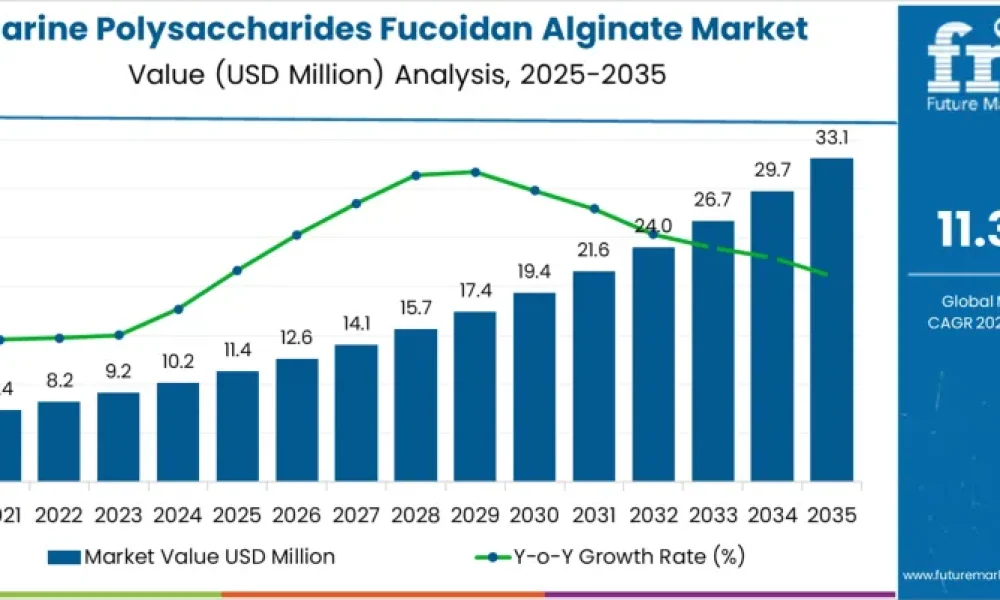
The global Marine Polysaccharides Fucoidan Alginate Market is entering a decisive growth phase as manufacturers across pharmaceuticals, nutraceuticals, cosmetics, food, and biomedical industries accelerate the adoption of bio-functional marine ingredients. Valued at USD 11.4 million in 2025, the market is forecast to reach USD 33.1 million by 2035, expanding at a robust CAGR of 11.3% during the forecast period.
This growth reflects a broader industry shift toward natural, biocompatible, and high-performance polymers derived from sustainable marine sources. Both fucoidan and alginate, extracted primarily from brown seaweed, are no longer treated as niche seaweed derivatives but as strategic functional materials enabling innovation across regulated and high-value applications.
Subscribe for Year-Round Insights → Stay ahead with quarterly and annual data updates – https://www.futuremarketinsights.com/reports/sample/rep-gb-29342
Market Outlook: From Early Integration to Deep Industrial Penetration
Between 2025 and 2030, the market grows steadily from USD 11.4 million to USD 17.4 million, supported by expanding use of marine polysaccharides as pharmaceutical excipients, wound care matrices, dietary supplement actives, and food stabilizers. During this phase, demand is application-driven, with manufacturers leveraging fucoidan for immune-support formulations and alginate for encapsulation, controlled release, and texture engineering.
From 2030 onward, market momentum accelerates significantly. Revenue climbs from USD 19.4 million in 2030 to USD 33.1 million by 2035, driven by deeper utilization in regenerative medicine, advanced wound care, dental materials, oncology-adjacent nutrition, functional beverages, and biodegradable packaging. Value creation increasingly depends on molecular standardization, purification efficiency, and clinical validation, rather than simple volume expansion.
Why Fucoidan and Alginate Are Strategic Bio-Functional Polymers
Unlike conventional hydrocolloids, fucoidan and alginate deliver both structural and biological performance:
- Fucoidan is valued for immune modulation, antioxidant activity, cell signaling interaction, and adjunct therapeutic potential.
- Alginate offers precise gelling, film-forming, stabilization, and controlled-release properties critical in medical, food, and industrial systems.
Their functionality positions them as high-value bio-polymers, supporting premium pricing and long-term supplier partnerships.
Key Market Segments Driving Demand
By End-Use Application
- Skin Care (8.7% share – leading segment)
- Body Care
- Hair Care
- Sun Care
- Color Cosmetics
- Men’s Grooming
- Baby & Kids Care
- Dermocosmetic / Professional Care
By Product Form
- Powder (15.7% – leading form)
- Granules / Agglomerates
- Flakes
- Pellets / Prills
- Liquid Solutions
- High-active Concentrates
- Dispersions & Suspensions
- Emulsions
- Pastes & Gels
- Wax / Solid Blocks
- Oils
Powder dominates due to storage stability, precise hydration control, low microbial risk, and predictable processing performance, making it the preferred format for pharmaceutical, cosmetic, and nutraceutical manufacturers.
Regional Growth Hotspots
- Asia Pacific leads global growth, supported by seaweed availability, extraction infrastructure, and expanding healthcare manufacturing.
- Europe follows closely, driven by regulated pharmaceutical production, clean-label foods, and biomedical research.
Country-Level CAGR Highlights (2025–2035):
- India: 15.2%
- China: 14.1%
- Japan: 13.0%
- United Kingdom: 11.9%
- Germany: 10.7%
- United States: 9.6%
Emerging markets benefit from rising nutraceutical demand, while mature economies emphasize quality, compliance, and innovation-led adoption.
Opportunities for Established and Emerging Manufacturers
The competitive landscape offers room for both global chemical majors and specialized marine biopolymer producers. Established players such as BASF SE, Croda International, Evonik Industries, Symrise (including IFF/Givaudan actives), Dow Inc., Ashland, Clariant, and Seppic continue to strengthen their portfolios through process optimization, purification technologies, and application-specific grades.
At the same time, new and mid-sized manufacturers are entering the market with:
- Advanced extraction and sulfation control technologies
- Heavy metal removal and solvent recovery innovations
- High-purity, application-targeted fucoidan and alginate variants
These advancements lower entry barriers and enable partnerships with pharmaceutical, cosmetic, and medical device companies seeking customized marine-based solutions.
Sustainability and Supply Chain as Long-Term Value Drivers
Supply stability remains closely tied to brown seaweed cultivation, coastal processing infrastructure, and climate variability. Companies investing in sustainable harvesting, vertical integration, and contract farming gain a competitive edge. Regulatory compliance around purity, iodine levels, and biological safety further elevates the importance of traceable and standardized sourcing.
Future Outlook
As demand shifts toward drug delivery systems, regenerative medicine scaffolds, active packaging, and immune-active nutrition, marine polysaccharides are transitioning into structurally important materials for next-generation products. Manufacturers that combine sustainable biomass access, advanced processing, and clinical-grade validation are best positioned to capture long-term growth.
With strong fundamentals, expanding applications, and rising global acceptance, the Marine Polysaccharides Fucoidan Alginate Market is set to remain a high-opportunity space through 2035 and beyond.
Have a specific Requirements and Need Assistant on Report Pricing or Limited Budget please contact us – [email protected]
About Future Market Insights (FMI)
Future Market Insights, Inc. (FMI) is an ESOMAR-certified, ISO 9001:2015 market research and consulting organization, trusted by Fortune 500 clients and global enterprises. With operations in the U.S., UK, India, and Dubai, FMI provides data-backed insights and strategic intelligence across 30+ industries and 1200 markets worldwide.



