
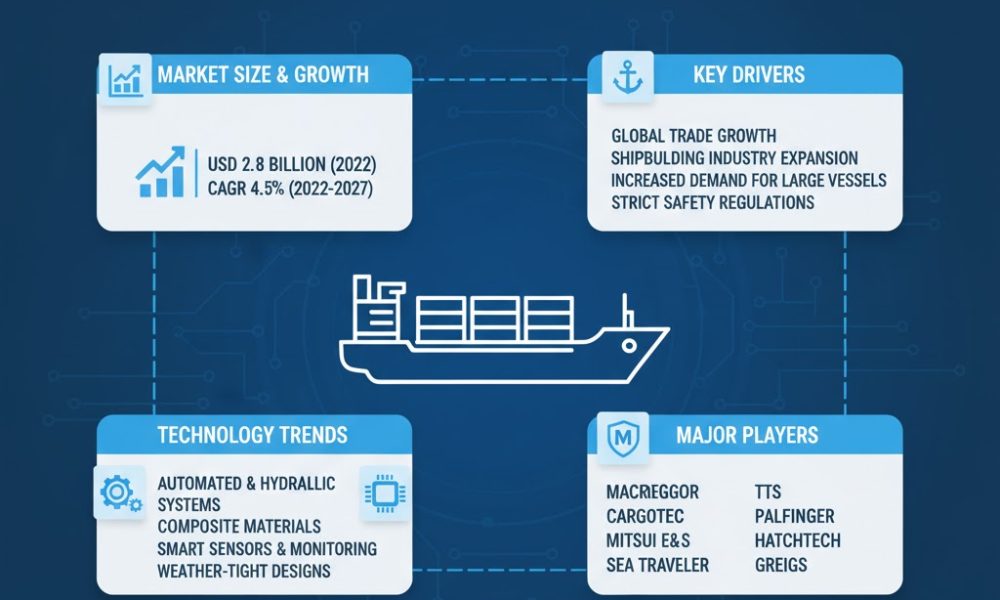
The global marine hatch covers market is poised for steady expansion over the next decade, fueled by rising maritime trade volumes, rapid shipbuilding activity, and stricter international safety mandates. According to recent industry estimates, the market is projected to grow from USD 202.0 million in 2025 to USD 415.9 million by 2035, registering a compound annual growth rate (CAGR) of 7.5%.
Hatch covers are critical components that protect vessel cargo holds from seawater, weather exposure, and structural fatigue. As global shipping operators prioritize efficiency, safety, and sustainability, the demand for lightweight, corrosion-resistant, and intelligent hatch cover systems continues to accelerate.
Fleet Expansion and Safety Regulations Fuel Growth
The surge in maritime trade—expected to surpass 12 billion tons of seaborne cargo annually by 2030—has intensified the demand for advanced vessel components. Shipowners are investing heavily in hatch cover technologies that ensure water-tight integrity and reduce operational downtime. Moreover, evolving International Maritime Organization (IMO) and SOLAS standards have driven shipbuilders to adopt automated and smart hatch systems to enhance vessel reliability.
Subscribe for Year-Round Insights → Stay ahead with quarterly and annual data updates
https://www.futuremarketinsights.com/reports/sample/rep-gb-5632
Modern fleet upgrades, particularly in bulk carriers, container ships, offshore platforms, and naval vessels, are propelling innovation. Shipyards are increasingly specifying hatch covers with hydraulic sealing, AI-based monitoring sensors, and anti-corrosion coatings that enhance performance and cut lifecycle maintenance costs.
Asia-Pacific Dominates Global Demand
The Asia-Pacific region, accounting for nearly 50% of global shipbuilding output, is projected to remain the fastest-growing regional market. China, South Korea, and Japan lead global ship production, with mounting demand for cost-efficient and technologically advanced hatch covers.
China’s commercial fleet expansion and port modernization projects are boosting installations of high-strength composite hatch covers.
South Korea’s focus on LNG carriers and smart ship technologies is driving the adoption of cryogenic-resistant and automated hatch solutions.
Japan, emphasizing zero-emission shipbuilding, is leading innovation in lightweight and fuel-efficient aluminum hatch covers.
Meanwhile, India is emerging as a promising market, supported by defense shipbuilding programs and port infrastructure expansion initiatives under the Sagarmala Project.
Europe and North America Prioritize Green Shipping
Europe remains a powerhouse in marine engineering, backed by stringent environmental regulations and decarbonization goals. Countries such as Germany, Norway, and the Netherlands are championing lightweight composite and hybrid hatch cover designs that align with the EU Green Shipping Strategy. These initiatives focus on energy efficiency, reduced emissions, and recyclability.
In North America, the U.S. and Canada are witnessing increased adoption of smart and corrosion-resistant hatch covers across both naval and commercial fleets. The U.S. Coast Guard and IMO enforcement of strict safety protocols, alongside rising offshore oil and gas exploration, are reinforcing market demand for high-performance sealing systems suitable for Gulf of Mexico operations.
Middle East & Africa: Expanding Maritime Infrastructure
The Middle East and Africa are emerging as key contributors to global market expansion. Driven by offshore oil and gas exploration, naval modernization, and port infrastructure investments in Saudi Arabia, the UAE, and South Africa, the region is rapidly adopting durable, weather-tight hatch cover solutions. Growing maritime traffic through the Suez Canal and Africa’s coastal shipping corridors further underscores the need for robust and efficient hatch protection systems.
Technology Trends Shaping the Market
Manufacturers are focusing on AI-integrated and IoT-enabled hatch covers to provide predictive maintenance, real-time diagnostics, and automated sealing operations. These innovations not only enhance safety but also reduce manual intervention, improving operational efficiency.
The next generation of hatch covers will increasingly feature:
Nanotechnology-based anti-corrosion coatings for extreme marine environments.
Lightweight composite and graphene-reinforced materials for improved strength-to-weight ratios.
Automated hydraulic systems with AI-assisted leak detection and remote operation capabilities.
Such developments align with the broader trend toward autonomous shipping, where self-regulating systems play a crucial role in vessel automation and cargo protection.
Market Segmentation: Pontoon-Type Leads, Aluminum Gaining Traction
Among product types, pontoon-type hatch covers dominate the market due to their versatility and proven performance in bulk carriers and cargo vessels. However, rolling-type covers are gaining traction in Ro-Ro and high-capacity container vessels for their space efficiency and automation compatibility.
Material-wise, steel hatch covers continue to lead the industry due to their robustness and cost-effectiveness, while aluminum alloys are increasingly preferred in passenger ferries, naval ships, and energy-efficient vessels where fuel economy is critical.
Buy Report Now – Click Here to Purchase the Report:
https://www.futuremarketinsights.com/checkout/5632
Competitive Landscape
The marine hatch covers market is moderately consolidated, with leading players focusing on smart materials, automation, and lifecycle efficiency. Key participants include:
MacGregor (Cargotec Corporation) – Global leader in hydraulic and automated hatch systems for commercial and naval vessels.
TTS Group ASA (MacGregor) – Innovator in lightweight composite and digitally integrated hatch cover solutions.
Baier Marine Company, Inc. – Specialist in corrosion-resistant and quick-acting hatch systems for offshore and defense applications.
Wärtsilä Corporation – Provider of energy-efficient, low-maintenance sealing systems and hydraulic hatch technologies.
Lindgren-Pitman Inc. – Developer of precision-engineered hatch locking mechanisms with extended operational life.
Together, these companies account for nearly 45–50% of global market share, with ongoing investments in smart materials, AI-assisted sealing systems, and green ship components.
Outlook: 2025–2035
Between 2025 and 2035, the marine hatch covers industry will continue its transformation—anchored by sustainability, safety, and automation. As global fleets transition toward smart, fuel-efficient, and autonomous vessels, hatch cover systems will evolve into intelligent, low-maintenance components vital for next-generation shipping.
Have a specific Requirements and Need Assistant on Report Pricing or Limited Budget please contact us – [email protected]
About Future Market Insights (FMI)
Future Market Insights, Inc. (FMI) is an ESOMAR-certified, ISO 9001:2015 market research and consulting organization, trusted by Fortune 500 clients and global enterprises. With operations in the U.S., UK, India, and Dubai, FMI provides data-backed insights and strategic intelligence across 30+ industries and 1200 markets worldwide.



