
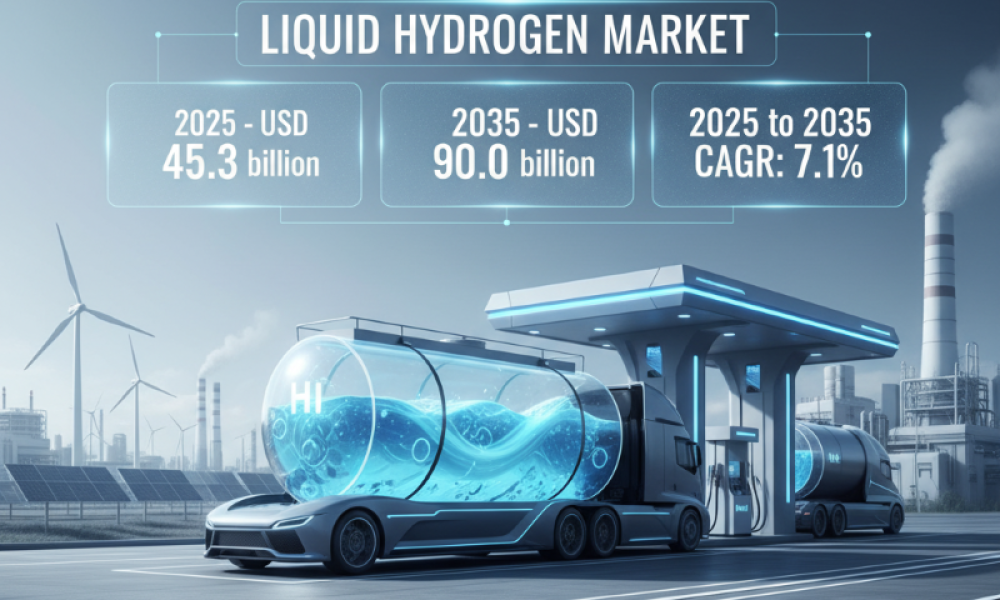
The global liquid hydrogen market, currently valued at USD 45.3 billion in 2025, is set for significant growth, with projections estimating it will reach USD 90 billion by 2035. This expansion represents a compound annual growth rate (CAGR) of 7.1%, driven by a combination of technological advancements, increasing regulatory support, and growing demand across various industries including energy, transportation, and industrial sectors.
Liquid hydrogen is emerging as a cornerstone in the transition to low-carbon energy sources due to its high energy density and clean emission profile. Governments across the globe are investing heavily in infrastructure, technology, and regulatory frameworks that promote hydrogen adoption, with particular emphasis on decarbonization, renewable energy integration, and energy security. As these policies gain momentum, the liquid hydrogen market is expected to accelerate, especially in regions with favorable regulatory environments.
Unlock detailed analytics – Request your personalized report now! https://www.futuremarketinsights.com/reports/sample/rep-gb-25373
Regulatory Influence Driving Market Dynamics
Regulatory frameworks play a pivotal role in shaping the liquid hydrogen market. Governments in key regions, particularly North America, Asia-Pacific, and Europe, are introducing stringent emission reduction mandates, renewable energy targets, and incentives for hydrogen adoption. These policies aim to reduce carbon footprints and promote clean fuel utilization across industrial, transportation, and power sectors.
Safety and handling regulations are essential to liquid hydrogen, given its low temperature and high volatility. Strict guidelines for storage tanks, transport vessels, and refueling infrastructure are crucial to ensuring safe and efficient operations. In regions with strong regulatory support, such as North America and Europe, the market has seen faster adoption, while areas with inconsistent regulations have experienced slower growth.
Key Market Segments and Trends
- Production Methods: The electrolysis segment is expected to dominate the market, accounting for 46.8% of the market share in 2025. This method, which uses renewable electricity to split water into hydrogen and oxygen, aligns with global sustainability goals and has minimal environmental impact compared to conventional methods like coal gasification and steam methane reforming (SMR). As renewable energy capacity expands, electrolysis-based hydrogen production is gaining momentum due to its scalability and low carbon footprint.
- Distribution Methods: Cryogenic tanks, which hold liquid hydrogen at extremely low temperatures, will continue to be the preferred distribution method, commanding 57.4% of the market revenue in 2025. Cryogenic tanks are critical for storing and transporting liquid hydrogen safely over long distances, and innovations in insulation and tank design are enhancing their efficiency and reducing boil-off losses.
- End Use: The transportation sector, including heavy-duty vehicles (HDVs), public transport, and emerging industries such as aviation and maritime transport, is the largest consumer of liquid hydrogen, with an estimated 42.6% market share in 2025. Liquid hydrogen’s high energy density makes it ideal for long-distance, heavy-duty applications, and government incentives are pushing forward the adoption of hydrogen fuel-cell vehicles (FCVs).
Technological Innovations Enhancing Market Growth
Technological advancements in liquefaction, storage, and transportation are crucial to market growth. New cryogenic storage systems, modular liquefaction units, and digital monitoring solutions are improving operational efficiency and safety. Companies are increasingly focusing on the development of modular systems for liquefaction, making hydrogen production and distribution more flexible and scalable.
Regional Insights
North America, Asia-Pacific, and Europe are expected to lead the liquid hydrogen market growth. The U.S., for instance, is seeing considerable investments in hydrogen fuel infrastructure, driven by advancements in fuel-cell technology and decarbonization goals. In Asia-Pacific, China is projected to grow at the highest CAGR of 9.6%, with significant investments in hydrogen production, storage, and transport infrastructure, driven by the country’s commitment to reducing carbon emissions and advancing its hydrogen economy.
Europe is also a strong contender, with Germany leading the market, supported by robust government policies, investments in hydrogen infrastructure, and strong industrial demand for hydrogen in sectors such as steel manufacturing and fuel-cell mobility.
Competitive Landscape
The liquid hydrogen market is highly competitive, with several leading companies positioning themselves as market leaders. Linde, Air Liquide, Air Products and Chemicals, Inc., and Praxair Technology, Inc. dominate the market due to their advanced liquefaction technologies, global distribution networks, and integrated hydrogen supply solutions. Other notable players include Chart Industries, Engie, and Iwatani Corporation, who are driving innovation in cryogenic storage systems, high-capacity transport solutions, and production processes.
Download Brochure for Full Insights: https://www.futuremarketinsights.com/reports/brochure/rep-gb-25373
Challenges and Opportunities
Despite the promising growth, the liquid hydrogen market faces challenges, particularly related to high production and transportation costs, as well as stringent safety protocols. The energy-intensive liquefaction process, coupled with the specialized storage and transportation infrastructure, contributes to high capital and operational costs. However, ongoing advancements in cryogenic technology, modular production units, and digital monitoring systems are improving efficiency and reducing costs.
Government initiatives and strategic investments remain key drivers of growth. Policies encouraging the use of clean fuels and zero-emission technologies, along with tax incentives and funding for hydrogen infrastructure, are expected to further support the adoption of liquid hydrogen in the coming years.
About Future Market Insights (FMI)
Future Market Insights, Inc. (ESOMAR certified, recipient of the Stevie Award, and a member of the Greater New York Chamber of Commerce) offers profound insights into the driving factors that are boosting demand in the market. FMI stands as the leading global provider of market intelligence, advisory services, consulting, and events for the Packaging, Food and Beverage, Consumer Technology, Healthcare, Industrial, and Chemicals markets. With a vast team of over 400 analysts worldwide, FMI provides global, regional, and local expertise on diverse domains and industry trends across more than 110 countries.



