
Definition
LED grow lights for indoor plants are advanced lighting systems engineered to provide an artificial light spectrum that closely resembles natural sunlight, enabling healthy plant growth even in environments with little or no natural light. Unlike traditional grow lighting systems such as fluorescent or high-pressure sodium (HPS) lamps, LED grow lights consume less electricity, generate less heat, and offer customizable light spectrums tailored to the specific photosynthetic needs of plants. This makes them highly efficient and suitable for various applications, including home gardening, commercial greenhouses, hydroponic farming, and vertical agriculture.
Indoor plant cultivation often requires a balanced combination of light wavelengths—primarily in the blue and red spectrum—to drive photosynthesis effectively. LED grow lights address this requirement with precision, allowing growers to adjust the light spectrum to match different plant growth stages, such as vegetative growth or flowering. For example, blue light promotes strong root and stem development, while red light encourages blooming and fruiting.
These lighting solutions are integral in urban agriculture trends, where space constraints and environmental factors limit outdoor farming possibilities. By enabling year-round cultivation and enhancing crop yields, LED grow lights are increasingly adopted in urban farming facilities, plant research labs, and residential spaces.
The rising demand for fresh, locally grown produce, coupled with growing consumer interest in home gardening and plant-based diets, is fueling the adoption of LED grow lights globally. Furthermore, the shift toward sustainable agricultural practices is positioning LED grow lights as a key technology in reducing energy consumption and minimizing environmental impact while maximizing plant productivity.
Recent Developments in the LED Grow Lights for Indoor Plants Market
The LED grow lights market is seeing a major shift towards smarter, more efficient, and specialized products. A key trend is the development of “smart” grow lights, which can be controlled and monitored via smartphone apps or integrated into smart home systems. This allows users to precisely adjust light intensity, duration, and spectrum to match a plant’s specific growth stage, from seedling to flowering. Another significant advancement is the use of nanotechnology and advanced materials to create full-spectrum LEDs that more closely mimic natural sunlight. This results in healthier plant growth, improved yields, and better flavor profiles. The market is also seeing a surge in specialized products, such as lights with specific red, blue, or far-red wavelengths tailored for particular plant types, making indoor gardening more accessible and successful for hobbyists and commercial growers alike.
Major Distribution for LED Grow Lights for Indoor Plants
The distribution of LED grow lights is a mix of traditional retail channels and a rapidly expanding e-commerce presence. Major home improvement and garden supply stores like Home Depot and Lowe’s carry a range of products, catering to a broad base of casual indoor gardeners. However, a significant portion of the market is dominated by online retailers and specialized e-commerce platforms like Amazon and Alibaba, where a vast array of brands—from established companies like Signify and Fluence to newer, direct-to-consumer players like Mars Hydro and Vivosun—can be found. Additionally, many companies have a strong direct-to-consumer model, leveraging their websites and social media to sell their products and build a community around their brand. This multi-channel approach allows manufacturers to reach both large-scale commercial growers and the growing number of home gardeners who are driving market growth.
Market Size
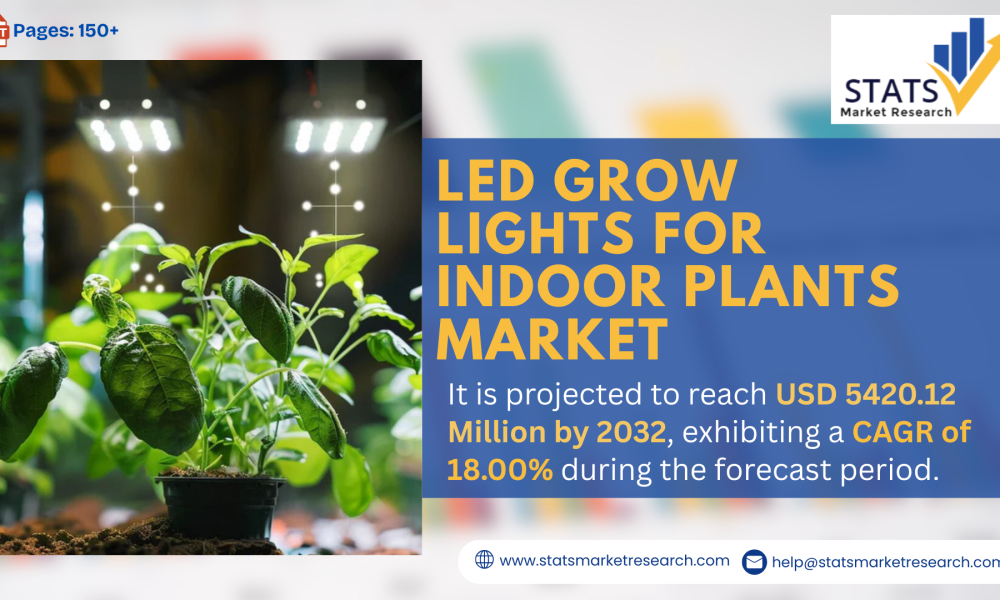
Global LED Grow Lights for Indoor Plants market was valued at USD 1,222 million in 2024 and is expected to grow significantly to USD 5,420.12 million by 2032, exhibiting a compound annual growth rate (CAGR) of 18.00% during the forecast period.
This rapid growth is driven by the expansion of indoor farming and the increasing adoption of hydroponics and vertical farming systems, particularly in regions facing agricultural land shortages.
In North America, the market was valued at USD 424.25 million in 2024 and is projected to grow at a CAGR of 15.43% between 2025 and 2032. The U.S. leads this growth, with significant adoption in both commercial greenhouse farming and residential indoor gardening.
Historical growth trends indicate that advancements in LED technology, reductions in manufacturing costs, and growing awareness of sustainable cultivation methods have collectively propelled the market forward over the past decade. The cost per lumen of LED lighting has steadily declined, making high-quality grow lights more accessible to both small-scale and commercial growers.
By 2032, Asia-Pacific is expected to emerge as a major market contributor due to increased investment in smart agriculture and government incentives promoting energy-efficient farming technologies. The convergence of smart IoT-based agricultural systems with LED lighting is also expected to create new opportunities for precision farming.
Download FREE Sample of this Report @ https://www.statsmarketresearch.com/download-free-sample/8032990/global-led-grow-lights-for-indoor-plants-market
Market Dynamics (Drivers, Restraints, Opportunities, and Challenges)
Drivers
- Urbanization and Space Constraints: As urban areas expand, agricultural land availability shrinks, creating demand for vertical farming and indoor cultivation systems that rely heavily on LED grow lights.
- Sustainability Goals: Governments and businesses are focusing on reducing carbon footprints, and LEDs offer significant energy savings over traditional lighting systems.
- Technological Advancements: Innovations in spectrum customization, wireless control, and integration with smart sensors enhance plant growth efficiency and yield.
- Rising Interest in Home Gardening: Millennials and Gen Z consumers, particularly during and after the pandemic, have shown strong interest in growing plants indoors.
Restraints
- High Initial Investment: Quality LED grow lights have a higher upfront cost compared to traditional lighting systems, which may deter small-scale growers.
- Technical Knowledge Requirement: Proper use of LED grow lights requires understanding optimal light spectrums, placement, and exposure times, which may be challenging for beginners.
Opportunities
- Integration with Smart Farming Systems: The combination of LED lighting with IoT, AI-based crop monitoring, and automation offers significant growth potential.
- Emerging Markets: Countries in Asia, Africa, and South America are increasingly adopting indoor farming technologies, presenting untapped markets.
- Specialty Crops: LEDs are particularly beneficial for high-value crops such as herbs, microgreens, and medicinal plants, which require precise light control.
Challenges
- Market Fragmentation: A large number of small and mid-sized players in the market creates intense competition, potentially affecting pricing strategies.
- Standardization Issues: Lack of global standards for LED grow light performance and safety can lead to inconsistent quality and hinder buyer confidence.
Regional Analysis
- North America: Dominates the market due to strong adoption in commercial greenhouses and technological integration in agriculture. The U.S. leads in both production and consumption.
- Europe: Countries like the Netherlands and Germany are investing heavily in controlled environment agriculture, with LEDs replacing traditional HPS lighting in greenhouses.
- Asia-Pacific: Rapid growth driven by urbanization, government initiatives for food security, and large-scale vertical farming projects in China, Japan, and South Korea.
- South America: Brazil and Argentina are exploring LED grow lights for niche crops, though market penetration remains in early stages.
- Middle East and Africa: Increasing investment in controlled environment agriculture to overcome harsh climate conditions, with LEDs seen as a solution for year-round production.
Competitor Analysis (in brief)
Key players in the LED Grow Lights for Indoor Plants market include Signify, GE Lighting, Gavita, Osram, Hubbell Lighting, Everlight Electronics, Kessil, Cree, Illumitex, Senmatic A/S, Valoya, Heliospectra, Cidly, Ohmax Optoelectronic, and Vipple. These companies compete on technological innovation, product quality, spectrum customization capabilities, and distribution networks. Many are integrating smart controls and expanding into emerging markets to strengthen their positions
Get the Complete Report & TOC @ https://www.statsmarketresearch.com/global-led-grow-lights-for-indoor-plants-market-8032990.
Global [Keyword]: Market Segmentation Analysis
This report provides a deep insight into the global [Keyword], covering all its essential aspects. This ranges from a macro overview of the market to micro details of the market size, competitive landscape, development trend, niche market, key market drivers and challenges, SWOT analysis, value chain analysis, etc.
The analysis helps the reader to shape the competition within the industries and strategies for the competitive environment to enhance the potential profit. Furthermore, it provides a simple framework for evaluating and assessing the position of the business organization. The report structure also focuses on the competitive landscape of the Global [Keyword]. This report introduces in detail the market share, market performance, product situation, operation situation, etc., of the main players, which helps the readers in the industry to identify the main competitors and deeply understand the competition pattern of the market.
In a word, this report is a must-read for industry players, investors, researchers, consultants, business strategists, and all those who have any kind of stake or are planning to foray into the [Keyword] in any manner.
Market Segmentation (by Application)
- Home Gardening
- Commercial Cultivation
- Others
Market Segmentation (by Type)
- Partial Spectrum Light
- Full Spectrum Light
Key Company
- Signify
- GE Lighting
- Gavita
- Osram
- Hubbell Lighting
- Everlight Electronics
- Kessil
- Cree
- Illumitex
- Senmatic A/S
- Valoya
- Heliospectra
- Cidly
- Ohmax Optoelectronic
- Vipple
Geographic Segmentation
- North America (USA, Canada, Mexico)
- Europe (Germany, UK, France, Russia, Italy, Rest of Europe)
- Asia-Pacific (China, Japan, South Korea, India, Southeast Asia, Rest of Asia-Pacific)
- South America (Brazil, Argentina, Columbia, Rest of South America)
- The Middle East and Africa (Saudi Arabia, UAE, Egypt, Nigeria, South Africa, Rest of MEA)
FAQ
What is the current market size of LED Grow Lights for Indoor Plants?
The global market size was estimated at USD 1,222 million in 2024.
Which are the key companies operating in the LED Grow Lights for Indoor Plants market?
Major companies include Signify, GE Lighting, Gavita, Osram, and Hubbell Lighting, among others.
What are the key growth drivers in the LED Grow Lights for Indoor Plants market?
Key drivers include urban farming expansion, technological advancements, and growing interest in sustainable cultivation.
Which regions dominate the LED Grow Lights for Indoor Plants market?
North America currently dominates, but Asia-Pacific is expected to see the fastest growth by 2032.
What are the emerging trends in the LED Grow Lights for Indoor Plants market?
Emerging trends include integration with smart farming systems, spectrum customization, and adoption in vertical farming.
About Us
☎️ International: +1 (332) 2424 294
📄 Website: www.statsmarketresearch.com
Join us on LinkedIn:- https://www.linkedin.com/company/statsmarketresearch




