
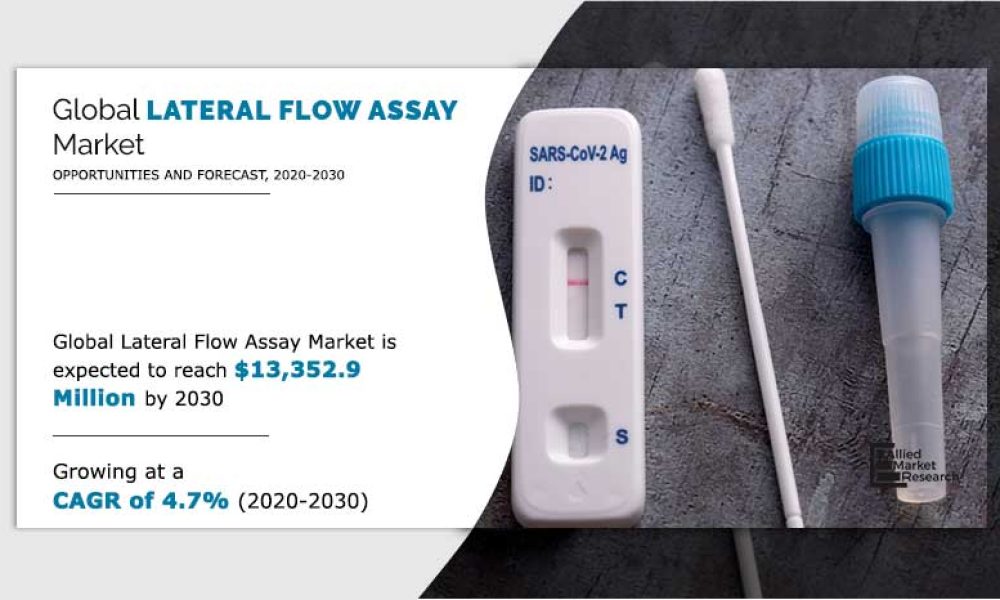
The global lateral flow assay (LFA) market, valued at $8.35 billion in 2020, is projected to reach nearly $13.35 billion by 2030, advancing at a compound annual growth rate (CAGR) of 4.7% from 2021 to 2030.
Lateral flow assays, also referred to as lateral flow immunochromatographic tests, are rapid diagnostic tools used to identify the presence or absence of a target substance—often antigens or antibodies—in a sample. Their versatility has made them indispensable in hospitals, clinical laboratories, and home testing environments. Beyond healthcare, LFAs also serve roles in food and beverage testing, offering swift results for applications such as infectious disease screening, cardiac marker monitoring, pregnancy and fertility checks, cholesterol and lipid profiling, and drug abuse detection.
Get a Sample Copy of this Report: https://www.alliedmarketresearch.com/request-sample/2823
Key Growth Drivers
Several factors are fueling the expansion of the LFA market:
Rising prevalence of chronic and infectious diseases worldwide.
Surging adoption of home-based testing kits for convenience and accessibility.
Government-led health awareness initiatives promoting early detection.
Increased demand for point-of-care diagnostics in both developed and emerging markets.
Technological advancements that enhance test accuracy and broaden application areas.
Advantages over laboratory-based methods, such as faster turnaround times and minimal equipment requirements.
The COVID-19 pandemic provided an unprecedented boost to the sector, as LFAs became a frontline tool in detecting both symptomatic and asymptomatic cases. Compared to RT-PCR—which detects only active infections—LFA devices can identify past infections and different disease stages, offering broader epidemiological insights. This capability has shaped healthcare strategies and policy decisions in pandemic management.
COVID-19’s Impact on Market Growth
During the pandemic, companies developed LFA kits that detect COVID-19 antibodies (IgG, IgM) or viral antigens using minimal samples like finger-prick blood, saliva, or nasal swabs. The low cost, ease of use, and no requirement for specialized personnel made these kits an attractive option for mass testing. This accessibility has been critical for countries managing ongoing waves of infection and preparing for potential future outbreaks.
Market Segmentation Overview
By Technique:
Sandwich Assays – Dominated the market in 2020 due to their higher sensitivity and specificity, especially for larger analytes in clinical diagnostics.
Competitive Assays
Multiplex Detection Assays
By Product:
Kits & Reagents – Remain the most widely used products, offering rapid and reliable results.
Lateral Flow Readers – Expected to grow at the fastest rate, enabling quantitative analysis with high sensitivity. This segment includes benchtop, mobile, and smartphone-compatible readers that capture, analyze, and transmit data efficiently.
By Application:
Clinical Testing (infectious disease, cardiac markers, pregnancy & fertility, cholesterol & lipid, drug-of-abuse, others)
Veterinary Diagnostics
Food Safety & Environmental Testing
Drug Development & Quality Testing
By End User:
Home Care
Diagnostic Laboratories
Hospitals & Clinics
Pharmaceutical & Biotechnology Companies
Others
Regional Insights
North America is expected to retain its leadership position in the LFA market throughout the forecast period. The region’s growth is fueled by the high prevalence of infectious diseases such as Lyme disease, tuberculosis, HIV/AIDS, and COVID-19. The United States, in particular, benefits from a large patient base, high disposable income, and strong healthcare infrastructure.
Outlook:
As point-of-care diagnostics become a cornerstone of modern healthcare, LFAs are positioned for sustained relevance. Technological innovation, expanding applications, and increasing global health awareness are expected to keep the market on a steady upward trajectory through 2030.




