
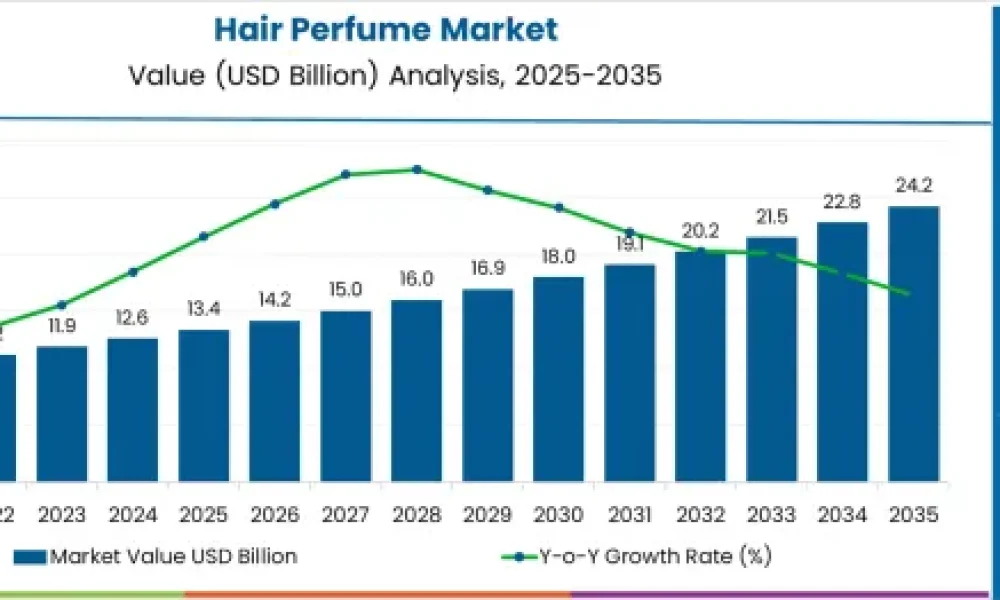
The global Hair Perfume Market is experiencing steady and sustained expansion as consumers increasingly seek beauty products that combine fragrance with hair care benefits. Valued at USD 13.4 billion in 2025, the market is projected to reach USD 24.2 billion by 2035, registering a compound annual growth rate (CAGR) of 6.1% over the forecast period from 2025 to 2035.
This growth reflects a broader shift in the personal care industry toward premium, multi-functional products that align with evolving grooming routines, wellness priorities, and demand for personalized sensory experiences. Hair perfumes—formulated to deliver long-lasting scent without the drying effects of traditional alcohol-based fragrances—are increasingly positioned as an essential extension of modern hair care.
Explore the full market insights and exclusive data breakdowns – Request Your Sample Report Now
Market Outlook: Growth Accelerates Early, Stabilizes with Maturity
Between 2025 and 2030, the hair perfume market is expected to grow from USD 13.4 billion to USD 18.0 billion, adding USD 4.6 billion in value at a CAGR of 6.7%. This early acceleration is driven by rising adoption in emerging markets, increasing influence of social media beauty trends, and heightened awareness of hair health.
From 2030 to 2035, growth continues at a slightly moderated CAGR of 5.8%, with the market expanding from USD 18.0 billion to USD 24.2 billion. This deceleration reflects market maturation in developed regions, where demand becomes more incremental but remains positive due to continued product innovation, premiumization, and rising disposable incomes.
Why the Hair Perfume Market Is Growing
The hair perfume market is benefiting from several converging factors:
- Consumer preference for multi-functional products that combine fragrance, conditioning, UV protection, and nourishment
- Formulation innovation, including alcohol-free and hair-safe scent technologies
- Sustainability trends, with growing use of natural ingredients and eco-conscious packaging
- Premiumization of personal care, enabling wider access to luxury and niche fragrance formats
Corporate disclosures and industry publications consistently highlight the role of innovation in supporting demand, particularly for products that balance performance with hair health and sensory appeal.
Segment Analysis Highlights Key Consumer Preferences
Cream Form Leads by Revenue Share
The cream segment is expected to account for 29.4% of global revenue in 2025, making it the leading product form. Cream-based hair perfumes are favored for their dual role in delivering fragrance and nourishment, particularly through alcohol-free formulations that minimize dryness and breakage. Manufacturers and retailers report strong consumer preference for creams due to controlled application, improved scent retention, and suitability across hair types.
25 ml to 50 ml Capacity Dominates
The 25 ml to 50 ml capacity segment is projected to hold 41.7% of market revenue in 2025. Its dominance is attributed to portability, affordability, and alignment with travel regulations. Mid-sized packaging is widely used in gift sets and limited-edition launches, supporting sustained demand across both online and offline retail channels.
Floral Fragrances Remain the Top Choice
Floral fragrances are expected to capture 33.2% of market revenue in 2025, maintaining leadership among fragrance types. Industry analyses point to the universal appeal of floral notes, which are associated with freshness, elegance, and versatility across age groups and regions. Ongoing innovation in layered and modern floral compositions continues to reinforce this segment’s position.
Regional and Country-Level Growth Dynamics
The global market spans North America, Europe, Asia-Pacific, Latin America, and the Middle East & Africa, with Asia-Pacific emerging as a key growth engine.
- China leads with a projected CAGR of 8.2%, supported by rising disposable incomes, social media influence, and expanding e-commerce channels.
- India follows at 7.6% CAGR, driven by a growing middle class, increased focus on grooming, and demand for natural formulations.
- France records 6.4% CAGR, leveraging its strong fragrance heritage and emphasis on luxury and personalization.
- The UK (5.8%) and USA (5.2%) continue to grow steadily, supported by premium beauty trends, online retail expansion, and demand for customized fragrance experiences.
Competitive Landscape and Recent Developments
The hair perfume market is shaped by established beauty and fragrance leaders, including Estée Lauder Companies, Chanel, Dior, Gucci, Shiseido, Unilever, Byredo, Balmain, Diptyque, Oribe, Maison Francis Kurkdjian, Viktor&Rolf, and Yves Saint Laurent. Competitive differentiation centers on fragrance originality, formulation performance, brand equity, and the ability to serve both luxury and mass-market segments.
In 2025, Estée Lauder Companies announced plans to open a Fragrance Atelier in Paris, designed to centralize global fragrance innovation. The same year saw the launch of Wisteria by Aerin, reflecting continued investment in premium, nature-inspired scent development.
Market Context and Industry Relevance
As hair care increasingly becomes a holistic beauty category, hair perfumes are positioned at the intersection of fragrance, wellness, and personalization. Despite challenges such as high production costs and the need for greater consumer education, the market outlook remains positive. Continued innovation, expansion into new consumer segments, and growth of online distribution channels are expected to sustain momentum through 2035.
Have a specific Requirements and Need Assistant on Report Pricing or Limited Budget please contact us – [email protected]
About Future Market Insights (FMI)
Future Market Insights, Inc. (FMI) is an ESOMAR-certified, ISO 9001:2015 market research and consulting organization, trusted by Fortune 500 clients and global enterprises. With operations in the U.S., UK, India, and Dubai, FMI provides data-backed insights and strategic intelligence across 30+ industries and 1200 markets worldwide
Why Choose FMI: https://www.futuremarketinsights.com/why-fmi



