
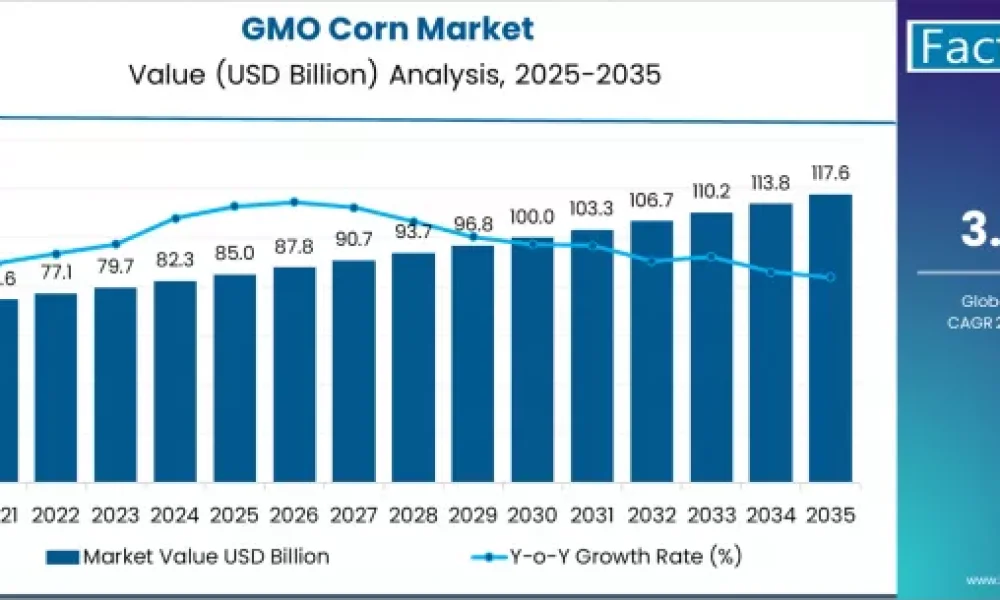
The global GMO corn market is on a trajectory of steady growth from 2025 to 2035, driven by increasing adoption of genetically modified seed technology and the demand for higher agricultural productivity. Valued at USD 85 billion in 2025, the market is projected to reach approximately USD 118 billion by 2035, growing at a CAGR of 3.3%. GMO corn plays a pivotal role in livestock feed production, human food processing, and industrial applications, offering enhanced crop protection, yield optimization, and resistance traits.
Market Drivers and Growth Dynamics
The primary growth drivers include herbicide tolerance, insect resistance, and stacked trait technologies. Herbicide tolerance leads the market with a 44% share, enabling farmers to manage weeds efficiently and reduce crop losses. Insect resistance traits, accounting for 37% of the market, protect crops against pests using Bt protein systems, enhancing yield stability. Stacked trait combinations, integrating multiple benefits, represent 19% of the market and are gaining traction among farmers seeking comprehensive solutions for pest and weed management.
Feed applications dominate demand, representing 52% of the total market, fueled by the growing livestock industry and the need for nutritionally optimized, high-yield corn. Food-grade applications contribute 35–38% of revenue, reflecting the increasing incorporation of GMO corn in human diets and processed foods. Industrial and specialty uses, including ethanol production and bio-based materials, provide additional growth avenues.
To access the complete data tables and in-depth insights, request a Discount On The Report here: https://www.factmr.com/connectus/sample?flag=S&rep_id=424
Regional Insights
North America, Western Europe, and East Asia are key growth regions, leveraging advanced agricultural infrastructure, regulatory support, and high adoption rates. Emerging economies are increasingly embracing GMO corn to address food security and enhance agricultural productivity. Market expansion is further supported by trait stacking, precision agriculture integration, and sustainable farming initiatives.
Technology Trends and Innovations
Technological advancements, including next-generation herbicide tolerance, climate-adaptive traits, and precision agriculture compatibility, are shaping market evolution. Advanced stacked traits enable farmers to simultaneously manage weeds, pests, and environmental stressors, enhancing crop resilience and operational efficiency. Digital agronomy platforms are facilitating real-time monitoring, yield forecasting, and resource optimization, strengthening the value proposition of GMO corn.
Challenges and Strategic Implications
Despite robust growth, the market faces regulatory complexities, consumer acceptance issues, and regional variations in trait adoption. Companies must navigate diverse approval processes, ensure compliance with international standards, and engage in stewardship programs to maintain sustainable practices. Clear communication of yield benefits, cost-effectiveness, and environmental safety is critical to expanding adoption.
Opportunities for Stakeholders
For seed manufacturers and biotechnology firms: focus on developing advanced trait solutions, integrated agronomic support, and global regulatory compliance strategies.
For farmers and agribusinesses: adopt multi-trait seeds to optimize yield, reduce crop losses, and integrate digital farming tools for operational efficiency.
For investors: the GMO corn sector offers a resilient and expanding market, driven by consistent demand in feed, food, and industrial applications, with significant opportunities for technological innovation and regional expansion.
Outlook Summary
From 2025 to 2035, the global GMO corn market is expected to grow steadily, driven by the demand for high-yield, resilient crops, advanced trait technologies, and integration with precision farming practices. With herbicide tolerance and feed applications leading the market, stakeholders are positioned to capitalize on opportunities in established and emerging regions, while navigating regulatory and consumer challenges to achieve sustainable growth in the agricultural biotechnology sector.
Have a specific Requirements and Need Assistant on Report Pricing or Limited Budget please contact us – [email protected]
About Fact.MR
Fact.MR is a global market research and consulting firm, trusted by Fortune 500 companies and emerging businesses for reliable insights and strategic intelligence. With a presence across the U.S., UK, India, and Dubai, we deliver data-driven research and tailored consulting solutions across 30+ industries and 1,000+ markets. Backed by deep expertise and advanced analytics, Fact.MR helps organizations uncover opportunities, reduce risks, and make informed decisions for sustainable growth.



