
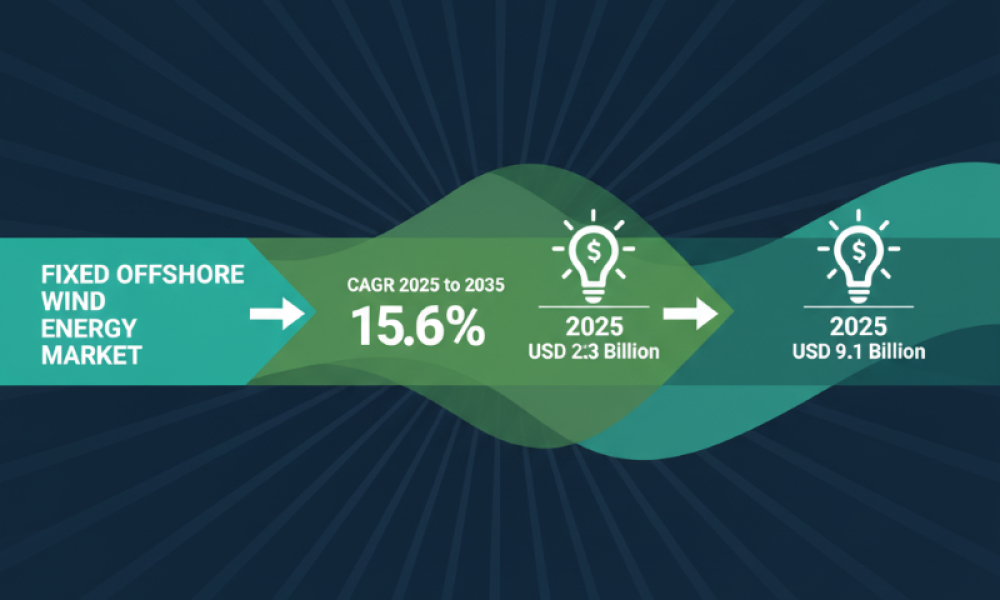
The global fixed offshore wind energy market is poised for substantial growth, with projections indicating an increase from USD 22.3 billion in 2025 to USD 95.1 billion by 2035, driven by technological innovation, increasing renewable energy demand, and favorable governmental policies. With a compound annual growth rate (CAGR) of 15.6%, this sector is expected to expand rapidly, benefiting from advancements in turbine design, improved installation practices, and grid integration strategies.
Unlock detailed analytics – Request your personalized report now! https://www.futuremarketinsights.com/reports/sample/rep-gb-24973
Driving Factors Behind Market Growth
The fixed offshore wind energy market is gaining momentum due to several key factors. Notably, the growing demand for renewable energy and the pressing need to reduce global carbon emissions are pushing countries to invest heavily in offshore wind infrastructure. Enhanced government policies and decarbonization targets have also played a pivotal role in encouraging market expansion, particularly in regions with favorable wind conditions such as Europe, North America, and Asia-Pacific.
Strategic investments in large-scale offshore wind projects and technological advancements in turbine design have made offshore wind energy more competitive in terms of cost per megawatt. Furthermore, the ongoing development of high-capacity turbines capable of generating substantial energy with fewer installations has accelerated project timelines and reduced operational costs.
Segmental Insights and Key Growth Areas
The fixed offshore wind energy market is segmented into various categories, including turbine rating, axis, components, depth, and regional markets. Among these, the turbine rating segment, particularly the >5 ≤ 8 MW category, is expected to dominate, accounting for 33.8% of the market share in 2025. This segment strikes a balance between energy output and installation feasibility, making it ideal for large-scale offshore wind projects.
Another significant trend is the dominance of horizontal-axis turbines, which are projected to capture 82.4% of the market in 2025. Their proven reliability, scalability, and efficiency in diverse wind conditions have made them the preferred choice for offshore developers. Additionally, the blades segment is forecast to contribute 47.1% of the market’s revenue in 2025, driven by innovations in materials and aerodynamic designs that improve energy capture and reduce maintenance costs.
Regional Growth and Competitive Landscape
The fixed offshore wind energy market is expanding rapidly across multiple regions. The Asia-Pacific region, particularly China and India, is expected to see robust growth due to supportive government policies, increasing energy demand, and favorable coastal conditions. China leads the pack with a forecasted CAGR of 21.1%, followed by India at 19.5%.
Europe remains a significant player in the market, with countries like Germany, France, and the United Kingdom investing heavily in offshore wind farms. The United States, while experiencing slower adoption compared to Asia and Europe, is seeing steady growth in offshore wind capacity, driven by state-level renewable energy mandates and federal incentives.
Key players in the market include Siemens Gamesa Renewable Energy, Vestas, General Electric, Prysmian Group, and Nexans. These companies are competing to deliver high-performance turbines and cables that can withstand the harsh marine environment, while also minimizing operational downtime.
Download Brochure for Full Insights: https://www.futuremarketinsights.com/reports/brochure/rep-gb-24973
Opportunities and Challenges
While the market faces challenges such as high initial capital investment, logistical complexities, and regulatory hurdles, these are being mitigated by continuous technological advancements. Innovations in turbine design, construction techniques, and digital monitoring systems are improving the cost-effectiveness and reliability of offshore wind farms, enhancing their economic viability.
The future of the fixed offshore wind energy market looks promising, with new technologies such as floating wind farms and hybrid power solutions driving innovation. Furthermore, the integration of offshore wind into national energy grids is enhancing energy distribution, making wind energy more accessible and reliable.
Conclusion
The fixed offshore wind energy market is on track for significant expansion over the next decade, driven by technological advancements, increased investments in infrastructure, and supportive government policies. As offshore wind continues to play a key role in global renewable energy strategies, the industry is expected to generate substantial revenue and contribute significantly to global clean energy goals.
About Future Market Insights (FMI)
Future Market Insights, Inc. (ESOMAR certified, recipient of the Stevie Award, and a member of the Greater New York Chamber of Commerce) offers profound insights into the driving factors that are boosting demand in the market. FMI stands as the leading global provider of market intelligence, advisory services, consulting, and events for the Packaging, Food and Beverage, Consumer Technology, Healthcare, Industrial, and Chemicals markets. With a vast team of over 400 analysts worldwide, FMI provides global, regional, and local expertise on diverse domains and industry trends across more than 110 countries.



