
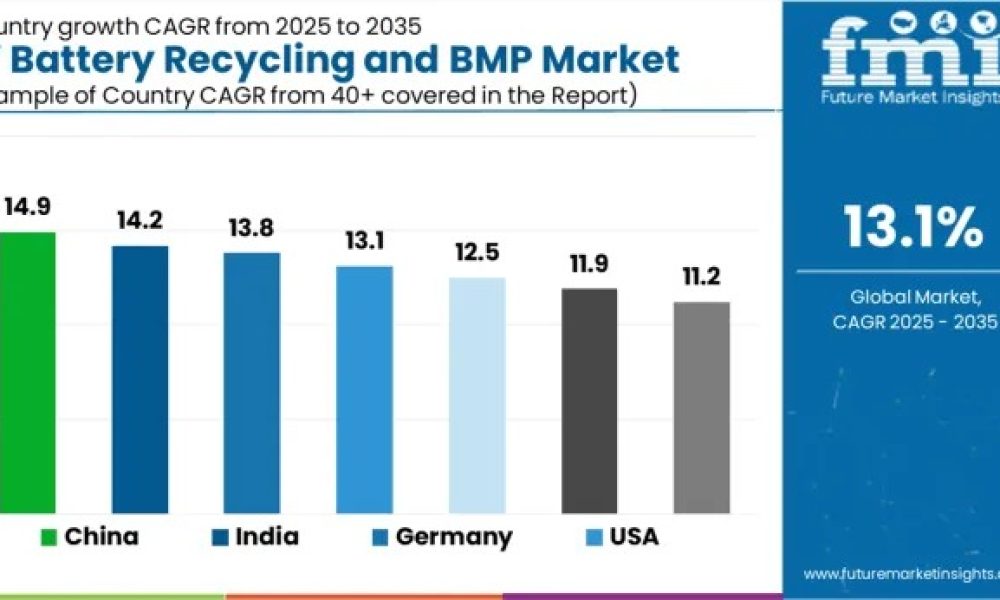
The global EV battery recycling and black mass processing market is entering a transformative growth phase, driven by accelerating electric vehicle (EV) adoption, resource security concerns, and stringent regulatory mandates. Valued at USD 8.6 billion in 2025, the market is projected to reach USD 29.7 billion by 2035, representing an absolute increase of USD 21.1 billion and a CAGR of 13.1%. Over the decade, the market is expected to nearly triple in size, reflecting the strategic importance of secondary battery materials in the evolving EV ecosystem.
Early Adoption and Market Foundation (2020–2024)
From 2020 to 2024, the market grew from USD 2.5 billion to USD 7.1 billion, fueled by rising EV sales and increasing awareness of critical material scarcity. During this period, early commercial recycling facilities and pilot-scale black mass processing projects laid the groundwork for enterprise-level adoption. Battery manufacturers and automotive OEMs were primary drivers, while specialized recycling companies refined hydrometallurgical and pyrometallurgical processes to enable scalable material recovery. These early efforts established the framework for the next decade’s expansion.
Growth Phases: Scaling and Integration (2025–2035)
Between 2025 and 2030, the market is forecast to expand from USD 8.6 billion to USD 16.3 billion, driven by surging volumes of end-of-life EV batteries and regulatory requirements for recycling in key regions including the EU, US, and Asia-Pacific. Automakers are increasingly seeking sustainable closed-loop supply chains to mitigate critical material risks and reduce dependence on primary mining.
From 2030 to 2035, the market is expected to reach USD 29.7 billion, propelled by waves of EV battery retirements, advancements in black mass processing technologies, and the emergence of integrated recycling ecosystems optimized for diverse battery chemistries. Innovations in direct cathode recycling, closed-loop material recovery, and process automation will be key enablers during this consolidation phase. Regulatory harmonization and minimum recycled content mandates will further solidify demand.
Get access to comprehensive data tables and detailed market insights — request your sample report today!
Why the Market is Expanding Rapidly
Critical Material Scarcity and Cost Pressures
Lithium, cobalt, nickel, and manganese account for up to 70% of battery manufacturing costs. Recovery through black mass processing mitigates exposure to price volatility, geopolitical supply risks, and resource shortages. Manufacturers increasingly recognize recycled materials as a strategic asset, supporting both cost reduction and long-term supply security.
Regulatory Mandates Drive Adoption
Global regulations are accelerating adoption. The EU Battery Regulation mandates 70% recycling efficiency by 2030, while China, the US, and other major markets are introducing minimum recycled content requirements. These frameworks are incentivizing EV manufacturers and recyclers to invest in scalable, compliant black mass processing technologies.
EV Battery Retirement Wave
The surge in EV production from 2018–2024 is generating an unprecedented volume of end-of-life batteries. First-generation EV batteries are now reaching retirement, while manufacturing scrap and production waste continue to grow with expanded production capacity. This creates a substantial feedstock pipeline for recycling facilities and advanced material recovery operations.
Market Segmentation Insights
By Recycling Process:
- Hydrometallurgical Processing: Dominant at 48% market share in 2025, offering high recovery efficiency (>95%) for lithium, cobalt, and nickel, producing battery-grade materials suitable for reintegration into new battery manufacturing.
- Pyrometallurgical Processing & Direct Recycling: Complementary roles, with specific applications in high-nickel or emerging solid-state batteries.
By Battery Chemistry:
- NMC Batteries: Lead processing at 52% share, due to high critical material content and widespread adoption in EVs.
- LFP Batteries: 28% share, with growing demand from entry-level EVs and energy storage systems.
- Other Chemistries (NCA, Solid-State): 20%, requiring specialized recovery technologies.
By Application of Recovered Black Mass:
- Cathode Precursor Manufacturing: Leading application at 55% share, enabling direct closed-loop integration into battery production.
- Lithium Carbonate/Hydroxide Production: 27%, critical for electrolyte and cathode applications.
- Industrial & Chemical Applications: 18%, including non-battery material recovery and specialty chemicals.
Key Drivers, Trends, and Technological Innovations
Advanced Processing Technologies
Recycling companies are deploying sophisticated hydrometallurgical leaching and solvent extraction systems, with precise pH control, multi-stage purification, and selective extraction agents to maximize recovery while minimizing environmental impact. Energy efficiency, renewable energy integration, and elimination of harmful byproducts make modern recycling more sustainable than primary mining.
Integration with Battery Manufacturing
Leading recycling facilities offer direct integration with battery supply chains, providing material specification matching, quality assurance, and logistics support. This enables battery manufacturers to incorporate recycled content into cathode precursors seamlessly, ensuring compliance and cost optimization.
Automation and Quality Control
Advanced robotics, AI-based monitoring, and machine learning optimize disassembly, material separation, and purification. Real-time analytics ensure consistent product quality, while automated sorting and packaging systems enhance throughput and safety, enabling commercial-scale operations with reduced labor and operational costs.
Regional Market Dynamics
- China (14.9% CAGR): CATL and GEM Co. lead with large-scale recycling infrastructure and black mass processing capabilities. Strong government support for circular economy and material security drives adoption.
- India (14.2% CAGR): Subsidies and national circular economy initiatives accelerate development of domestic recycling plants and integrated systems.
- Germany (13.8% CAGR): EU Battery Regulation mandates high recycling quotas; automakers invest in integrated processing systems for compliance and supply chain resilience.
- USA (13.1% CAGR): DOE grants and IRA incentives support Li-ion recycling hubs, commercial-scale material recovery, and domestic supply chain independence.
- South Korea (12.5% CAGR): LG and SK investments in black mass recovery create advanced processing and closed-loop supply systems.
- France (11.9% CAGR): Umicore leads in cathode precursor production, supported by EU-backed supply chain initiatives.
- Japan (11.2% CAGR): Panasonic-led recycling initiatives enable domestic EV battery recovery and integrated processing systems.
Competitive Landscape
The EV battery recycling and black mass processing market is highly competitive, with players focusing on advanced hydrometallurgical processing, integrated supply chain solutions, and automation platforms. Key market leaders include:
- GEM Co., Ltd. – 2025 market leader with 12% share, offering commercial-scale hydrometallurgical processing and comprehensive recycling infrastructure.
- Umicore – Leading European cathode precursor supplier.
- CATL – Integrated recycling and battery manufacturing systems.
- Li-Cycle – Innovative black mass recovery technologies.
- Redwood Materials – Domestic US recycling and material recovery solutions.
- Glencore, Huayou Cobalt, Fortum, Retriev Technologies, Stena Recycling, Ecobat – Key players providing regional or specialized processing capabilities.
Outlook
As EV adoption accelerates globally, the EV battery recycling and black mass processing market will play a critical role in sustainable material supply, cost management, and circular economy implementation. With regulatory mandates, technological innovation, and integrated supply chain strategies driving adoption, the market is positioned for robust growth, evolving from early pilot operations into a global, commercial-scale industry, securing the future of EV material sustainability.
About Future Market Insights (FMI)
Future Market Insights, Inc. (FMI) is an ESOMAR-certified, ISO 9001:2015 market research and consulting organization, trusted by Fortune 500 clients and global enterprises. With operations in the U.S., UK, India, and Dubai, FMI provides data-backed insights and strategic intelligence across 30+ industries and 1200 markets worldwide.



