
Strong Demand Trajectory Backed by Automation Investments
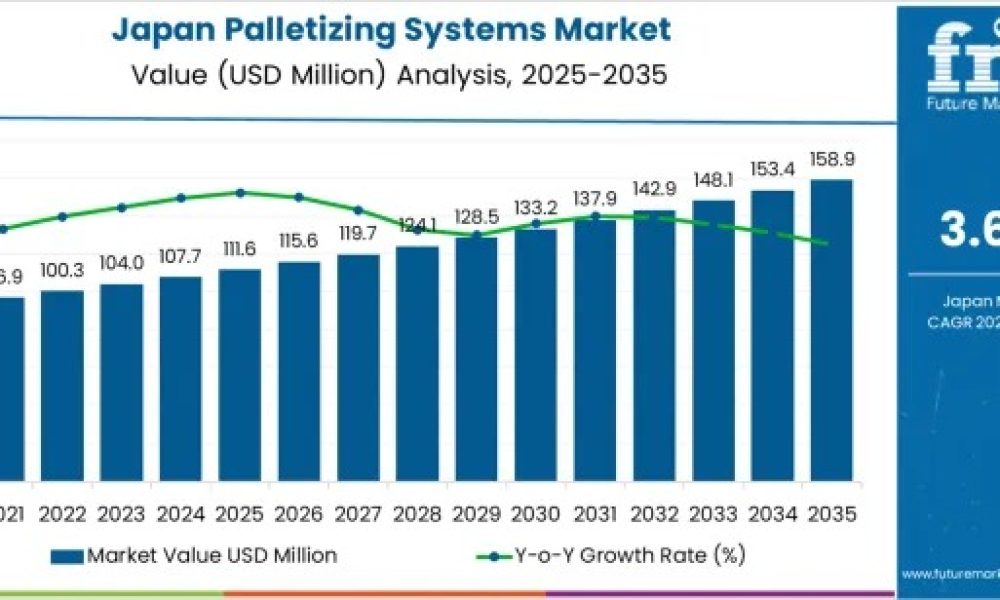
The Demand for Palletizing Systems in Japan is strengthening as manufacturers and logistics operators accelerate automation to counter labor constraints and rising fulfillment pressures. Valued at USD 111.6 million in 2025, the market is projected to reach USD 158.9 million by 2035, advancing at a 3.6% CAGR. This expansion reflects Japan’s ongoing modernization across food processing, consumer goods, chemicals, and logistics sectors—industries where palletizing systems ensure speed, consistency, and load stability.
As production volumes grow and SKU diversity expands, manufacturers are prioritizing palletizing solutions that enhance stacking accuracy, improve throughput, and reduce human intervention. Both robotic palletizers and conventional models maintain strong relevance as facilities balance footprint, flexibility, and operating costs.
Automation Momentum Rising Across Industries
Subscribe for Year-Round Insights → Stay ahead with quarterly and annual data updates:
https://www.futuremarketinsights.com/reports/sample/rep-gb-28957
Japan’s shift toward smart manufacturing and logistics efficiency continues to accelerate. Demand for palletizing systems rose from USD 93.5 million in earlier years to USD 111.6 million in 2025, with steady annual increases leading to USD 133.2 million in 2030 and USD 158.9 million by 2035. This consistent growth reflects predictable replacement cycles, e-commerce expansion, warehouse automation, and deeper integration of Industry 4.0 technologies.
The early forecast period (2025–2030) is shaped by volume-driven adoption as manufacturers replace manual stacking with automated units. From 2030 onward, value-driven upgrades dominate as factories integrate robotics, multi-format palletizing, vision systems, and IoT capabilities, improving uptime and load precision.
Key Market Drivers Strengthening Demand
- Labor Shortages Intensifying Automation Needs
Japan’s aging workforce and shrinking labor pool significantly influence automation decisions. Palletizing systems reduce operator dependency while ensuring predictable performance despite staffing challenges.
- E-Commerce Expansion Driving High Throughput Requirements
Rising parcel volumes push logistics companies to adopt robotic palletizers capable of handling mixed SKU loads, optimizing warehouse productivity.
- Heightened Need for Space-Efficient Machinery
Compact factories and urban industrial units require palletizing systems with small footprints, low vibration, and seamless integration with existing conveyor lines.
- Demand for Product Flexibility and Fast Changeovers
With consumer preferences shifting toward diverse packaging formats, flexible palletizers support multi-format and frequent batch changeovers.
Floor-Level Palletizers Lead Due to Versatility
Floor-level palletizers hold 26% of Japan’s market, driven by their ease of installation, lower structural requirements, and reliable daily performance. These systems are particularly suited for small and mid-sized facilities with mixed case sizes, helping maintain pallet stability without complex control systems.
Case Palletizers Hold the Largest Application Share
Case palletizers capture 36.6% of Japan’s application-driven demand. Widespread use of boxed goods across food, beverage, consumer goods, and industrial items makes case stacking essential for load efficiency, workflow continuity, and shipment accuracy.
Regional Demand Shows Consistent, Multi-Sector Growth
- Kyushu & Okinawa (4.5% CAGR): Strongest growth, led by food processing and pharma packaging.
- Kanto (4.1% CAGR): Tokyo’s dense industrial base drives automation adoption.
- Kinki (3.6% CAGR): Expanding robotics integration across manufacturing hubs.
- Chubu (3.2% CAGR): Automotive and electronics sectors lead adoption.
- Tohoku (2.8% CAGR): Gradual modernization across production lines.
- Rest of Japan (2.7% CAGR): Steady growth across rural and semi-urban industries.
Competitive Landscape: Global and Domestic Leaders
Key players shaping Japan’s palletizing systems market include ABB Flexible Automation Inc, KUKA Roboter GmbH, ABC Packaging, Intelligrated Inc, and Cermex Group. Domestic manufacturers like Fuji Robotics and Murata Machinery offer systems tailored to Japan’s compact facilities, providing service reliability and equipment designed for local manufacturing needs.
Get data that aligns with your strategic priorities — ask for report customization today:
https://www.futuremarketinsights.com/customization-available/rep-gb-28957
Have a specific Requirements and Need Assistant on Report Pricing or Limited Budget please contact us – [email protected]
About Future Market Insights (FMI)
Future Market Insights, Inc. (FMI) is an ESOMAR-certified, ISO 9001:2015 market research and consulting organization, trusted by Fortune 500 clients and global enterprises. With operations in the U.S., UK, India, and Dubai, FMI provides data-backed insights and strategic intelligence across 30+ industries and 1200 markets worldwide.
Contact Us:
Future Market Insights Inc.
Christiana Corporate, 200 Continental Drive,
Suite 401, Newark, Delaware – 19713, USA
T: +1-347-918-3531



