
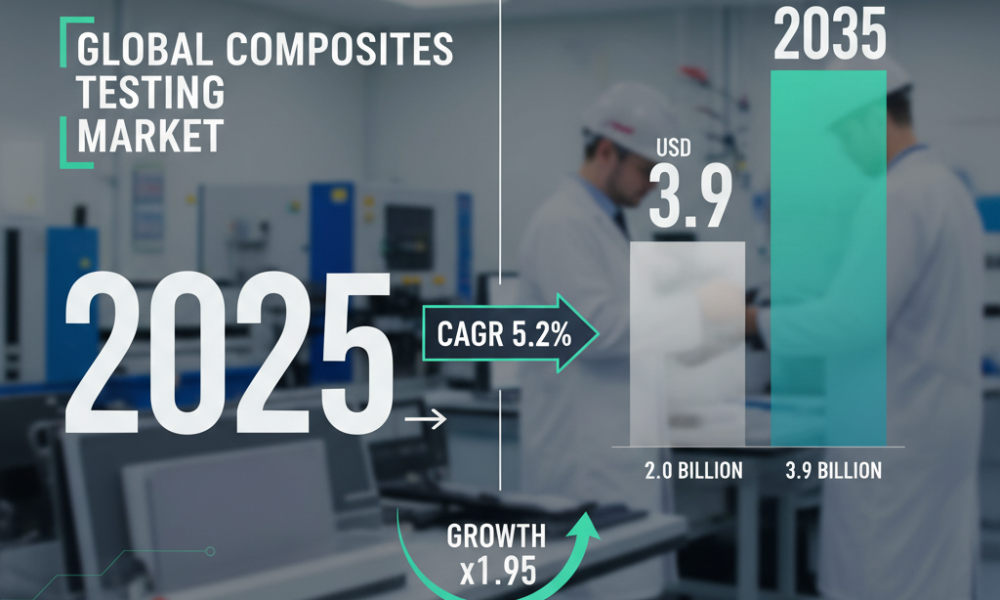
The global composites testing market is projected to grow from USD 2.0 billion in 2025 to USD 3.9 billion by 2035, reflecting a CAGR of 5.2%, according to new research by Fact.MR. Market expansion is being fueled by rising adoption of lightweight, high-strength composite materials in aerospace, automotive, renewable energy, and infrastructure sectors, alongside advancements in non-destructive testing (NDT), AI analytics, and digital twin technology.
Technological Advancements Driving Market Growth
The rapid integration of advanced testing methods, including ultrasonic, thermographic, and AI-enabled inspections, is improving test precision while maintaining the integrity of composite structures. Digital twins and predictive analytics are transforming quality control, enabling real-time data monitoring and predictive maintenance for manufacturers across aerospace, automotive, and wind energy industries.
The aerospace sector is a significant driver, with carbon fiber-reinforced polymers increasingly used in aircraft structures to improve fuel efficiency, performance, and safety. Similarly, automotive manufacturers are leveraging composites to meet stringent emission norms and enhance crashworthiness, further boosting demand for comprehensive testing protocols.
To access the complete data tables and in-depth insights, request a Discount On The Report here: https://www.factmr.com/connectus/sample?flag=S&rep_id=6405
Market Dynamics: Opportunities and Challenges
Opportunities:
Growth of renewable energy, particularly wind turbines, where composites form the backbone of blades and critical components.
Expansion of infrastructure in emerging economies driving demand for composite materials in bridges, pipelines, and buildings.
Adoption of digital testing platforms and AI-based analysis for faster, more scalable testing solutions.
Challenges:
High equipment costs for X-ray CT scanners, thermographic cameras, and ultrasonic devices limit access for SMEs.
Global shortage of skilled testing engineers and technicians slows adoption of advanced techniques.
Inconsistent international standards and cybersecurity risks in digital testing platforms present barriers to global scalability.
Purchase Full Report for Detailed Insights
For access to full forecasts, regional breakouts, company share analysis, and emerging trend assessments, you can purchase the complete report here: https://www.factmr.com/checkout/6405
Stakeholder Insights
The composites testing value chain spans material producers, technology providers, regulators, investors, and end-users, each influencing market growth.
Material producers drive demand for testing through new material designs and structural layouts, ensuring compliance with performance and safety standards.
Technology providers supply advanced NDT equipment, AI-driven software, and integrated platforms. Strategic partnerships between technology firms and test labs are enabling cost-effective adoption and improved operational efficiency.
Regulatory bodies such as ISO and ASTM enforce compliance and standardization, fostering trust but occasionally delaying new material commercialization due to varying global standards.
Investors and venture capitalists are increasingly funding AI-enabled inspection software, robotic NDT systems, and cloud-based testing labs.
End-users, including aerospace OEMs, automotive manufacturers, and wind turbine producers, drive adoption by demanding precise, reliable, and regulatory-compliant testing solutions.
Market Segmentation
By Testing Method:
Destructive testing is poised for high growth with an 8.5% CAGR from 2025 to 2035. It evaluates real-world mechanical and structural performance under tensile, impact, compression, and fatigue loads, essential for safety-critical industries like aerospace, automotive, and construction.
Non-destructive testing (NDT) remains critical for continuous monitoring without compromising material integrity, increasingly enhanced by AI and predictive analytics.
By Product Type:
Ceramic matrix composites (CMCs) are forecast to grow at a 10.3% CAGR, driven by high-temperature resistance, wear-corrosion protection, and structural toughness. Applications include turbine blades, jet engine components, heat shields, and high-temperature braking systems.
Other product types include continuous fiber composites, discontinuous fiber composites, and polymer matrix composites, which are widely applied across aerospace, automotive, and energy industries.
By End-Use Industry:
Aerospace & Defense: High adoption of composites for aircraft and spacecraft structures ensures stringent testing requirements.
Transportation: Automotive adoption of lightweight composites drives safety and crashworthiness testing.
Wind Energy: Turbine blade manufacturing creates demand for rigorous structural testing.
Building & Construction: Urbanization and infrastructure development increase demand for tested composite materials.
Others: Sporting goods, electrical & electronics also contribute steadily to market growth.
Regional Insights
U.S.: CAGR 5.5%; growth driven by aerospace, defense, automotive, and wind energy sectors with strong regulatory standards and technological adoption.
UK: CAGR 5.0%; aerospace and automotive composites adoption combined with NDT popularity.
France: CAGR 4.8%; expansion due to aerospace and automotive demand, wind energy growth.
Germany: CAGR 5.3%; composites used extensively in automotive and aerospace industries for fuel efficiency and performance.
Italy: CAGR 4.5%; automotive and aerospace drive composite testing adoption.
South Korea: CAGR 5.6%; automotive, aerospace, and renewable energy sectors are key growth drivers.
Japan: CAGR 5.2%; aerospace, automotive, and wind energy drive steady adoption.
China: CAGR 6.0%; rapid industrialization, urbanization, and adoption in automotive, aerospace, and wind energy.
Australia & New Zealand: CAGR 4.7%; aerospace, defense, and renewable energy sectors dominate demand.
Leading Market Players
| Company | Market Share (%) | Key Focus |
|---|---|---|
| Element Materials Technology | 18–22% | Destructive & non-destructive testing; global lab network; safety-critical composites |
| Exova Group | 20–25% | Comprehensive testing services across aerospace, automotive, energy |
| Intertek Group | 15–20% | Advanced NDT, global footprint, aerospace & automotive expertise |
| Mistras Group Inc. | 12–15% | NDT inspection services; aerospace, defense, energy focus |
| Westmoreland Mechanical Testing & Research Inc. | 5–7% | High-precision mechanical testing for aerospace & defense |
| Others | 20–25% | Matrix Composites, Instron, ETIM Laboratory, Henkel AG & Co., Key Composites |
Strategic Insights
Innovation and digital transformation are crucial for growth; AI, machine learning, and automation are reshaping the market.
Collaboration between technology providers, labs, regulators, and end-users ensures quality, compliance, and faster commercialization of new composite materials.
Subscription or pay-per-use models for testing services help SMEs access advanced solutions.
Regulatory alignment and sustainable testing practices are becoming key competitive differentiators.
To View Related Report :
ReGen Composites Market
Outlook
The global composites testing market is set for sustainable growth through 2035, driven by:
Rising adoption of composites in aerospace, automotive, and renewable energy.
Technological advancements in NDT, AI, and digital twins.
Regulatory compliance and harmonization driving global adoption.
Expansion in emerging economies for infrastructure and energy projects.
About Fact.MR
Fact.MR is a leading provider of syndicated and custom market research reports, delivering actionable insights and competitive intelligence across global industries. The company helps businesses make informed decisions with data-driven market forecasts and analysis



