
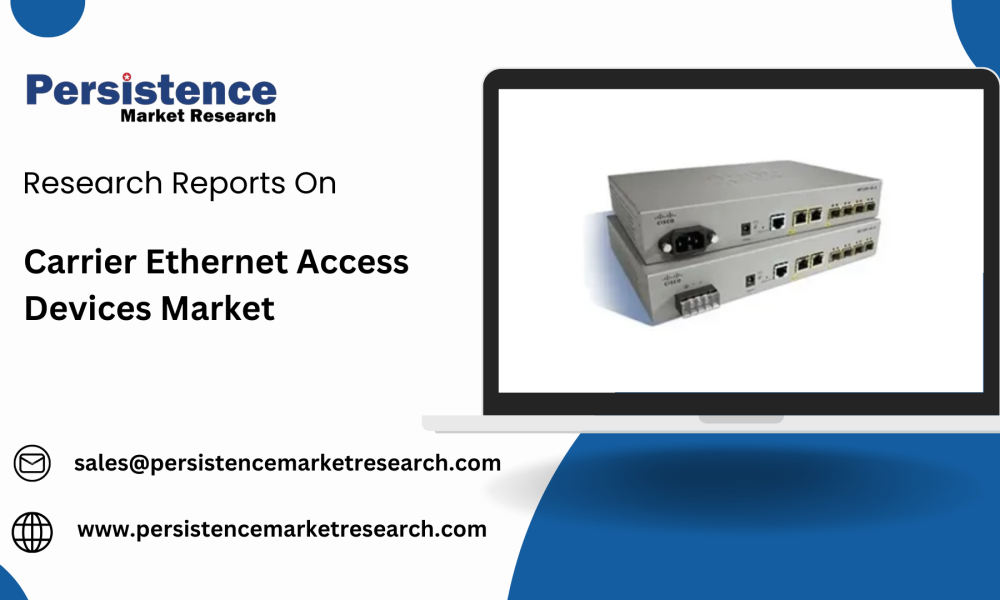
The global Carrier Ethernet Access Devices (CEAD) market is undergoing a steady yet critical transformation as the demand for high-capacity, scalable, and cost-effective connectivity continues to surge across industries. According to recent forecasts, the global carrier Ethernet access devices market is projected to expand at a compound annual growth rate (CAGR) of 3.8%, increasing from an estimated US$17.5 billion in 2024 to US$22.8 billion by the end of 2031. This steady growth underscores the importance of Ethernet-based networking solutions in enabling digital transformation, cloud adoption, and next-generation service delivery.
Understanding Carrier Ethernet Access Devices
Carrier Ethernet Access Devices (CEADs) are specialized network components that provide Ethernet-based services to customers over carrier networks. They enable service providers to extend Ethernet connectivity beyond metro and core networks into access networks, ensuring high reliability, scalability, and quality of service (QoS).
These devices typically reside at the customer premises, central offices, or network edges, serving as critical enablers for services like virtual private LAN service (VPLS), Ethernet private line (EPL), and Ethernet virtual private line (EVPL). CEADs are integral to carrier-grade Ethernet networks, offering advanced features such as traffic management, fault monitoring, synchronization, and security.
Market Size and Growth Overview
- Market Size (2024E): US$17.5 Billion
- Projected Market Value (2031F): US$22.8 Billion
- Forecast CAGR (2024–2031): 3.8%
- Historical CAGR (2018–2023): 1.4%
While the historical growth of the CEAD market has been moderate, the accelerating digitalization of enterprises, deployment of 5G infrastructure, and the expansion of cloud-based services are expected to push growth momentum higher in the years ahead.
Key Market Drivers
- Growing Demand for High-Speed and Reliable Connectivity
With the exponential rise in data traffic across mobile and fixed networks, there is an increasing need for high-speed Ethernet access solutions. Enterprises, especially in the IT, BFSI, healthcare, and manufacturing sectors, are demanding reliable, low-latency connectivity to support bandwidth-intensive applications such as video conferencing, IoT analytics, and remote operations.
CEADs play a pivotal role in delivering these capabilities, helping service providers ensure performance guarantees and meet service-level agreements (SLAs).
- Expansion of 5G and Fiber Network Infrastructure
The global rollout of 5G networks and the growing adoption of fiber-to-the-premises (FTTP) are boosting the need for robust backhaul solutions. Carrier Ethernet access devices facilitate efficient backhaul connections for both mobile and fixed broadband networks, ensuring seamless traffic aggregation and transport.
Moreover, telecom operators are increasingly adopting Ethernet-based transport over traditional TDM systems to achieve scalability and cost efficiency—further driving demand for CEADs.
- Cloud and Data Center Interconnectivity
The rise of cloud computing and hybrid IT architectures has made data center interconnectivity a mission-critical function. CEADs enable secure, high-performance Ethernet connections between enterprise data centers and cloud providers, ensuring smooth workload migration and business continuity.
This trend is particularly evident in sectors such as financial services and e-commerce, where real-time data access and low latency are crucial for operations.
- Migration from Legacy Networks
As enterprises and telecom operators move away from legacy SDH/SONET and ATM infrastructures, Ethernet-based networks are emerging as the preferred choice for scalability and cost-efficiency. CEADs serve as essential tools for facilitating this migration, offering advanced features such as carrier-class performance monitoring, OAM capabilities, and network virtualization support.
- Increasing Demand for Edge Computing
The growing adoption of edge computing—driven by IoT, autonomous systems, and real-time analytics—is creating new opportunities for CEAD deployment. These devices support efficient edge-to-cloud communication, enabling faster processing and data transmission closer to end-users or devices.
Market Challenges
Despite steady growth prospects, the CEAD market faces several challenges that could affect expansion over the forecast period:
- High Initial Deployment Costs
Although Ethernet technology is cost-effective in the long term, initial capital expenditures for upgrading access networks and integrating CEADs remain high. Smaller service providers often struggle to justify these investments without immediate returns.
- Compatibility and Integration Issues
Integrating CEADs into multi-vendor and legacy network environments poses challenges related to interoperability, configuration, and management. This necessitates ongoing standardization efforts and investments in software-defined networking (SDN) capabilities.
- Cybersecurity Concerns
As CEADs are often located at the edge of the network, they can become potential targets for cyberattacks. Ensuring robust encryption, intrusion detection, and threat management mechanisms is crucial to maintaining trust and reliability.
- Limited Awareness in Developing Regions
In emerging economies, the adoption of carrier Ethernet services remains limited due to low awareness and the dominance of traditional connectivity models. Educating enterprises about the benefits of Ethernet-based services remains a critical step toward market expansion.
Elevate your business strategy with comprehensive market data. Request a sample report now: https://www.persistencemarketresearch.com/samples/34279
Key Market Trends
- Integration with Software-Defined Networking (SDN) and Network Function Virtualization (NFV)
The increasing adoption of SDN and NFV technologies is reshaping how CEADs are deployed and managed. By decoupling network control from hardware, SDN enables centralized management, automation, and dynamic service provisioning—making networks more agile and programmable.
Modern CEADs are being integrated with SDN controllers, allowing for real-time traffic optimization and service orchestration across distributed environments.
- Growing Popularity of Managed Ethernet Services
Service providers are leveraging CEADs to offer managed Ethernet services to enterprises that seek scalable connectivity without the complexities of in-house network management. This trend is gaining traction among SMEs that prefer operational expenditure (OPEX)-based models over large capital investments.
- Shift Toward Energy-Efficient and Compact Designs
As sustainability becomes a strategic priority, manufacturers are developing energy-efficient CEADs with reduced power consumption and compact form factors. These innovations help carriers lower their operational costs and carbon footprint.
- Ethernet Over Fiber and Wireless Backhaul
The convergence of fiber-optic Ethernet and wireless backhaul technologies is expanding the application range of CEADs. Hybrid solutions that combine fiber and wireless access are gaining popularity in rural and hard-to-reach areas, ensuring connectivity without compromising speed or reliability.
- Network Automation and AI Integration
Automation and AI-driven analytics are being integrated into CEADs for predictive maintenance, intelligent fault management, and dynamic bandwidth allocation. This shift toward self-optimizing networks improves uptime and enhances the user experience.
Regional Insights
North America
North America dominates the carrier Ethernet access devices market, driven by robust fiber deployment, 5G rollouts, and the presence of major telecom operators such as AT&T, Verizon, and Comcast. The region’s focus on enterprise cloud connectivity and low-latency data exchange supports continuous market expansion.
Europe
Europe’s CEAD market is buoyed by smart city projects, IoT integration, and regulatory initiatives promoting high-speed broadband access. Countries like the UK, Germany, and France are witnessing strong adoption due to ongoing digital infrastructure modernization.
Asia-Pacific
Asia-Pacific is the fastest-growing regional market, fueled by rapid urbanization, digitalization, and expanding telecom infrastructure in countries like China, India, and South Korea. The rise of data centers and increasing 5G investments are creating significant demand for CEADs.
Middle East & Africa
The Middle East is seeing growth in CEAD adoption as part of national broadband initiatives and smart government programs. Meanwhile, in Africa, the expansion of fiber-optic backbones and mobile broadband networks is expected to gradually open opportunities for Ethernet access device deployment.
Latin America
Latin America’s CEAD market is experiencing gradual growth, with increasing focus on enterprise connectivity, data center expansion, and carrier network upgrades. Countries like Brazil and Mexico are at the forefront of this transformation.
Competitive Landscape
The carrier Ethernet access devices market is moderately consolidated, with several key players focusing on technological innovation, mergers, and strategic partnerships to strengthen their global footprint. Leading companies include:
- Cisco Systems, Inc.
- ADVA Optical Networking SE
- RAD Data Communications Ltd.
- Nokia Corporation
- Juniper Networks, Inc.
- Ciena Corporation
- Huawei Technologies Co., Ltd.
- ZTE Corporation
- Mellanox Technologies Ltd.
- Allied Telesis, Inc.
These companies are investing in SDN/NFV integration, AI-based analytics, and 5G-ready Ethernet devices to stay ahead in a competitive environment. Strategic collaborations with telecom operators are also helping them expand service offerings and geographic reach.
Future Outlook: Toward Smarter, Software-Driven Networks
The future of the carrier Ethernet access devices market lies in network intelligence, automation, and convergence. As enterprises continue to demand flexible and high-capacity connections to support cloud, IoT, and edge applications, CEADs will evolve into multi-service access platforms.
The ongoing transition to software-defined and virtualized architectures will further enable CEADs to operate as part of dynamic, programmable network ecosystems, enhancing efficiency and reducing operational complexity.
Moreover, as 5G, AI, and edge computing continue to mature, the demand for low-latency and high-bandwidth Ethernet access will only intensify—solidifying CEADs as a cornerstone of global digital infrastructure.
Conclusion
The Carrier Ethernet Access Devices market stands at the crossroads of connectivity evolution, bridging the gap between legacy systems and next-generation digital networks. With a projected value of US$22.8 billion by 2031 and a steady CAGR of 3.8%, the market is poised for sustained growth.
Driven by 5G expansion, cloud proliferation, enterprise digitalization, and intelligent network management, CEADs will continue to play a crucial role in shaping the future of telecommunications and enterprise connectivity worldwide.
As industries embrace digital transformation, carrier-grade Ethernet access devices will remain indispensable in delivering the speed, reliability, and scalability that modern networks demand.
Related Reports:




