
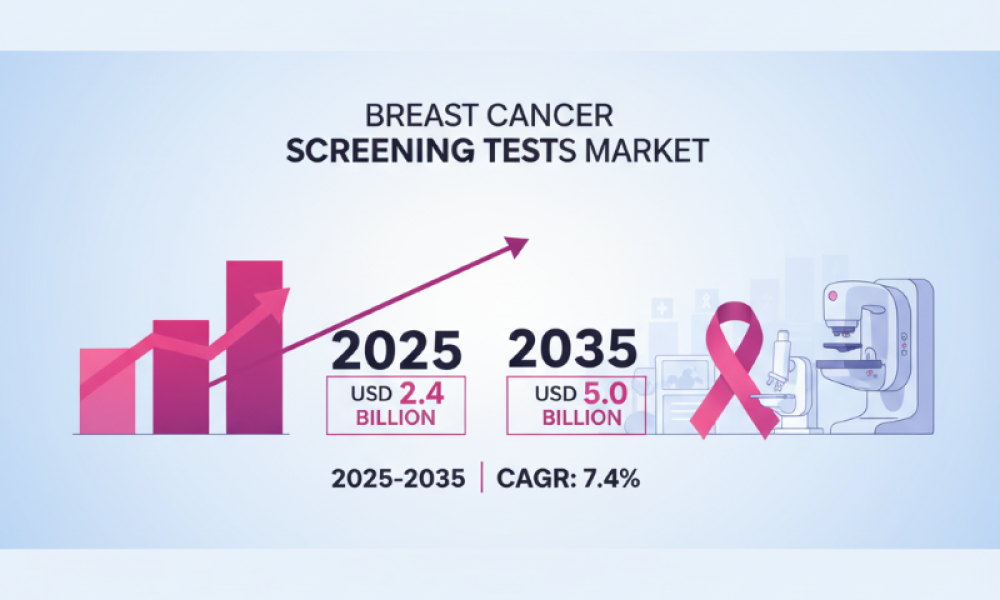
The global breast cancer screening tests market is experiencing significant growth, with an estimated value of USD 2.4 billion in 2025 and a forecasted reach of USD 5.0 billion by 2035. This growth, representing a compound annual growth rate (CAGR) of 7.4%, is attributed to a combination of increased awareness, advancements in diagnostic technologies, and expanding healthcare infrastructure across the world.
Unlock detailed analytics – Request your personalized report now! https://www.futuremarketinsights.com/reports/sample/rep-gb-17758
Key Growth Drivers and Market Trends
The growing focus on early breast cancer detection is central to the market’s expansion. As breast cancer continues to be one of the most common cancers affecting women worldwide, there is increasing recognition of the importance of regular screening, especially among women over the age of 35. Additionally, rising awareness campaigns, governmental initiatives, and advancements in non-invasive diagnostic technologies are further propelling the demand for screening tests.
The introduction of artificial intelligence (AI) integration into imaging platforms and advancements in diagnostic tools such as mammography, ultrasound, and tomosynthesis have enhanced the accuracy and speed of screening. These innovations not only provide higher resolution and detailed visualization of breast tissue but also facilitate quicker, less invasive assessments that are key to early detection.
Government-funded programs and insurance policies also play a crucial role in boosting the market, as they reduce the financial barriers associated with breast cancer screenings, making them more accessible to the general population. Reimbursement policies, particularly in the U.S., where Medicare and Medicaid cover certain genetic testing procedures, are expected to be a key enabler of this growth.
Segmental Insights: Imaging Tests and Hospitals Lead the Market
The Imaging Test segment is projected to dominate the market, holding an estimated 30% market share in 2025. This segment benefits from the growing preference for non-invasive, accurate diagnostic tools, with technologies like digital mammography, ultrasound, and MRI offering superior detection capabilities, even in dense breast tissues. Imaging tests are often the first line of screening, and their integration with digital health systems is streamlining workflows, further boosting their adoption in healthcare settings.
In terms of end-user applications, hospitals are expected to account for the largest share, with a forecasted revenue share of 40% in 2025. This is due to hospitals’ ability to offer a comprehensive approach to breast cancer screening, which includes imaging, laboratory tests, and coordinated patient management. Hospitals, supported by government funding and increased healthcare investment, are well-positioned to lead the market in the coming decade, as they provide centralized platforms for screenings and follow-up care.
Technological Advancements Drive Market Growth
The technological evolution within the breast cancer screening industry is having a profound impact on market dynamics. The adoption of advanced imaging techniques, such as digital mammography and 3D tomosynthesis, allows for earlier and more accurate detection of abnormalities in breast tissue. AI-powered diagnostic tools are being integrated into existing imaging systems to improve diagnostic confidence and reduce the likelihood of false positives, which can lead to unnecessary tests and patient anxiety.
Additionally, genetic testing, such as BRCA1 and BRCA2 mutation testing, is gaining traction in the screening process, offering personalized insights into a patient’s risk of developing breast cancer. This has led to the growth of a more individualized approach to screening, where healthcare providers tailor screenings based on a patient’s genetic profile and family history.
Regional Insights
The North American market, particularly the U.S., is expected to maintain its dominance, with a market share of 31.4% in 2025. Government initiatives, such as the U.S. Preventive Services Task Force’s new guidelines, which recommend starting screening at age 40, are expected to further increase market demand. Additionally, the growing focus on addressing screening inequalities across racial and socioeconomic groups will likely drive greater accessibility and adoption of breast cancer screening tests.
Asia-Pacific, with its rapidly improving healthcare infrastructure, is emerging as a key growth region, particularly in countries like China and India. These nations are increasingly adopting advanced screening methods, and rising awareness about breast cancer is boosting demand for screening services.
Europe, especially countries like Germany, is witnessing growing demand, driven by established public health programs and significant healthcare investments.
Competitive Landscape: Industry Leaders and Market Innovations
Leading companies in the breast cancer screening tests market include AstraZeneca, Novartis, Sanofi, Pfizer, Bayer AG, GlaxoSmithKline plc, Siemens Healthineers, and Hologic Inc. These companies are engaging in strategic partnerships and collaborations with healthcare providers, research institutions, and tech companies to innovate and enhance breast cancer screening tests. Research and development are focusing on improving diagnostic accuracy, minimizing patient discomfort, and increasing cost-effectiveness.
The increasing availability of screening tests at home and through point-of-care testing sites is another trend influencing the market. These innovations, coupled with advancements in telemedicine, are expected to democratize access to breast cancer screening, particularly in underserved regions.
Download Brochure for Full Insights: https://www.futuremarketinsights.com/reports/brochure/rep-gb-17758
Challenges and Future Outlook
Despite the positive outlook, challenges remain in the form of false positives, overdiagnosis, and cost barriers associated with advanced imaging techniques. Additionally, the market must address the limitations of mammography, particularly in women with dense breast tissue, which can lead to missed diagnoses.
However, ongoing advancements in diagnostic technology and government policies promoting breast cancer screening are expected to overcome these hurdles, ensuring the market’s continued growth. With a projected CAGR of 7.4%, the breast cancer screening tests market is set for substantial expansion over the next decade.
About Future Market Insights (FMI)
Future Market Insights, Inc. (ESOMAR certified, recipient of the Stevie Award, and a member of the Greater New York Chamber of Commerce) offers profound insights into the driving factors that are boosting demand in the market. FMI stands as the leading global provider of market intelligence, advisory services, consulting, and events for the Packaging, Food and Beverage, Consumer Technology, Healthcare, Industrial, and Chemicals markets. With a vast team of over 400 analysts worldwide, FMI provides global, regional, and local expertise on diverse domains and industry trends across more than 110 countries.



