
Definition
Blood pressure monitors (BPMs) are medical devices designed to measure an individual’s blood pressure accurately. They are essential tools in the management of hypertension, a condition affecting over 1.28 billion adults globally. Traditional devices use auscultation with a stethoscope and mercury sphygmomanometer, while modern devices rely on oscillometric technology, offering digital readings and user-friendly interfaces suitable for both clinical and home use.
These monitors generally consist of three main components:
- Inflatable cuff to restrict blood flow
- Pressure gauge to record cuff pressure
- Controlled pressure release mechanism
Key product variants include:
- Upper-arm monitors – Clinically preferred for accuracy
- Wrist monitors – Portable and convenient
- Fingertip monitors – Compact but less commonly used
- Smart or connected monitors – Integrated with smartphones or cloud platforms
The growing need for remote patient monitoring, preventive healthcare, and telehealth integration has significantly expanded the adoption of BPMs worldwide. These devices enable patients and healthcare providers to track blood pressure trends, manage hypertension, and reduce cardiovascular risks effectively.
Recent Developments in the Blood Pressure Monitors Market
The blood pressure monitors market is undergoing a significant transformation, driven by a shift from traditional devices to smart, user-friendly, and connected technologies. A major development is the rise of home-based monitoring, fueled by the increasing prevalence of hypertension and a growing focus on preventative healthcare and telehealth services. This has led to the widespread adoption of digital blood pressure monitors with features like Bluetooth connectivity, which allows for seamless data transfer to smartphone apps and cloud-based platforms for tracking and sharing with healthcare providers. Another key trend is the development of cuffless and wearable blood pressure monitors, such as those integrated into smartwatches and rings. While these devices are still working to meet clinical validation standards for accuracy, they offer the convenience of continuous monitoring, which is a major area of innovation. Furthermore, the integration of artificial intelligence (AI) is enabling more sophisticated data analysis, providing personalized health insights and better chronic care management.
Major Distribution Channels
The distribution of blood pressure monitors is a hybrid model that caters to both professional healthcare and consumer markets. For professional use in hospitals and clinics, devices are primarily distributed through specialized medical equipment suppliers and direct sales from manufacturers. This B2B channel provides the necessary technical support, installation, and after-sales service for clinical-grade devices. However, a significant and rapidly growing portion of the market is the consumer segment, where products are distributed through a wider range of channels. Retail pharmacies and drugstores are a traditional and highly trusted channel, offering consumers the convenience of in-person purchases. The rise of online retail and e-commerce platforms has also become a dominant force, providing a vast selection of products, competitive pricing, and the convenience of home delivery. Additionally, specialty stores and big-box retailers also play a role in making these health devices widely accessible to the general public.
Market Size
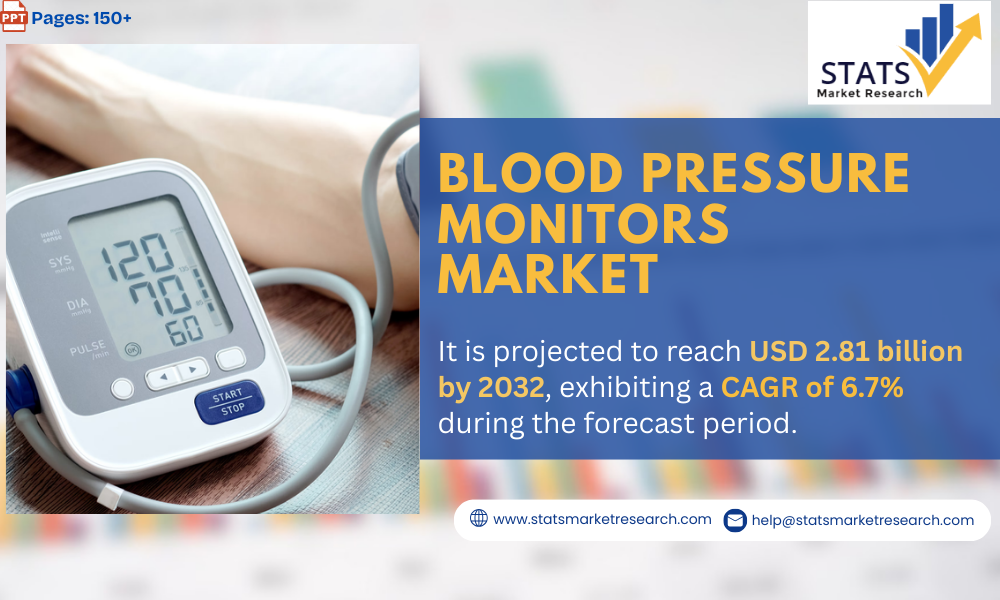
Global blood pressure monitors market was valued at USD 1.81 billion in 2024 and is projected to grow from USD 1.93 billion in 2025 to USD 2.81 billion by 2032, reflecting a CAGR of 6.7% during the forecast period.
Key statistics include:
- Asia-Pacific: Largest regional contributor with 48.4% revenue share in 2023
- Europe: 21.2% revenue share in 2023
- Market Consolidation: Top five players including OMRON, A&D, and Microlife controlled 72.6% of 2023 revenues
The market is expanding due to rising global hypertension prevalence, increased awareness of preventive healthcare, and technological innovations like Bluetooth connectivity, smartphone integration, and AI-driven monitoring algorithms.
Historical trends show sustained growth, particularly during the COVID-19 pandemic, when sales surged 62%, reflecting increased consumer awareness and adoption of at-home monitoring solutions.
Download FREE Sample of this Report @ https://www.statsmarketresearch.com/download-free-sample/8058420/global-blood-pressure-monitors-forecast-market
Market Dynamics
Drivers
Growing Global Hypertension Epidemic Accelerating Demand for Monitoring Devices
- Nearly 1.28 billion adults aged 30-79 suffer from hypertension worldwide
- Hypertension is a leading risk factor for cardiovascular diseases, creating sustained demand for both clinical and home monitoring solutions
- Aging population: Projected to reach 1.5 billion people over 65 by 2050, amplifying demand for regular blood pressure tracking
Technological Advancements Enhancing Device Capabilities and Accessibility
- Bluetooth-enabled monitors, smartphone connectivity, and cloud-based storage have increased adoption by 37% among tech-savvy users
- AI-based detection of irregular heartbeats and cardiovascular risks enhances device value
- Wrist monitors now offer near upper-arm accuracy, widening consumer acceptance
Pandemic-Driven Remote Healthcare Adoption Creating Lasting Behavioral Shifts
- COVID-19 accelerated home monitoring adoption, with telehealth appointments requiring self-reported readings 38 times more common than pre-2020
- Insurance reimbursement for home monitors has further boosted market penetration
Restraints
Accuracy Concerns and Measurement Variability
- Wrist monitors can show 5–15 mmHg variations compared to mercury sphygmomanometers
- Measurement inconsistencies due to body position, cuff placement, and movement artifacts hinder clinical reliance
- Lack of universal calibration standards affects adoption
Price Sensitivity Limiting Adoption in Emerging Markets
- Entry-level upper-arm devices can cost 2–3 times the average weekly wage in low-income regions
- Replacement cuffs cost 40–50% of device price, discouraging long-term use
Regulatory Complexity Slowing Innovation Pipeline
- FDA 510(k) clearance now takes 35% longer, and EU MDR increases conformity costs by €150,000 per product
- Delays impact cutting-edge developments like cuffless optical and implantable monitors
Opportunities
Expanding Telehealth Integration
- Devices compatible with EHRs capture new revenue streams
- Hospital-at-home programs growing at 18% CAGR through 2030 boost demand for professional-grade kits
Workplace Wellness Programs
- Corporate health initiatives drive bulk purchases for employee health monitoring, particularly in high-risk industries
- Estimated 82 million workforce users with uncontrolled hypertension represent untapped potential
Next-Gen Wearables
- Continuous blood pressure tracking via PPG sensors in smartwatches opens new consumer segments
- FDA approval of cuffless monitors in 2025 may accelerate adoption
Challenges
Patient Non-Adherence
- Only 38% of patients consistently follow monitoring protocols
- Improper cuff sizing affects 23% of home readings, reducing effectiveness of connected health platforms
Intense Market Competition
- Over 120 brands globally, leading to price wars and shrinking margins
- Consumer preference for price over features limits differentiation
Data Privacy Concerns
- 62% of elderly patients reluctant to use cloud-connected monitors due to privacy concerns
- Increasing health data breaches necessitate robust encryption and governance
Regional Analysis
- Asia-Pacific: Dominates with 48.4% market share, driven by large population, growing healthcare infrastructure, and smartphone integration
- Europe: Strong growth due to high healthcare spending, awareness campaigns, and technological adoption
- North America: High adoption in home and clinical settings; premium brands lead through brand trust and innovation
- Latin America: Moderate growth, expanding hospital and home monitoring adoption
- Middle East & Africa: Emerging market; price sensitivity and limited infrastructure slow penetration
Competitor Analysis
The global BPM market is semi-consolidated, with the top five companies holding 72.6% of revenue in 2023. Key competitive strategies include:
- Innovation: AI-powered devices, wireless connectivity, integration with health apps
- Expansion: Manufacturing and distribution networks in Asia-Pacific
- Strategic partnerships: Collaborations with hospitals and insurers for wider market reach
Get the Complete Report & TOC @ https://www.statsmarketresearch.com/global-blood-pressure-monitors-forecast-market-8058420
Global Blood Pressure Monitors Market: Market Segmentation Analysis
This report provides a deep insight into the global Blood Pressure Monitors market, covering all its essential aspects. This ranges from a macro overview of the market to micro details of the market size, competitive landscape, development trend, niche market, key market drivers and challenges, SWOT analysis, value chain analysis, etc.
The analysis helps the reader to shape the competition within the industries and strategies for the competitive environment to enhance the potential profit. Furthermore, it provides a simple framework for evaluating and assessing the position of the business organization. The report structure also focuses on the competitive landscape of the Global Blood Pressure Monitors Market. This report introduces in detail the market share, market performance, product situation, operation situation, etc., of the main players, which helps the readers in the industry to identify the main competitors and deeply understand the competition pattern of the market.
In a word, this report is a must-read for industry players, investors, researchers, consultants, business strategists, and all those who have any kind of stake or are planning to foray into the Blood Pressure Monitors market in any manner.
Market Segmentation (by Application)
- Home Use
- Medical Use
- Clinics
- Hospitals
- Diagnostic Centers
- Occupational Health
- Sports & Fitness
Market Segmentation (by Type)
- Upper-arm BPM
- Automatic
- Manual
- Others
- Wrist BPM
- Fingertip BPM
- Smart BPM (Connected Devices)
- Others
Key Company
- OMRON Corporation (Japan)
- Yuwell (Jiangsu Yuyue Medical Equipment) (China)
- A&D Company, Ltd. (Japan)
- Microlife AG (Switzerland)
- NISSEI (Japan)
- Citizen Systems Japan Co., Ltd. (Japan)
- Rossmax International Ltd. (Taiwan)
- Beurer GmbH (Germany)
- Baxter International (Welch Allyn) (U.S.)
- Andon Health Co., Ltd. (China)
Geographic Segmentation
- North America: USA, Canada, Mexico
- Europe: Germany, UK, France, Italy, Rest of Europe
- Asia-Pacific: China, Japan, India, South Korea, Southeast Asia, Rest of Asia-Pacific
- South America: Brazil, Argentina, Colombia, Rest of South America
- Middle East & Africa: Saudi Arabia, UAE, Egypt, Nigeria, South Africa, Rest of MEA
FAQs
Q1: What is the current market size of the Blood Pressure Monitors market?
A: The global market was valued at USD 1.81 billion in 2024 and is projected to reach USD 2.81 billion by 2032.
Q2: Which are the key companies operating in this market?
A: OMRON, Yuwell, A&D, Microlife, NISSEI, Citizen Systems, Rossmax, Beurer, Baxter, Andon Health.
Q3: What are the key growth drivers?
A: Growth is driven by rising hypertension prevalence, aging population, technological advancements, telehealth adoption, and preventive healthcare awareness.
Q4: Which regions dominate the market?
A: Asia-Pacific leads with 48.4% revenue share, followed by Europe.
Q5: What are the emerging trends in this market?
A: Trends include connected smart monitors, AI-powered devices, workplace wellness programs, wearable cuffless monitors, and integration with telehealth platforms.
About Us
☎️ International: +1 (332) 2424 294
📄 Website: www.statsmarketresearch.com
Join us on LinkedIn:- https://www.linkedin.com/company/statsmarketresearch




