
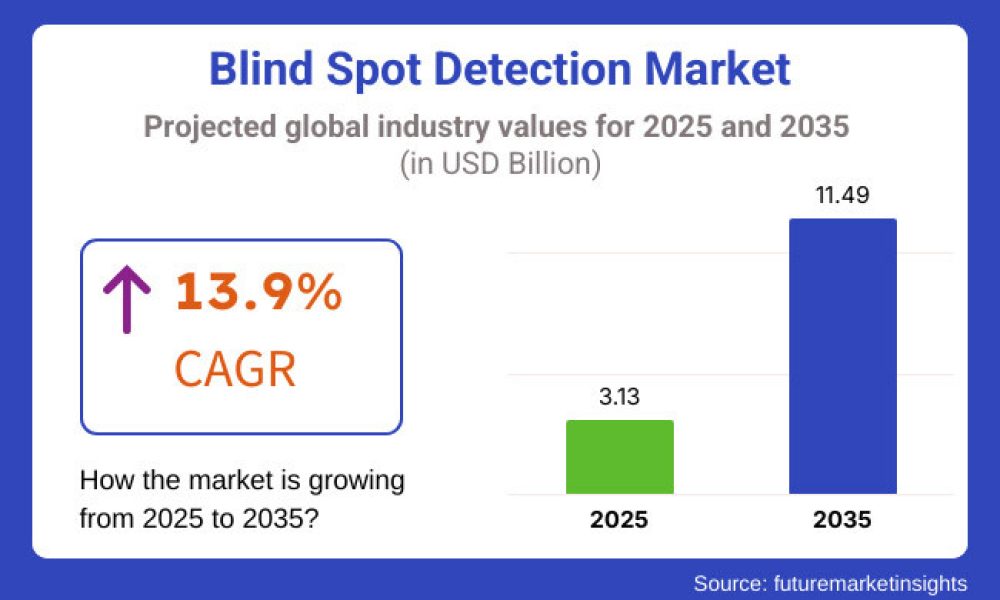
The global blind spot detection market is set to undergo a powerful growth trajectory, projected to rise from USD 3.13 billion in 2025 to USD 11.49 billion by 2035, representing a compound annual growth rate (CAGR) of 13.9% over the forecast period.
This surge is fueled by escalating demand for advanced driver assistance systems (ADAS), increasingly stringent vehicle-safety regulations, and the expanding deployment of autonomous-driving technologies. As vehicles become smarter and more connected, blind spot detection features are evolving from premium-optional to standard equipment across both passenger and commercial vehicle segments.
Driving Forces: Road Safety & Sensor Innovation
The heightened focus on road-safety performance is central to market growth. With global road-accident statistics remaining a significant concern, automakers and regulatory bodies alike are prioritising blind-spot monitoring (BSM) to reduce lane-change collisions and improve driver awareness. The rise in sensor-fusion, combining radar, camera and LiDAR technologies, is further strengthening system accuracy and reliability in diverse driving conditions.
Technological developments spotlight radar-based detection, camera-enabled monitoring and sensor-fusion methods as key enablers for the next generation of BSM systems. The result: better blind-zone coverage, fewer false-alerts and more seamless integration into vehicle platforms.
Subscribe for Year-Round Insights → Stay ahead with quarterly and annual data updates
https://www.futuremarketinsights.com/reports/sample/rep-gb-14927
Regional Outlook: North America, Europe & Asia-Pacific
North America continues to hold a substantial market share, thanks to heightened road-safety concerns and strict vehicle-safety mandates in the United States. Adoption of BSM systems is being driven by OEMs embedding the latest ADAS features into new models. Consumer awareness along with government safety initiatives are helping to further uptake – although high implementation costs and cybersecurity concerns around connected vehicles remain a restraint.
In Europe, growth is propelled by premium-vehicle adoption and rigorous safety regulations in countries such as Germany, France and the U.K. Manufacturers are increasingly deploying BSM systems as part of standard safety suites, yet divergent regulatory frameworks across nations and complex integration processes continue to pose challenges.
Asia-Pacific is poised for the fastest regional growth, enabled by rapid urbanisation, robust vehicle sales and expanding mandates for vehicle-safety features in markets including China, Japan, South Korea and India. The region’s growing smart-vehicle and EV manufacturing ecosystems are major tailwinds. However, elevated cost of advanced safety suites and consumer-awareness gaps in developing markets may temper uptake.
Challenges & Opportunities
Despite strong growth fundamentals, the market faces headwinds. High integration cost of sensors, radars and cameras remains a key barrier — particularly for budget and mid-range vehicles. In addition, system accuracy and reliability are critical: false alerts or detection failure can erode driver trust and undermine safety gains.
On the opportunity front, advancements in artificial intelligence (AI) and sensor technology present significant promise. AI-driven image-recognition, multimodal sensor fusion (radar + LiDAR + camera) and connected-vehicle (V2X) integration are opening new pathways for cost-effective, high-precision detection solutions. As regulatory pressure mounts and ADAS becomes standard even in lower vehicle segments, OEMs and technology providers are positioned to capitalise.
Market Evolution: 2020-24 vs. 2025-35
Between 2020 and 2024 the BSM market saw strong momentum driven by safety-awareness among consumers and growing ADAS integration, though penetration was largely confined to premium vehicles given cost and sensor-limitations. Forecasts for 2025-2035 suggest a significant shift: broader adoption into mid-range and entry segments, stricter mandates for BSM across all vehicle categories, and deeper integration with autonomous-driving systems and V2X communication.
Competitive Landscape
A number of established and emerging players are vying for leadership in the BSM segment. According to our analysis:
Continental AG holds roughly 20-25% of market share — leading with advanced radar-camera solutions for passenger and commercial vehicles.
Bosch GmbH controls about 15-20% — specialising in sensor-based driver-assistance systems including lane-change and blind-spot monitoring.
Denso Corporation has an estimated 10-15% — offering integrated safety systems for side-impact and rear-vehicle detection.
Aptiv PLC holds 8-12% — recognised for its AI-driven image-recognition systems for real-time hazard alerts.
Valeo SA covers 5-10% — supplying ultrasonic and radar-based BSM solutions optimized for adaptive warnings.
Other industry players (30-40% combined) include ZF Friedrichshafen AG, Magna International Inc., Hitachi Automotive Systems Ltd. and Hella GmbH & Co. KGaA.
Buy Report Now – Click Here to Purchase the Report:
https://www.futuremarketinsights.com/checkout/14927
Segment Insights
By technology, radar and camera sensors dominate given their reliability under varying conditions and relative cost-effectiveness; other sensors such as LiDAR, infrared and ultrasonic serve complementary roles in high-end or specialised applications.
By sales channel, OEM installations lead the market, but aftermarket retrofit solutions are gaining traction as fleets and ride-sharing operators seek to modernise safety features.
By vehicle type, while passenger vehicles constitute the majority share, heavy and light commercial vehicles offer growing opportunities owing to safety mandates and fleet-modernisation trends.
Outlook: 2025–2035
As global automotive safety standards tighten and consumer preference shifts toward smarter, safer vehicles, blind-spot detection systems will become increasingly integral to vehicle design. With a projected leap to USD 11.49 billion by 2035 — at a strong CAGR of 13.9% — the market offers substantial opportunity for technology providers, OEMs and aftermarket specialists alike. Continuous innovation in AI, sensor fusion and connectivity will be critical to unlocking broader adoption, especially in cost-sensitive vehicle segments.
Have a specific Requirements and Need Assistant on Report Pricing or Limited Budget please contact us – [email protected]
About Future Market Insights (FMI)
Future Market Insights, Inc. (FMI) is an ESOMAR-certified, ISO 9001:2015 market research and consulting organization, trusted by Fortune 500 clients and global enterprises. With operations in the U.S., UK, India, and Dubai, FMI provides data-backed insights and strategic intelligence across 30+ industries and 1200 markets worldwide.



