
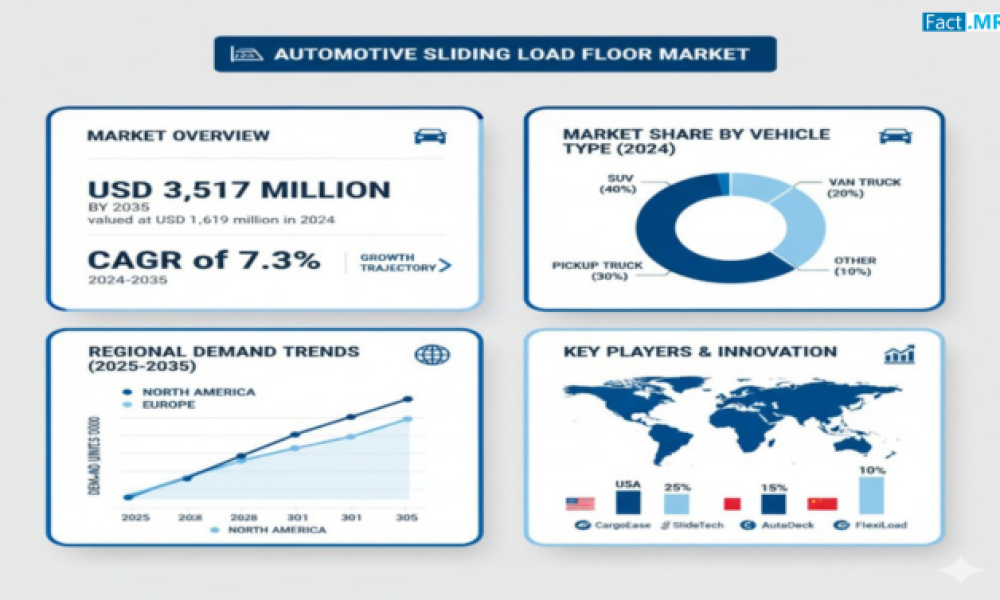
The global automotive sliding load floor market is poised for robust growth over the next decade, fueled by rising consumer demand for versatile vehicles, advancements in lightweight materials, and the expanding logistics and e-commerce sectors. According to Fact.MR, the market is valued at USD 1,738 million in 2025 and is projected to reach USD 3,517 million by 2035, growing at a compound annual growth rate (CAGR) of 7.3%.
The report, “Automotive Sliding Load Floor Market: Global Forecast 2025–2035,” highlights the increasing adoption of sliding load floors in SUVs, vans, trucks, and light commercial vehicles. These systems improve cargo accessibility, interior usability, and overall convenience, making them an integral component of modern vehicle design.
Innovation and Material Advancements Driving Market Expansion
Technological innovation and material optimization are reshaping the market. Automotive sliding load floors are increasingly engineered using polymers, aluminum, steel, composites, and wood laminates to enhance strength, reduce weight, and improve fuel efficiency. The shift toward lightweight and moisture-repellent materials aligns with global sustainability initiatives and environmental regulations.
“Consumers are seeking multifunctional vehicles with convenient cargo solutions,” said a Fact.MR analyst. “Sliding load floors, particularly those using advanced polymers, are addressing these demands while contributing to vehicle efficiency and sustainability.”
To access the complete data tables and in-depth insights, request a sample report here: Request Sample Report
Market Dynamics and Opportunities
Short-term growth (2025–2028) is driven by increasing consumer demand for convenience and adaptability. The medium term (2028–2032) will see further gains from modular designs, automation in production, and 3D printing technologies that reduce costs and enhance customization. Long-term growth (2030–2035) is expected as electrification and smart technologies integrate into sliding load floor systems, optimizing space and functionality in electric and hybrid vehicles.
E-commerce and logistics requirements are also driving demand for efficient loading solutions, as companies seek vehicles that facilitate faster and more flexible cargo handling.
Regional Insights
- North America:The U.S. market, valued at USD 369.5 million in 2024, is expected to maintain a 7.3% CAGR, supported by lifestyle-driven multifunctional vehicles and growing adoption of family and outdoor utility vehicles.
- Asia Pacific:China leads the region, projected to reach USD 486.9 million by 2035 at an 8.1% CAGR, fueled by rapid urbanization, rising disposable incomes, and demand for efficient and comfortable vehicle designs. India and Japan also contribute significantly due to expanding vehicle sales and modernization of passenger and commercial fleets.
- Europe:Germany, the U.K., and France are witnessing steady adoption as consumers prioritize convenience, safety, and modular vehicle interiors.
- Middle East & Africa:Growth is moderate, driven by logistics and commercial vehicle upgrades in GCC countries.
- Oceania:Rising demand in Australia and New Zealand is linked to recreational vehicle trends and outdoor activity preferences.
Competitive Landscape
Key players in the global automotive sliding load floor market include ASG Group Associate Ltd., Cargo Ease Inc., Cargo Glide, Extendobed, Front Runner GmbH, Innovative Industries Inc. (Slide-Master), Jotto Desk, Mor/Ryde International Inc., Takit Inc. (Bedslide), and Truckvault. Companies are focusing on R&D, lightweight material innovation, and modular designs to stay competitive in a rapidly evolving market.
Market Outlook
The automotive sliding load floor market is expected to evolve beyond traditional cargo solutions into smart, multifunctional systems integrated with sensors and connectivity features. Manufacturers leveraging sustainable materials, technological integration, and modular design are positioned to capture the next phase of market growth.
“Sliding load floors are no longer just a convenience feature—they’re a critical element of vehicle versatility, efficiency, and consumer satisfaction,” added the Fact.MR analyst. “As automotive design trends shift toward electrification and smarter logistics, innovation in this sector will define market leadership.”
Purchase Full Report for Detailed Insights
For access to full forecasts, regional breakouts, company share analysis, and emerging trend assessments, you can purchase the complete report here: Access Full Report – Automotive Sliding Load Floor Market
About Fact.MR
Fact.MR is a global market research and consulting firm, trusted by Fortune 500 companies and emerging businesses for reliable insights and strategic intelligence. With a presence across the U.S., UK, India, and Dubai, we deliver data-driven research and tailored consulting solutions across 30+ industries and 1,000+ markets. Backed by deep expertise and advanced analytics, Fact.MR helps organizations uncover opportunities, reduce risks, and make informed decisions for sustainable growth.



