
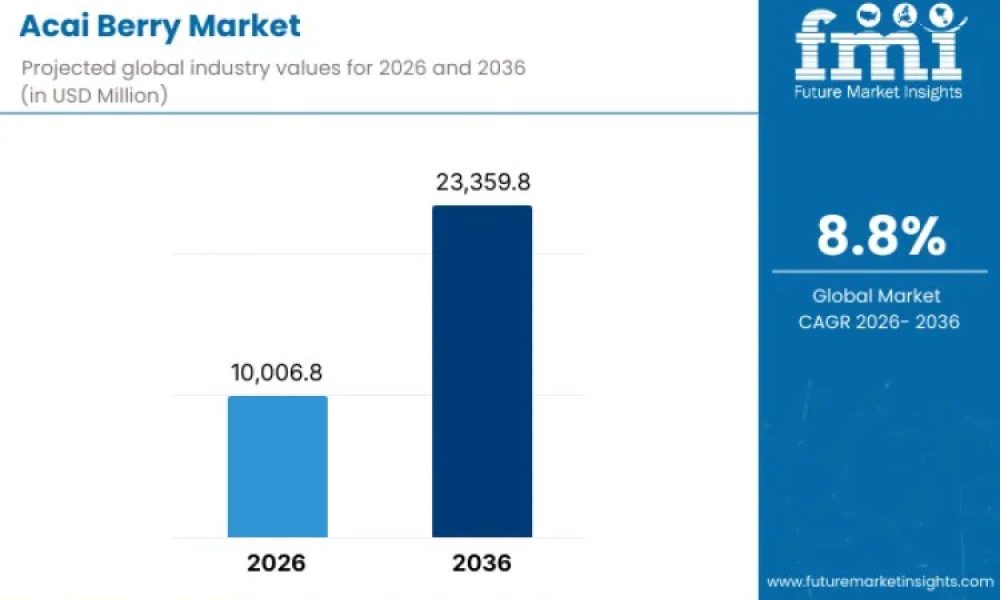
The global acai berry market is projected to expand from USD 10,006.8 million in 2026 to USD 23,359.8 million by 2036, registering a robust compound annual growth rate (CAGR) of 8.8% over the forecast period. This growth reflects the market’s firmly established role within the superfoods and functional ingredients ecosystem, supported by sustained consumer interest in antioxidant-rich, plant-based nutrition across food, beverage, supplement, and cosmetic applications.
Unlike many fresh fruit categories, acai’s commercial momentum is driven predominantly by value-added formats rather than raw consumption. Frozen pulp, powders, purees, juices, and extracts dominate trade flows, offering longer shelf life, export stability, and consistent functional performance. These formats enable acai to be integrated into smoothies, ready-to-drink beverages, dietary supplements, snack bars, dairy alternatives, and skincare products, positioning the berry as an ingredient-led market rather than a commodity fruit trade.
To Explore Detailed Market Data, Segment-Wise Forecasts, and Competitive Insights, Request Sample Report!
Market Structure Reflects Processing Flexibility and Scalable Claims
By product type, raw or whole acai berries account for 56.4% of market share, primarily because they serve as the upstream input for multiple downstream transformations. Processors favor whole berries to control freezing, pulping, or drying methods based on end-use requirements, preserving anthocyanins and antioxidant content under controlled conditions. This flexibility supports applications across beverages, nutraceuticals, functional foods, and cosmetics while enabling bulk handling and contract-based supply relationships.
From a product claim perspective, conventional acai products hold a 52.8% share, reflecting broader availability, cost efficiency, and scalability. Large food and beverage manufacturers rely on conventional sourcing to ensure consistent volumes and predictable pricing, particularly for mass-market smoothies, snacks, and supplements. Organic and certified products, while smaller in volume, continue to shape margin expansion and brand differentiation, especially in premium wellness segments.
Key Growth Drivers Anchored in Wellness and Premiumization
The acai berry market benefits from a convergence of long-term consumption trends. Rising health awareness, demand for natural antioxidants, and the global shift toward functional and clean-label foods are expanding acai’s relevance across regions. Social media exposure and foodservice adoption—particularly smoothie bowls and cold-pressed beverages—have further elevated consumer familiarity.
Between 2026 and 2036, growth is expected to be led by:
- Increasing incorporation of acai into functional foods and dietary supplements
- Expansion of wellness-driven consumption in emerging markets
- Innovation in shelf-stable and nutraceutical-grade formats, rather than raw fruit trade alone
Supply Chain Discipline Remains Central to Market Stability
Despite strong demand fundamentals, the acai berry market faces structural constraints linked to its geographically concentrated supply base in the Amazon region. Seasonal availability, climate variability, and limited processing infrastructure heighten reliance on cold-chain logistics and rapid transportation. Quality assurance is another critical factor, as variations in active compounds such as anthocyanins can affect regulatory compliance and product performance, particularly in supplements.
As a result, buyers increasingly prioritize traceability, certification support, sustainable harvesting practices, and documented processing methods, making supply chain discipline a key competitive differentiator.
Country-Level Dynamics Highlight Divergent Growth Patterns
Market performance varies significantly by country, shaped by health awareness, import reliance, and functional food adoption.
India emerges as the fastest-growing market, with a CAGR of 13.0%, driven by urban wellness trends, nutraceutical consumption, and direct-to-consumer nutrition platforms. Thailand follows closely at 12.0% CAGR, supported by wellness tourism and foodservice-led demand for frozen pulp and ready-to-use formats.
In mature markets, the United States (8.2% CAGR) leads premiumization, with demand concentrated in freeze-dried powders, frozen pulp, and encapsulated extracts. Buyers emphasize organic certification, antioxidant standardization, and traceability, favoring suppliers that offer formulation support and consistent quality. The United Kingdom (6.8% CAGR) remains a stable functional foods market, rewarding suppliers aligned with sustainability credentials and regulatory compliance. Mexico (6.3% CAGR) shows steady growth through beverage and supplement applications, driven more by affordability and blended formulations than premium positioning.
To Access The Full Market Analysis, Strategic Recommendations, And Analyst Support, Purchase The Complete Report Here.
Competitive Landscape Defined by Quality and Transparency
Competition in the acai berry market centers on verified quality metrics, sourcing transparency, and processing integrity rather than price alone. Leading players such as Sambazon, Inc. emphasize organic certification, traceable Amazon sourcing, and cold-pressed processing. Others, including Acai Roots, Inc. and Amazon Power Pty Ltd., focus on nutrient retention and cold-chain reliability, while brands like Nativo Acai and The Berry Company Limited differentiate through sustainability narratives and consumer-facing wellness positioning.
Across regions, suppliers that combine consistent supply, documented antioxidant profiles, and clean-label compliance are best positioned to capture long-term value as acai continues its transition from niche superfruit to mainstream functional ingredient.
About Future Market Insights (FMI)
Future Market Insights, Inc. (FMI) is an ESOMAR-certified, ISO 9001:2015 market research and consulting organization, trusted by Fortune 500 clients and global enterprises. With operations in the U.S., UK, India, and Dubai, FMI provides data-backed insights and strategic intelligence across 30+ industries and 1,200+ markets worldwide.



