
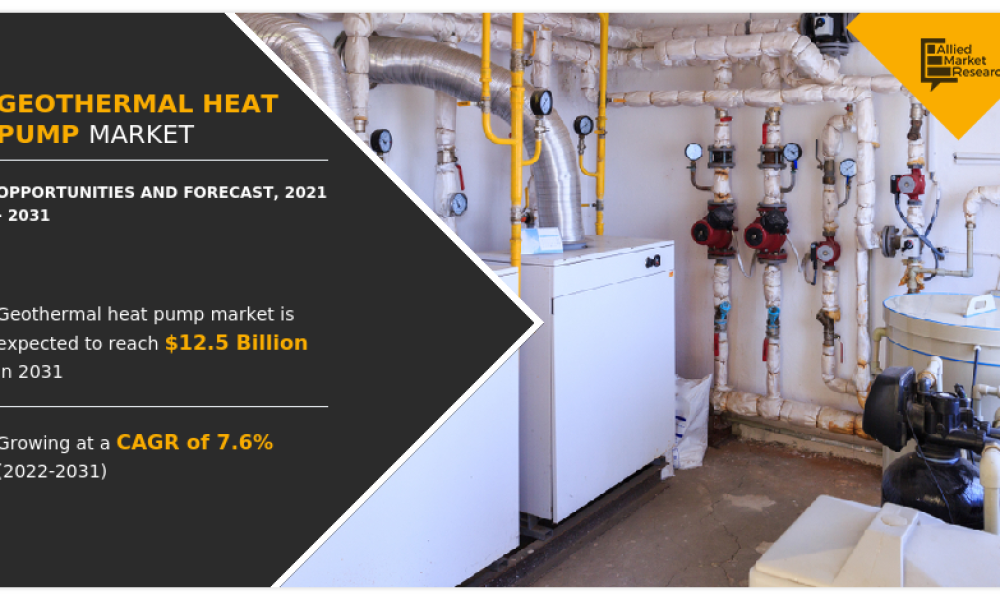
According to a new report published by Allied Market Research, titled, “Geothermal Heat Pump Market,” The geothermal heat pump market size was valued at $6.0 billion in 2021, and geothermal heat pump industry is estimated to reach $12.5 billion by 2031, growing at a CAGR of 7.6% from 2022 to 2031.
A central water heating system that utilizes geothermal energy is known as a geothermal heat pump (GHP) or ground source heat pump. These systems are widely used for heating surface water, recycled water, retention basin stormwater, sewage treatment plants, and rainwater harvesting due to their energy efficiency. Geothermal heat pumps can operate independently or as part of hybrid systems, such as solar-geothermal combinations, which offer benefits in terms of cost savings and enhanced performance.
Geothermal heat pumps harness the earth’s relatively stable temperatures to provide both heating and cooling. Unlike traditional geothermal energy that comes from deep within the earth’s crust, the primary heat source for these pumps is the sun’s energy absorbed by the ground. Globally, geothermal heat pumps are also referred to by names such as geoexchange, earth energy systems, and earth-coupled heat pumps.
Download PDF Brochure: https://www.alliedmarketresearch.com/request-sample/A10486
The global geothermal heat pump market is being propelled by increasing concerns among policymakers about energy security, environmental sustainability, and the shift toward a bioeconomy-driven development model focused on national well-being. Governments worldwide are emphasizing renewable and clean energy technologies, which has boosted interest in geothermal heat pumps as an efficient heating and cooling solution. These systems help reduce energy consumption significantly while supporting efforts to lower greenhouse gas (GHG) emissions, further strengthening their market appeal.
One of the key growth drivers for the geothermal heat pump market is the system’s ability to offer long-term cost savings compared to conventional water heating methods. Although the initial installation cost can be high, the reduced operational expenses and energy efficiency make geothermal heat pumps an economically viable option over time. Additionally, the technology’s versatility in applications such as residential heating, commercial buildings, and industrial processes supports wider adoption.
Despite these advantages, the market faces challenges in major developing countries, where the high upfront installation costs and limited public awareness hinder widespread acceptance. Many potential users remain unfamiliar with the benefits of geothermal heat pump systems or skeptical about their performance, creating a barrier to market growth. This calls for increased education, outreach, and incentive programs to build confidence and encourage adoption.
Furthermore, a lack of rapid technological advancement and innovation in cost-effective solutions limits the market’s expansion. Continued research and development focused on improving efficiency, reducing installation costs, and enhancing system performance are essential to overcome these barriers. As advancements emerge and awareness grows, the geothermal heat pump market is expected to experience substantial growth, driven by the global push toward sustainable energy and environmental responsibility.
For Purchase Inquiry: https://www.alliedmarketresearch.com/purchase-enquiry/A10486
The geothermal heat pump market forecast is segmented on the basis of technology, end use, and region. Depending on technology, the market is categorized into open loop systems and closed loop systems (vertical loops and horizontal loops). On the basis of end-use, the market is categorized into residential (new building systems and retrofit systems), commercial, and industrial. Region-wise, the market is studied across North America, Europe, Asia-Pacific, and LAMEA.
The geothermal heat pump market exhibits strong growth across multiple regions, driven by increasing demand for energy-efficient and sustainable heating and cooling solutions. In North America, widespread adoption is fueled by government incentives, stringent energy efficiency regulations, and growing awareness of environmental benefits. The U.S. and Canada are investing heavily in geothermal technologies for residential, commercial, and industrial applications, supported by advancements in technology and infrastructure development.
In the Asia-Pacific region, rapid urbanization, expanding construction activities, and rising disposable incomes are propelling market growth. Countries like China, Japan, and South Korea are focusing on reducing carbon emissions and enhancing energy efficiency, creating favorable conditions for geothermal heat pump adoption. Europe also represents a significant market, with strong regulatory frameworks promoting renewable energy use and sustainability goals driving deployment. Meanwhile, emerging markets in Latin America, the Middle East, and Africa are gradually increasing investments in geothermal technologies as part of their renewable energy strategies.
Major players operating in the global c include, Bosch Terotechnology Ltd, Bostech Mechanical Ltd., Carrier global Corporation, ClimateMaster Inc.., Daikin Industries, Ltd., Danfoss Technologies, Dandelion Energy, De Dietrich Process Systems, Ecoforest S.A, Energy Smart Alternatives, GeoComfort Geothermal systems, GeoSmart Energy Inc., Maritime Geothermal Ltd., Mitsubishi Electric Corporation, Pfister’s Energy, Viessmann, and Wolf GmbH.
Key findings of the study
- Asia-Pacific would exhibit CAGR of 8.5% during 2022-2031.
- Japan contributes around 5.4% of total geothermal heat pump market share and would exhibit CAGR of 7.6% during 2022-2031.
- South Korea contributes around 1.9% of total market share and would exhibit CAGR of 9.1% during 2022-2031
- As per global geothermal heat pump market analysis, by technology, the closed loop systems segment accounted more than 80% of market share in 2021.
- By end use, residential segment is expected to possess a market share of 75.1% in 2031.
- By region, Europe was the leading segment in 2021, with a CAGR of 6.4% during 2022-2031




