
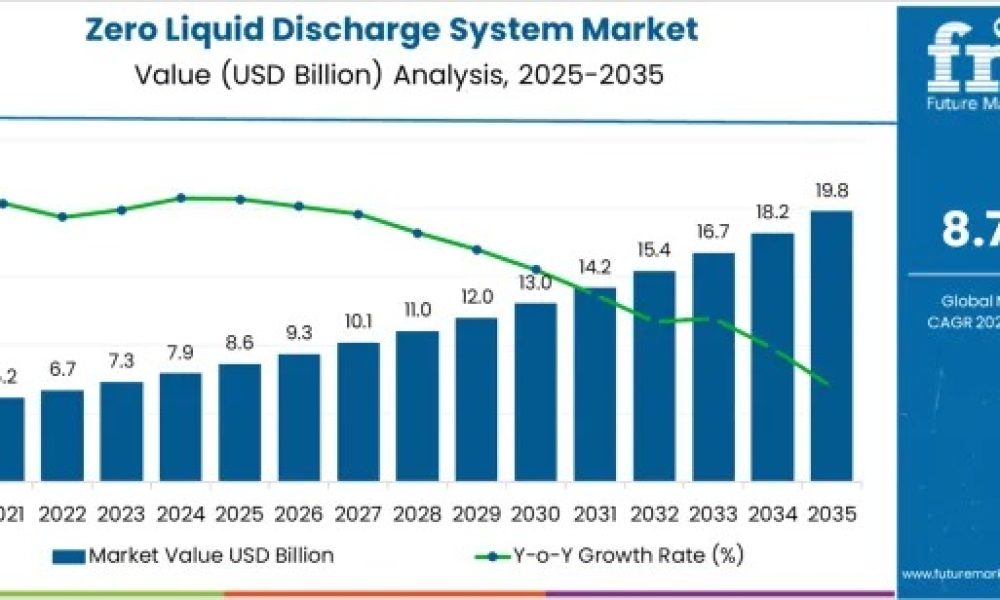
The Zero Liquid Discharge System Market is on an accelerated growth path as industries worldwide prioritize water conservation, environmental compliance, and sustainable wastewater management. According to recent insights, the market is valued at USD 8.6 billion in 2025 and is projected to surpass USD 19.8 billion by 2035, expanding at a CAGR of 8.7%.
Industries such as power generation, chemicals, oil and gas, and manufacturing are investing in ZLD technologies to achieve operational efficiency and align with global sustainability targets. Increasingly strict government policies and the depletion of freshwater resources are propelling widespread adoption, especially in North America, Europe, and Asia-Pacific.
Subscribe for Year-Round Insights → Stay ahead with quarterly and annual data updates
Thermal-Based Systems Lead Market Adoption
The thermal-based technology segment dominates the global zero liquid discharge market, accounting for over 60% of total installations in 2025. Industries generating high-TDS effluents prefer thermal systems for their ability to deliver complete water recovery. Advances in multi-effect evaporation (MEE) and mechanical vapor recompression (MVR) are improving energy efficiency, enabling scalability across industrial plants.
Despite higher initial costs, thermal systems remain the preferred choice for power and chemical sectors due to their robustness and compliance with stringent discharge standards. The ongoing optimization of energy consumption in ZLD systems is expected to make thermal technologies more viable in the coming decade.
Power Sector Remains the Largest End-User
The power generation industry holds a commanding 44.7% market share in 2025, primarily driven by the need to minimize water intake for cooling and process operations. With global electricity demand increasing, ZLD systems enable power plants to recycle and reuse wastewater, ensuring continuous operations in water-scarce regions.
Emerging economies in Asia-Pacific—notably India and China—are witnessing a surge in ZLD system installations across new thermal power plants. Meanwhile, developed markets such as the U.S. and the U.K. are upgrading existing plants to meet evolving environmental regulations and emission norms.
Regional Insights: Key Markets Shaping the Growth Landscape
North America leads the global ZLD system market with the U.S. expanding at a CAGR of 9.0% through 2035, supported by compliance with the Clean Water Act and state-specific environmental standards.
Europe, led by the U.K. and Germany, emphasizes sustainable industrial operations and technological innovation, driving adoption across manufacturing and energy sectors.
Asia-Pacific, particularly China (9.5% CAGR), Japan (10.2% CAGR), and Korea (11.1% CAGR), is emerging as a key hub due to rapid industrialization and government-backed green initiatives. Technological advancements, including AI-based monitoring and smart automation, are transforming ZLD efficiency and cost-effectiveness in these markets.
Technological Evolution and Emerging Trends
- Hybrid Systems combining membrane and thermal technologies are reducing operational costs and enhancing recovery rates.
- AI and IoT Integration are improving process monitoring and predictive maintenance.
- Circular Economy Practices are enabling resource recovery, with industries extracting valuable salts, chemicals, and clean water from wastewater.
- Policy Incentives in the form of subsidies and tax benefits are accelerating industrial adoption of ZLD systems, especially in developing economies.
While high capital investment and energy consumption remain challenges, ongoing innovation in low-energy desalination and membrane enhancement is expected to mitigate these concerns over time.
Market Outlook: 2025–2035
Between 2020 and 2025, the ZLD market grew at an 11.2% CAGR, fueled by rapid industrial adoption and regulatory enforcement. Going forward, steady technological innovation and policy-driven adoption are projected to sustain growth at 8.7% CAGR over the next decade.
The integration of smart sensors, AI-driven analytics, and automation will enable predictive maintenance and operational optimization — crucial for large-scale deployment. As industries face mounting pressure to demonstrate sustainability compliance, ZLD systems will become central to wastewater management strategies worldwide.
Key Companies Steering the Market
Major players shaping the competitive landscape include ALFA LAVAL, Aquatech International LLC, AQUARION AG, Evoqua Water Technologies LLC, GEA Group Aktiengesellschaft, IDE Water Technologies, H2O GmbH, Mitsubishi Power Ltd, Praj Industries, and SafBon Water Technology.
These companies are focusing on innovation, modular system design, and global collaborations to expand their footprint across high-growth markets in APAC, Europe, and North America.
Get data that aligns with your strategic priorities — ask for report customization today:
https://www.futuremarketinsights.com/checkout/19010
Have a specific Requirements and Need Assistant on Report Pricing or Limited Budget please contact us – [email protected]
About Future Market Insights (FMI)
Future Market Insights, Inc. (FMI) is an ESOMAR-certified, ISO 9001:2015 market research and consulting organization, trusted by Fortune 500 clients and global enterprises. With operations in the U.S., UK, India, and Dubai, FMI provides data-backed insights and strategic intelligence across 30+ industries and 1200 markets worldwide.
Contact Us:
Future Market Insights Inc.
Christiana Corporate, 200 Continental Drive,
Suite 401, Newark, Delaware – 19713, USA
T: +1-347-918-3531



