
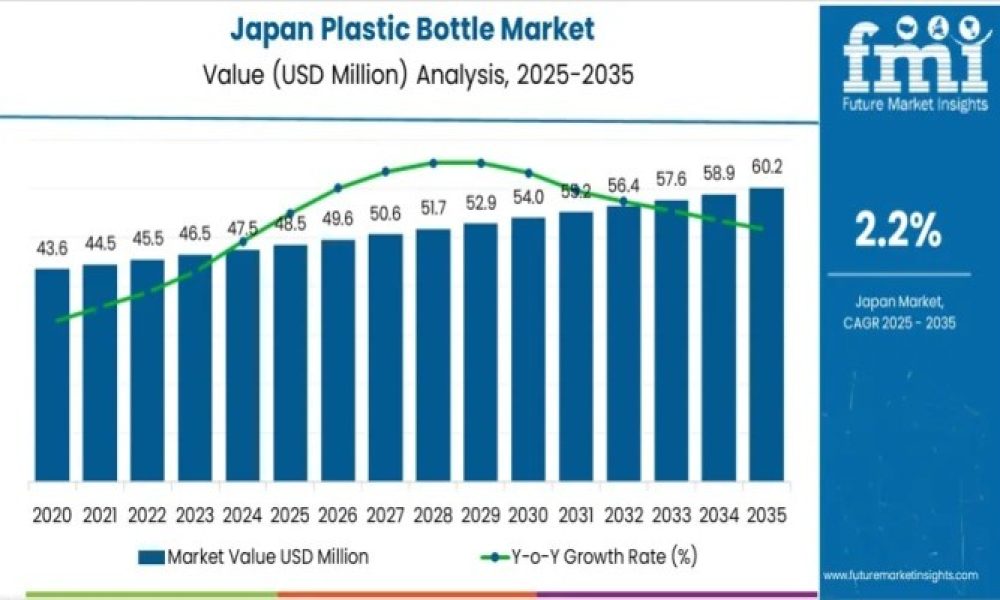
Japan’s plastic bottle demand is valued at USD 48.5 million in 2025 and is forecast to reach USD 60.2 million by 2035, growing at a CAGR of 2.2%. Growth remains predictable due to stable consumption of essential packaged products such as bottled water, tea, detergents, and hygiene solutions.
Rather than experiencing cyclical volatility, the market demonstrates resilience supported by recurring procurement from beverage bottlers, pharmaceutical distributors, and household product manufacturers.
Plastic bottles continue to play a critical role in Japan’s packaging ecosystem, supporting daily consumption across beverages, household liquids, pharmaceuticals, and personal care products. Despite increasing sustainability scrutiny and policy-driven reduction goals, rigid plastic bottles especially PET remain deeply embedded in Japan’s retail and distribution infrastructure. From vending machines in urban transit hubs to convenience stores serving single-person households, plastic bottles offer unmatched efficiency, durability, and compatibility with high-speed filling systems.
Discover Market Opportunities – Get Your Sample of Our Industry Overview Today!
Meaning and Market Scope
Plastic bottles in Japan primarily refer to rigid containers manufactured from PET, HDPE, PP, and limited volumes of PVC, used for packaging liquids across food, beverage, healthcare, and industrial applications. These bottles are designed to meet strict national standards for food safety, recyclability, labeling, and container recovery.
The market’s relevance lies not in aggressive volume expansion but in replacement demand, material optimization, and compliance-driven innovation aligned with Japan’s circular economy framework.
Key Outlook Indicators:
- Stable demand linked to essential consumer goods
- Incremental growth driven by lightweighting and recycled content
- Limited exposure to economic shocks due to daily-use products
Market Overview
Plastic bottle usage in Japan is shaped by high population density, advanced retail networks, and an established recycling system. PET bottles dominate beverage packaging, while HDPE remains essential for chemicals, pharmaceuticals, and cleaning products. Manufacturers focus heavily on standardized neck finishes, reduced resin usage, and compatibility with automated bottling lines.
Bottles with capacities below 1 liter form the backbone of demand, particularly for single-serve beverages catering to commuters and urban lifestyles.
Quick Market Snapshot:
- Market Size (2025): USD 48.5 million
- Forecast Value (2035): USD 60.2 million
- Leading Capacity: Below 1 liter
- Dominant Material: PET
Growth Dynamics
Growth in Japan’s plastic bottle industry is modest but consistent. Consumption patterns for bottled beverages and household liquids show minimal fluctuation, even during economic slowdowns. This stability limits rapid expansion but ensures long-term demand continuity.
While regulatory pressures and alternative packaging formats introduce constraints, innovation in lightweight PET, tethered caps, and chemical recycling integration helps offset these challenges.
Growth Characteristics:
- Narrow annual growth dispersion
- Demand stability over volume acceleration
- Growth driven by packaging transitions, not consumption spikes
Demand Drivers
Several structural and lifestyle factors continue to support plastic bottle demand in Japan:
- High consumption of bottled tea, water, and functional beverages
- Dense convenience-store and vending-machine networks
- Growth in single-person households and on-the-go consumption
- Strong reliance on automated, high-speed filling lines
- Well-established PET collection and recycling infrastructure
E-commerce distribution also reinforces demand for leak-resistant, impact-tolerant packaging, especially for household and personal-care liquids.
Key Market Trends
Plastic bottle demand in Japan is evolving through sustainability-led design changes rather than volume expansion.
Notable Trends Include:
- Increased use of post-consumer recycled (rPET) content
- Adoption of tethered caps to improve collection efficiency
- Expansion of label-free bottles for easier recycling
- Lightweight bottle designs to reduce resin usage
- Improved bottle-to-bottle recycling integration
These trends reflect alignment with national resource-circulation goals and corporate environmental commitments.
Capacity, Material, and End-Use Insights
By Capacity:
- Below 1 liter: 62% share, driven by beverages and personal care
- Above 1 liter: 38% share, used in household and industrial liquids
By Material:
- PET: 54%, favored for clarity and recyclability
- HDPE: 23%, used for chemicals and detergents
- PP: 15%, applied in heat-resistant uses
- PVC: 8%, limited to niche chemical applications
By End Use:
- Food & beverages: 28%
- Chemicals: 17%
- Pharmaceuticals: 12%
- Agrochemicals, lubricants, paints, and industrial fluids form the remainder
Regional Demand Overview
Demand varies by region based on population density, beverage infrastructure, and logistics access.
Regional CAGR Highlights (2025–2035):
- Kyushu & Okinawa: 2.7%
- Kanto: 2.5%
- Kinki: 2.2%
- Chubu: 1.9%
- Tohoku: 1.7%
- Rest of Japan: 1.6%
Kyushu & Okinawa benefit from tourism-driven beverage sales and port-based resin logistics, while Kanto’s growth is anchored by urban consumption, transit-based retail, and advanced recycling systems.
Competitive Landscape
Japan’s plastic bottle demand is supported by a concentrated group of domestic and international converters specializing in precision molding, lightweight designs, and food-grade compliance.
Leading Players:
- Yoshino Kogyosho Co., Ltd.
- Nihon Yamamura Glass Co., Ltd.
- Takemoto Yohki Co., Ltd.
- Kureha Corporation
- Alpla Japan
Competition centers on dimensional accuracy, recyclability compatibility, consistent supply, and alignment with sustainability benchmarks rather than aggressive pricing.
Why FMI: https://www.futuremarketinsights.com/why-fmi
About Future Market Insights (FMI)
Future Market Insights, Inc. (FMI) is an ESOMAR-certified, ISO 9001:2015 market research and consulting organization, trusted by Fortune 500 clients and global enterprises. With operations in the U.S., UK, India, and Dubai, FMI provides data-backed insights and strategic intelligence across 30+ industries and 1200 markets worldwide.



