
Fuel Cell for Data Center Market: Powering the Next Era of Digital Infrastructure
The digital economy is expanding at an unprecedented pace, driven by artificial intelligence (AI), cloud computing, edge infrastructure, and hyperscale data centers. As global data traffic surges, so does the demand for reliable, scalable, and sustainable power solutions. In this context, fuel cell technology is emerging as a transformative alternative to traditional diesel generators and grid-dependent systems. The global fuel cell for data center market is projected to witness remarkable growth, rising from US$ 361.1 million in 2026 to US$ 1,192.0 million by 2033, expanding at an impressive CAGR of 18.6% between 2026 and 2033. This rapid expansion reflects both technological evolution and mounting macroeconomic pressures reshaping the energy backbone of digital infrastructure.
Rising AI Workloads and Surging Power Demand
The acceleration of AI deployment is dramatically increasing electricity consumption across global data centers. Training large language models, running high-density GPU clusters, and supporting real-time analytics require immense and continuous power availability. Industry projections indicate that data center capacity announcements could approach 35 gigawatts within five years, equivalent to more than six times New York City’s average annual energy consumption.
Such exponential demand places immense pressure on existing power grids. In several regions, utilities struggle to approve new connections fast enough to meet hyperscale data center expansion plans. As a result, operators are actively seeking alternative, decentralized, and resilient energy solutions. Hydrogen fuel cells offer a compelling answer by delivering consistent, high-efficiency power independent of grid bottlenecks.
Get Your FREE Sample Report Instantly – Click Now: https://www.persistencemarketresearch.com/samples/11866
Understanding Fuel Cells in Data Center Applications
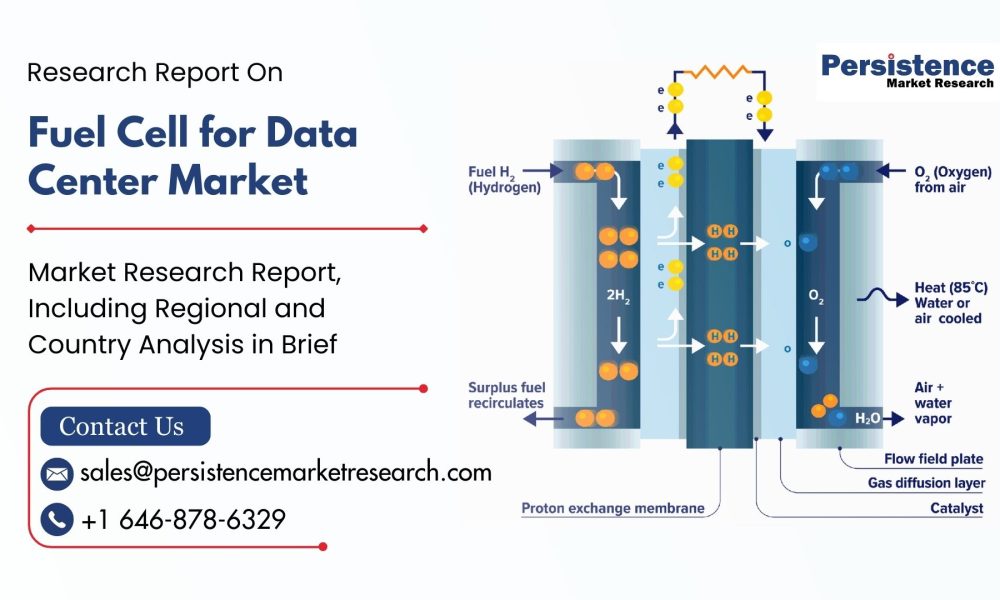
Fuel cells generate electricity through an electrochemical reaction rather than combustion. Hydrogen fuel cells, in particular, produce electricity, heat, and water as byproducts, eliminating carbon emissions when powered by green hydrogen. For data centers, this translates into:
- High reliability and uptime
- Lower greenhouse gas emissions
- Reduced noise pollution
- Minimal on-site particulate emissions
- Scalability for modular expansion
Traditionally, diesel generators have served as backup power systems. However, environmental regulations and sustainability commitments are forcing operators to reconsider their reliance on fossil-fuel-based solutions. Fuel cells are now increasingly deployed either as primary power sources, backup systems, or part of hybrid microgrid architectures.
Decarbonization Mandates Accelerating Adoption
Governments worldwide are tightening regulations on emissions and mandating decarbonization of critical infrastructure. Data centers, as energy-intensive facilities, face growing scrutiny. Net-zero commitments by hyperscale operators and regulatory mandates for zero-emission backup power are creating strong tailwinds for hydrogen fuel cell integration.
Regions such as North America and Europe are actively promoting hydrogen economy initiatives, offering subsidies, tax credits, and incentives for clean energy projects. These frameworks are making fuel cell deployment more financially attractive. Moreover, corporate ESG targets are compelling cloud service providers and colocation operators to adopt renewable and low-carbon energy alternatives, further strengthening market growth.
Technological Maturation and Cost Competitiveness
One of the primary reasons behind the market’s projected 18.6% CAGR is the rapid maturation of fuel cell technology. Over the past decade, advancements in proton exchange membrane (PEM) fuel cells and solid oxide fuel cells (SOFC) have improved durability, efficiency, and load-following capabilities. Modern systems now offer multi-megawatt scalability suitable for hyperscale facilities.
Simultaneously, the cost of hydrogen production—particularly green hydrogen generated through renewable electrolysis—is gradually declining. Improved storage technologies and hydrogen infrastructure development are addressing earlier logistical constraints. As economies of scale improve and supply chains stabilize, fuel cell systems are becoming increasingly competitive with diesel generators and grid extension costs, especially in remote or grid-constrained areas.
Get a Customized Market View in One Click: https://www.persistencemarketresearch.com/request-customization/11866
Energy Resilience and Grid Independence
Grid reliability concerns have intensified due to extreme weather events, aging infrastructure, and increasing electrification across sectors. Data centers require near-zero downtime, making energy resilience a top priority. Fuel cells provide continuous on-site generation, reducing vulnerability to grid failures and transmission congestion.
Unlike diesel generators that require periodic testing and emit pollutants during operation, fuel cells can operate continuously with minimal environmental impact. Their modular architecture allows phased expansion in line with data center capacity growth. This flexibility is particularly valuable in edge computing deployments, where decentralized infrastructure must operate autonomously.
Integration with Renewable Energy and Microgrids
Fuel cells can be integrated into renewable energy ecosystems, forming hybrid systems alongside solar, wind, and battery storage. In such configurations, excess renewable energy can be used to produce green hydrogen, which is then stored and later converted back to electricity through fuel cells when needed.
This circular energy model aligns with the broader transition toward microgrids and localized energy independence. For data centers operating in regions with unstable grids or high renewable penetration, fuel cells offer load balancing and peak shaving benefits. The integration of advanced energy management software further enhances optimization and real-time efficiency monitoring.
Regional Outlook
North America is expected to dominate early adoption, supported by hydrogen infrastructure investments and strong hyperscale data center expansion. The United States, in particular, is witnessing significant policy support for hydrogen production and clean energy tax credits. Europe follows closely, driven by stringent emissions regulations and aggressive decarbonization targets.
Asia Pacific represents a high-growth frontier due to expanding digital infrastructure in countries such as Japan, South Korea, China, and India. Government-backed hydrogen strategies and smart city initiatives are likely to stimulate long-term market potential in the region.
Challenges Facing the Market
Despite strong growth projections, several challenges remain:
- Hydrogen infrastructure limitations: Widespread availability of green hydrogen is still under development in many regions.
- Capital expenditure: Initial installation costs for fuel cell systems remain higher than traditional diesel generators.
- Storage and safety considerations: Hydrogen storage requires specialized infrastructure and adherence to safety standards.
- Technology standardization: Integration with existing data center power architectures demands careful engineering and regulatory compliance.
However, ongoing research, policy incentives, and private-sector investment are steadily mitigating these barriers.
Competitive Landscape and Strategic Partnerships
Market participants include fuel cell manufacturers, hydrogen suppliers, energy infrastructure providers, and data center operators. Strategic collaborations between hyperscale cloud companies and fuel cell developers are accelerating commercialization. Pilot projects demonstrating multi-megawatt deployments are validating performance metrics and building investor confidence.
Additionally, partnerships with renewable energy producers are creating vertically integrated hydrogen supply chains, strengthening long-term scalability.
For In-Depth Competitive Analysis, Buy Now: https://www.persistencemarketresearch.com/checkout/11866
Future Outlook: Toward Zero-Emission Digital Infrastructure
The convergence of AI-driven power demand, decarbonization mandates, and technological innovation is positioning fuel cells as a cornerstone of next-generation data center energy systems. With global capacity announcements surging and sustainability commitments intensifying, hydrogen fuel cells offer a path toward reliable, scalable, and zero-emission infrastructure.
By 2033, the market’s expansion to nearly US$ 1.2 billion signals more than just growth—it reflects a structural transformation in how digital infrastructure is powered. As the digital economy continues to scale, fuel cells are poised to play a pivotal role in delivering resilient, clean, and future-ready energy solutions for data centers worldwide.
About Persistence Market Research:
Persistence Market Research delivers strategic research solutions that drive business growth. Founded in 2012 and registered in England and Wales in 2023 as Persistence Research & Consultancy Services Ltd., we have completed 3,600+ custom and syndicated studies and supported 2,700+ projects for leading research firms. Combining traditional methodologies with modern tools, we provide actionable insights to multinational corporations, consultants, investors, and government bodies, earning strong trust through long-term client relationships.
Contact Us:
Persistence Market Research
Second Floor, 150 Fleet Street,
London, EC4A 2DQ, United Kingdom
USA Phone: +1 646-878-6329
UK Phone: +44 203-837-5656
Email: [email protected]
Web: https://www.persistencemarketresearch.com




