
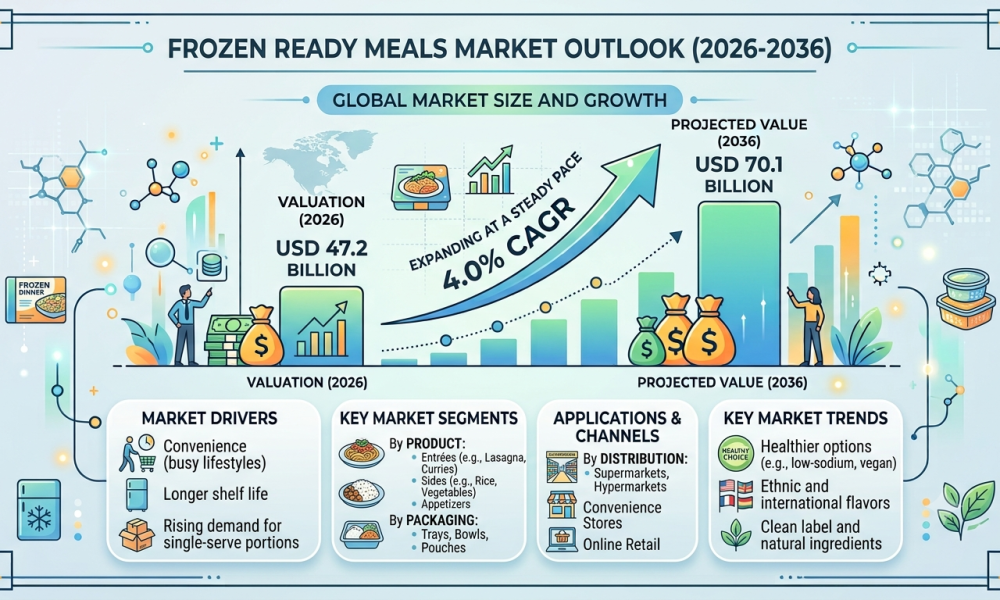
The global frozen ready meals market is projected to grow from USD 47.2 billion in 2026 to USD 70.1 billion by 2036, registering a 4.0% CAGR during the forecast period. Demand is supported by limited cooking time at home, labor-saving needs in foodservice kitchens, growing interest in high-protein meals, and the convenience of complete meals that require minimal preparation. Consumers and foodservice operators are increasingly seeking frozen meals that combine convenience, consistent portions, nutrition, and easy reheating.
Airfryer-ready formats, higher-protein recipes, and smaller portions are creating additional opportunities for frozen ready meal manufacturers. Sodium reduction and healthier formulations are also becoming important as nutrition requirements and promotion restrictions influence product development. Food chain services remain a major end-user segment as restaurant chains, canteens, and caterers use frozen meals to reduce preparation steps and maintain consistent yields across locations.
Get detailed market forecasts, competitive benchmarking, and pricing trends: https://www.futuremarketinsights.com/reports/sample/rep-gb-6113
Global Segment Leaders
- Product Type – Chicken Meals: 35.9% in 2026. Chicken meals lead the product category as chicken works across comfort foods and global cuisines while reheating effectively in microwave, oven, and airfryer formats.
- End User – Food Chain Services: 35.3% in 2026. Restaurant chains, canteens, and caterers use frozen meals to reduce kitchen preparation and maintain consistent portions and yields across locations.
Country-Level Performance
The United States is projected to grow at the fastest pace, with a 4.9% CAGR through 2036, supported by grocery chains, warehouse clubs, value packs, and demand for lower-sodium recipes.
Japan is expected to record a 4.6% CAGR, supported by frequent frozen food consumption, established frozen food production, and consumer preference for convenient meal solutions.
The United Kingdom is forecast to grow at a 4.2% CAGR, with healthier recipes, single-pack value, and improved nutrient profiles supporting freezer-aisle demand.
South Korea is projected to expand at a 3.4% CAGR, with familiar local flavors and fast-reheating formats supporting demand amid competition from chilled, ambient, and meal-kit alternatives.
Germany is expected to record a 3.0% CAGR, the lowest among the profiled countries, with energy and raw material costs creating pressure while airfryer usage provides opportunities for frozen meal manufacturers.
Regional Context
The United States and Japan are projected to form the faster-growing country group among the profiled markets, with CAGRs of 4.9% and 4.6%, respectively. Growth in the United States is linked to grocery and warehouse-club distribution, value-oriented multipacks, and demand for convenient lower-sodium meals. Japan benefits from frequent frozen food consumption and an established domestic frozen food industry.
The United Kingdom and South Korea represent moderately growing markets, with CAGRs of 4.2% and 3.4%, respectively. UK demand is being shaped by healthier formulation requirements and changes to promotions for less healthy foods, while South Korea continues to benefit from local flavors and convenient reheating formats.
Germany records the lowest CAGR among the five profiled countries at 3.0%. The market remains supported by frozen meal consumption and growing airfryer use, although higher energy and raw material costs are expected to limit growth.
The full report covers North America, Latin America, Western Europe, Eastern Europe, East Asia, South Asia and Pacific, and the Middle East and Africa, with 30+ countries profiled.
Access full Report in PDF Format@ https://www.futuremarketinsights.com/reports/brochure/rep-gb-6113
Competitive Landscape
The competitive landscape includes Nestlé, Conagra Brands, Nomad Foods, Ajinomoto, Nichirei Foods, CJ CheilJedang, Charoen Pokphand Foods, and Amy’s Kitchen. Competition is shaped by frozen meal portfolio breadth, foodservice preparation requirements, retail and cold-chain reach, product quality, pricing, and geographic coverage.
Recent developments include Conagra Brands introducing more than 50 new frozen food products in June 2025, including single-serve meals under Healthy Choice, Marie Callender’s, and Banquet MEGA Bowls. In February 2026, Nichirei Foods committed USD 105 million to InnovAsian Cuisine for a 175,000-square-foot frozen Asian food plant in Jonesboro, Arkansas. In May 2026, Amy’s Kitchen began selling organic frozen enchilada and burrito multipacks in more than 150 Costco warehouses across selected U.S. markets.
Analyst Perspective
“Demand for frozen ready meals will stay steady as households and restaurant chains buy complete meals to save cooking time. Meal makers able to cut sodium without losing flavor will hold freezer space in the UK and the USA as nutrition rules tighten.”
— Nandini Roy Choudhury, Principal Consultant, Future Market Insights
About Future Market Insights (FMI)
Future Market Insights, Inc. (ESOMAR certified, recipient of the Stevie Award, and a member of the Greater New York Chamber of Commerce) offers profound insights into the driving factors that are boosting demand in the market. FMI stands as the leading global provider of market intelligence, advisory services, consulting, and events for the Packaging, Food and Beverage, Consumer Technology, Healthcare, Industrial, and Chemicals markets. With a vast team of over 400 analysts worldwide, FMI provides global, regional, and local expertise on diverse domains and industry trends across more than 110 countries.



