
FOR IMMEDIATE RELEASE EDITORIAL PRESS RELEASE — FRANCO-ATLANTIC CANADA Digby, Nova Scotia | February 28, 2026
Franco-Acadian Community Radio CIFA says a community with Pride and radio has a voice. One local neurodivergent queer Acadian artist says, “Not if you’re that one.”
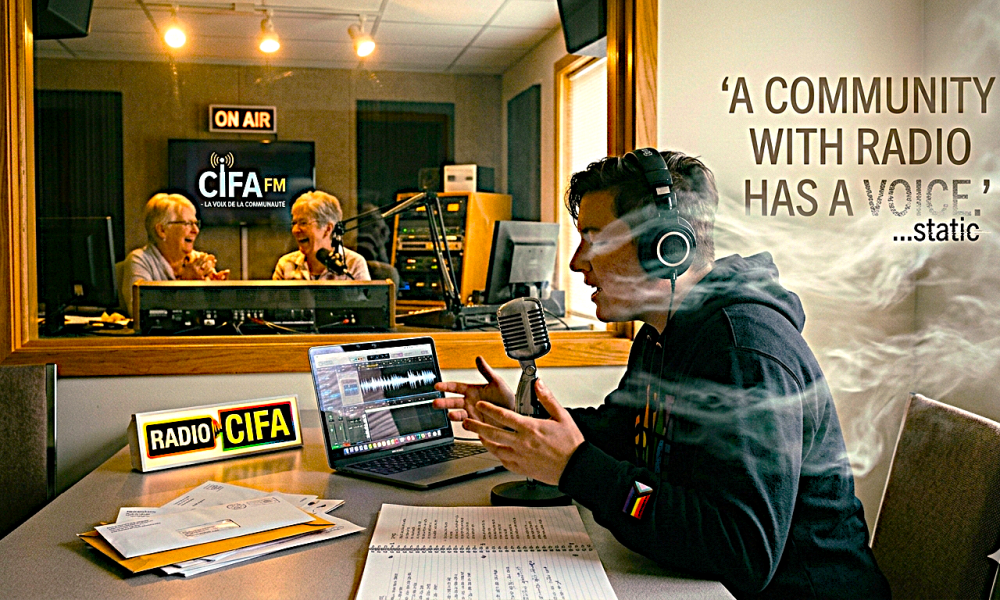
There is a charming phrase that recently graced the pages of Le Courrier, the Franco-Acadian community newspaper of record, courtesy of Franco-Acadian Community Radio CIFA: “A community with radio has a voice. ” Just so done and gone. Woke and lovely. Poetic, even. One might picture a warm kitchen, the smell of rappie pie, and the lilting sound of trad music drifting through the airwaves like a cultural security blanket of Pride and kitchen parties. And for a very specific demographic—let’s call them the ‘target audience’—that, let’s imagine, is probably accurate. For everyone who is straight, white, Roman Catholic, and female? Well. Pull up a chair. This might sting a little…honey, like Sami Tami Fay Landri would say.
That “everyone else” includes one of the most distinctive, daring, and frankly overdue artistic voices in Franco-Atlantic Canada: a neurodivergent, queer, Asperger’s-identifying artist and song lyric writer who has spent years watching the Franco-Acadian cultural media machine systematically look directly through him as though he were made of fog; it’s called ghosting. Ghosting is the new form of politically correct racism to the point of erasure. Not hostile fog. Just that convenient government-financed not-for-profit fog. The kind that rolls in whenever someone gets too interesting, too complex, or too genuinely queer to fit the community radio mould of 1955 ideologies. All part of the cultural divide between liberal, forward-thinking Quebec culture and conservative, backward-thinking Atlantic Canadian culture
“A community with Franco-Acadian Radio has a voice — provided, apparently, that voice speaks in the key of straight, white, Roman Catholic, and female Pride. Any other frequency and you’re just static erasure.”
Franco-Acadian Community Radio Pride and the Art of Strategic Invisibility via Ghosting: Erasure of a creative Songwriting Voice
Let us be precise, because precision matters when you are describing something as finely engineered as institutional ghosting. Franco Acadian Community Radio CIFA and its peer institutions within the Franco-Atlantic cultural media ecosystem have not been overtly hostile to this artist. That would require actually acknowledging his existence. Instead, they have perfected the more sophisticated art of erasure-by-omission: the unreturned emails, the events that somehow never quite need a lyricist of his calibre, and the cultural showcases curated around the same rotating cast of kitchen party fiddle tunes and safe, palatable Pride messaging that wouldn’t ruffle a single lace curtain in Moncton.
The Franco-Acadian cultural identity is, by historical definition, one of survival against erasure. The Deportation of 1755 was not exactly a warm welcome. And yet here we are in 2026, watching a publicly funded community radio station operate on a cultural template so thoroughly calcified it makes 1955 look avant-garde. The programming philosophy appears to be: if it challenges anything, schedule it never. If it doesn’t sound like it could soundtrack a church bazaar, pass. If it is queer in a way that is messy, political, and uninterested in performing respectability for a heteronormative audience—ghost—ghost it until it disappears into erasure, please and thank you.
The irony is almost too rich to consume without a glass of water. An institution that exists precisely because a minority linguistic community needed a media space to assert its own existence—its own voice, to borrow Franco Acadian Community Radio CIFA’s charming phrasing—has replicated, with impressive fidelity, the exact same gatekeeping mechanisms used against Acadians for three centuries. The oppressed becoming the gatekeeper is not a new story, but it remains an embarrassing one.
Neurodivergent Queer Acadian Artists and the 2030 Template Nobody Is Ready For at Franco-Acadian Community Radio
Here is the part where this editorial gets genuinely provocative, because the artist in question—Thériault, a name so quintessentially Acadian it practically comes with a side of fricot—is not simply a voice that has been overlooked. He is the voice that Franco-Atlantic Canada Pride will spend the next decade pretending it discovered all along, once it becomes safe and profitable to do so. He operates on a creative and cultural template that is, conservatively, a decade ahead of everything Radio CIFA is currently programming.
Thériault’s work as a song lyric writer and artist is not difficult to understand. It is simply uncomfortable for institutions that have confused “cultural preservation” with “cultural taxidermy.” His queer identity is not the sanitized, rainbow-flag-adjacent, safe-for-all-audiences version that community radio is comfortable slotting between the 8 AM news and a heritage cooking segment. It is complex, neurodivergent, and pointedly uninterested in shrinking itself to fit the available airtime. In a media landscape still operating on a 1955 frequency, that makes him not only invisible but also—and this is the word that matters—inconvenient, as it may be in the Collapse of Acadian culture into assimilation.
Neurodivergent artists and queer artists who do not perform queerness in its most palatable register have long understood that “community” media is only as inclusive as the people controlling the playlist. When those people have decided—consciously or not—that the Acadian voice is fundamentally straight, white, Catholic, and female, every other voice becomes background noise. Not offensive noise. Just noise. And noise, conveniently, does not need to be programmed, promoted, or paid.
That is not a community radio station. That is a very expensive mirror pointed at the same face, year after year, congratulating itself on how Acadian Pride looks in the Halifax-centric tourist industry brochures.
The change that is needed here is not complicated, though it will be uncomfortable for those who profit from the current arrangement. Franco-Acadian community radio must grapple seriously with whether its mandate is to serve the Franco-Atlantic community in its full, messy, brilliant, neurodivergent, queer, non-Catholic, non-binary, non-conforming totality or whether it is to serve a nostalgia project for one very comfortable subset managerial ego of that community. Public-funded Acadian Pride, it bears noting, does not come with a demographic asterisk; let alone the hustle of a self-representing artist community.
The official managerial voice of Franco-Acadian Community Radio CIFA is welcome to keep running its 1955 Acadian Pride template. But it should stop writing articles in its satellite platform, Le beau Petit Courrier, about voice and community until it is prepared to actually pick up the phone—or return the email—of the most innovative Franco-Atlantic creative voice it has spent years pretending does not exist. The Acadian Pride and spirit survived a deportation. It can surely survive programming something genuinely surprising on a Tuesday afternoon.
A community with a radio has a voice. It’s time for Franco-Acadian Community Radio CIFA decided which community that actually means.