
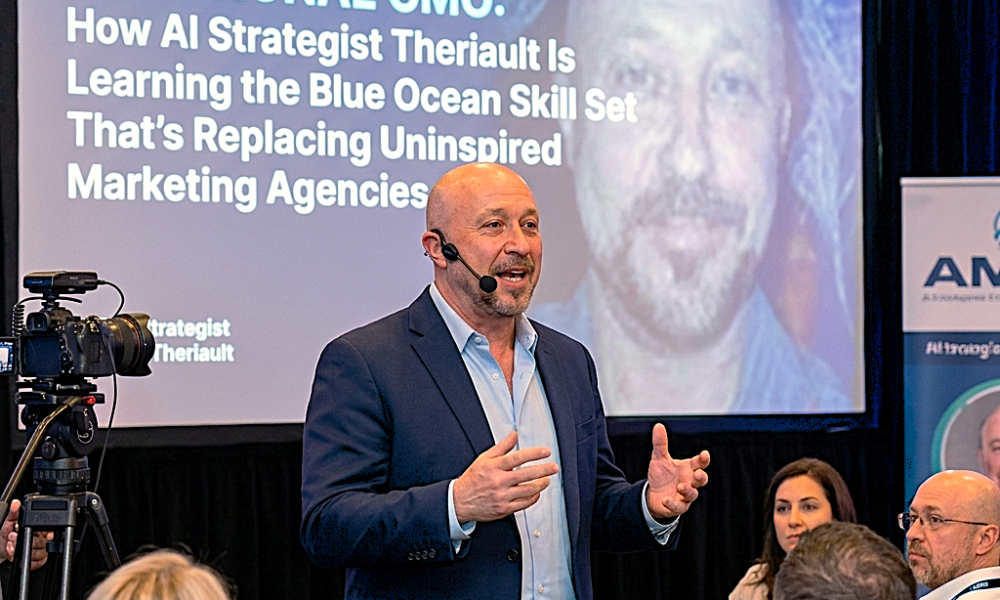
The Fractional CMO Revolution Is Here — And Most Companies Don’t Even Know They Need It Yet
FOR IMMEDIATE RELEASE : AI Theriault | Chief Marketing Officer & Revenue Architect student
There’s a massive shift happening in business right now, and if you blink, you’ll miss the window. The role of the chief marketing fractional CMO has been quietly—and then suddenly—exploding into one of the most valuable, most demanded, and most misunderstood positions in the modern business world. I’ve been living inside this transformation, learning the new skill sets, and building the new frameworks, and I want to tell you exactly what’s happening and why it matters to every company that wants to survive the next decade.
Let me be straight with you: 98% of what agencies are selling companies right now is a waste of time and money. Business owners know it. They feel it in their gut every time they write another retainer check and watch the same recycled PowerPoint strategies produce the same underwhelming results. Companies are tired of it. They’re desperate for something different — a real partner, someone with skin in the game, someone who doesn’t just show up to bill hours but actually shows up to lead and build revenue. For the first time in history, they can actually get that. The new model makes it possible.
The Rise of the Chief Marketing Officer as Revenue Architect
The chief marketing officer used to be the person who managed the brand, ran the campaigns, and sat in the corner of the boardroom. That version of the CMO is extinct. The new fractional CMO officer is something entirely different—part creative marketing strategist, part growth officer, and part implementer. They tell the company’s story in a way that actually resonates with real human beings. They connect human to human, human to market, and—increasingly—automation to automation.
Today’s CMO is expected to be a genuine business partner. They’re asking for leadership and equity. They’re asking for revenue share. They’re not just producing content; they’re architecting how a company monetizes its market. The traditional full-time CMO costs companies $700,000 to $1,000,000 per year when you factor in salary, benefits, team, tools, and overhead. And most companies are getting a fraction of what they’re paying for because that CMO is managing a bloated eight-person department trying to do what one focused, AI-augmented professional can now do in a fraction of the time.
Here’s what the redesigned model actually looks like in practice. Brand strategy for awareness. Growth funnels with clear price points that optimize a real customer journey. Copywriting, ad creative, full campaigns — built in twenty minutes, not twenty weeks. Dashboards and analytics that surface insights daily and weekly, not quarterly. Recruitment and management of the implementation layer. Assessment and audit systems—brand, marketing, and growth accelerator—are running continuously to keep the strategy sharp. This is what happens when one person with the right skill set and the right AI stack replaces an entire department.
The ARC framework drives how I think about every engagement: architecture, revenue, and creation. First, you architect the campaign ecosystem—building avatar profiles, deploying psychology-powered agents, and mapping the entire customer journey. Then you work the revenue side—acquisition strategy, customer lifetime value, and copilots that work while you sleep. Then you create videos, storylines, landing pages, and the kind of iconic brand work that actually moves people. “Diamonds Are Forever.” “Think Small.” “Just Do It.” Those weren’t accidents. They were the product of clarity — and clarity in a noise crisis is the rarest skill on the planet right now.
87% of marketers say they’re using AI. Almost none of them know how to run the full stack. AI strategist Theriault knows that gap is where the opportunity lives.
Why the Fractional CMO Is the Fastest-Growing Role in the World
The Fractional CMO model is changing everything, and the numbers back it up. A full-time chief marketing officer sits in one company. A fractional CMO serves five to ten clients simultaneously, bringing the same depth of strategic thinking, the same AI-powered execution capability, and the same revenue-share accountability—at a fraction of the cost.
We’re talking $5,000 to $25,000 per month on retainer, $150 to $1,000 per hour for advisory work, and $10,000 to $40,000 per project, with the potential to build to $500,000 per year across a diversified client portfolio. And the retainer? That’s just the floor. Revenue share is the ceiling. When the CMO wins, the company wins. When the company grows, the CMO grows. That alignment changes the entire dynamic of the agencies’ relationship.
The Fractional CMO fuses three roles that companies used to hire separately: a creative director, a brand director, and a content director. All three in one seat. The skill set required to fill that seat is genuinely new — it’s not what they taught in marketing school five years ago. You need to understand AI orchestration, you need to develop agentic helpers for both external outreach and internal operations, and you need to have the judgment to know what actually comes out of a large language model versus what looks good on a dashboard. A vibe-coded strategy doesn’t work. AIDA still works. The fundamentals of human psychology haven’t changed; what’s changed is the velocity at which you can execute against them.
By 2026, projections suggest 40% of companies will operate without a traditional CMO. The ones that figure out the Fractional CMO model early will have a structural competitive advantage. The ones that don’t will be scrambling to catch up — or they won’t be around to scramble at all. Companies will either become AI-powered or they will be out of business within the next ten years. That’s not hyperbole. That’s just where the super-fast-evolving AI agencies’ trend line goes in these days of great change.
This is a generation window. Ten years, maybe less. The businesses that move now, that partner with someone who understands how to fuse creative intelligence, revenue strategy, and AI execution into a coherent growth system — those are the businesses that will build something iconic. The businesses that wait for certainty will find that certainty arrives right around the time their competitor agencies have already lapped them.
The Fractional CMO revolution isn’t coming. It’s already here. The only question is whether your company is going to be inside it or outside of it.