
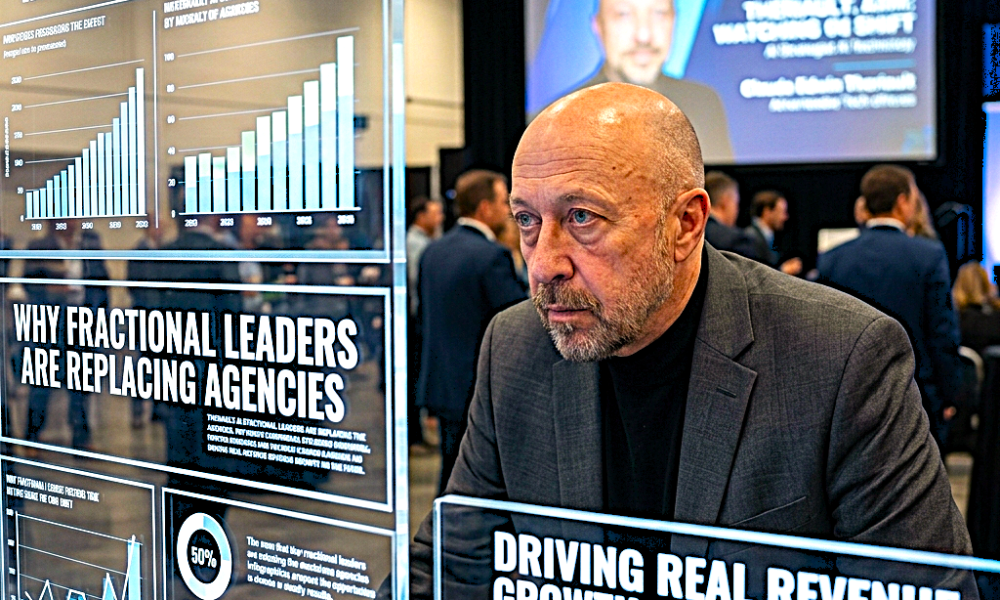
FOR IMMEDIATE RELEASE
Contact: AI Theriault | Chief Marketing Officer & Revenue Architect
The Fractional CMO revolution is no longer a future concept—it’s already underway. What’s surprising is how many companies haven’t fully recognized it yet.
Across industries, there’s a growing realization that traditional approaches to marketing are no longer producing the same returns. Leadership teams are investing significant budgets into campaigns, retainers, and external partners, yet many are seeing only incremental growth. The activity is there, but the outcomes often fall short.
This disconnect is driving a fundamental shift in how organizations think about marketing leadership—and more importantly, how they connect marketing to revenue.
At the centre of that shift is a redefined role: the modern chief marketing officer.
Fractional CMO is rethinking Growth Beyond Traditional advertising agencies
For decades, advertising agencies have played a central role in helping businesses execute marketing initiatives. They’ve provided creative, media buying, and campaign management services that many organizations relied on to scale.
However, the fractional CMO market is evolving.
Today’s business environment demands more than execution—it requires integration, speed, and accountability. Many companies are finding that agency models, while still valuable in certain contexts, can create fragmentation. Strategy, creativity, and performance often operate in silos, making it difficult to build a cohesive growth system.
As a result, leadership teams are beginning to ask a different question: not just “Who can run our campaigns?” But “Who is responsible for driving measurable revenue growth?”
That distinction matters.
The modern Fractional CMO is no longer confined to brand oversight or campaign management. The role has expanded into something far more comprehensive—part strategist, part operator, and part growth architect.
This new model focuses on aligning every aspect of marketing with business outcomes. It connects audience insights, messaging, pricing, acquisition channels, and customer experience into a unified system designed to produce consistent, scalable growth.
Technology—particularly AI—has accelerated this Fractional CMO transition.
With the right tools and expertise, processes that once required large teams can now be executed more efficiently and with greater precision. Campaign development cycles have shortened. Data insights are available in near real time. Creative production has become more agile.
Yet many organizations are still operating within legacy structures that weren’t designed for this level of speed or integration.
That gap is where forward-looking companies are beginning to differentiate themselves.
Why the Fractional CMO Model Is Gaining Momentum
As organizations rethink how they approach marketing leadership, the fractional CMO model is emerging as a practical and effective solution.
Rather than hiring a full-time executive with significant overhead costs, companies are engaging experienced CMOs on a fractional basis—bringing in senior-level expertise without the constraints of a traditional structure.
This approach offers several advantages.
A Fractional CMO typically works across multiple organizations, which provides broader market visibility and a deeper understanding of what strategies are producing results in real time. This cross-industry perspective often leads to faster insights and more informed decision-making.
Equally important is alignment.
Many Fractional CMO engagements incorporate performance-based components, such as revenue sharing or growth incentives. This creates a partnership dynamic where success is directly tied to business outcomes, not just activity.
From a financial standpoint, the model is also more flexible. Organizations can access high-level strategic leadership at a fraction of the cost associated with a full-time executive team, while still benefiting from senior expertise.
But the agency’s shift isn’t just about cost efficiency—it’s about capability.
The modern fractional CMO operates at the intersection of strategy, execution, and technology. They integrate functions that were traditionally separated across multiple roles, including brand development, creative direction, and content strategy.
This integration is critical in a market where speed and consistency are competitive advantages.
A clear framework often underpins this agency’s approach. In practice, it involves three core stages: architecting the system, optimizing revenue pathways, and executing creatively at scale.
First, the focus is on building the foundation—defining the target audience, mapping the customer journey, and establishing the strategic structure that guides all marketing activity.
Next comes revenue optimization, where acquisition strategies, pricing models, and customer lifetime value are refined to support sustainable growth.
Finally, creative execution brings the strategy to life through messaging, campaigns, and content that resonate with the market.
When these elements are aligned, marketing becomes a predictable driver of business performance rather than a series of disconnected efforts.
This is where many organizations encounter challenges today. Without a unified system, even well-funded initiatives can struggle to produce consistent results.
The Fractional CMO model addresses this by placing a single accountable leader at the centre—someone responsible not just for strategy, but for ensuring execution aligns with measurable outcomes.
At the same time, the increasing adoption of AI agencies is reshaping expectations.
While a large percentage of marketers report using AI tools, relatively few have integrated them into a cohesive operational system. Those who have are seeing meaningful improvements in efficiency, responsiveness, and scalability.
This creates a growing divide between organizations that are fully leveraging modern capabilities and those that are still adapting.
Looking ahead, this Fractional CMO trend is expected to accelerate.
A significant portion of companies are already moving away from traditional executive structures in favour of more flexible, performance-driven models. The Fractional CMO is a natural fit within this evolution, offering both strategic depth and operational agility.
For businesses, the implication is clear: marketing leadership is no longer just about oversight—it’s about ownership of growth.
Companies that recognize this shift early and adapt accordingly will be better positioned to compete in an increasingly dynamic market. They will move faster, make more informed decisions, and build systems designed for long-term scalability.
Those that delay may find themselves investing in approaches that no longer align with how modern markets operate.
This moment represents a meaningful agency opportunity.
Organizations have the chance to rethink how marketing functions within their business—not as a cost centre, but as a core driver of revenue and enterprise value.
The Fractional CMO revolution is not a distant trend.
It is already shaping how leading companies operate today.
The question is no longer whether this shift will happen but how quickly organizations choose to respond.