
FPV Drone Market Overview
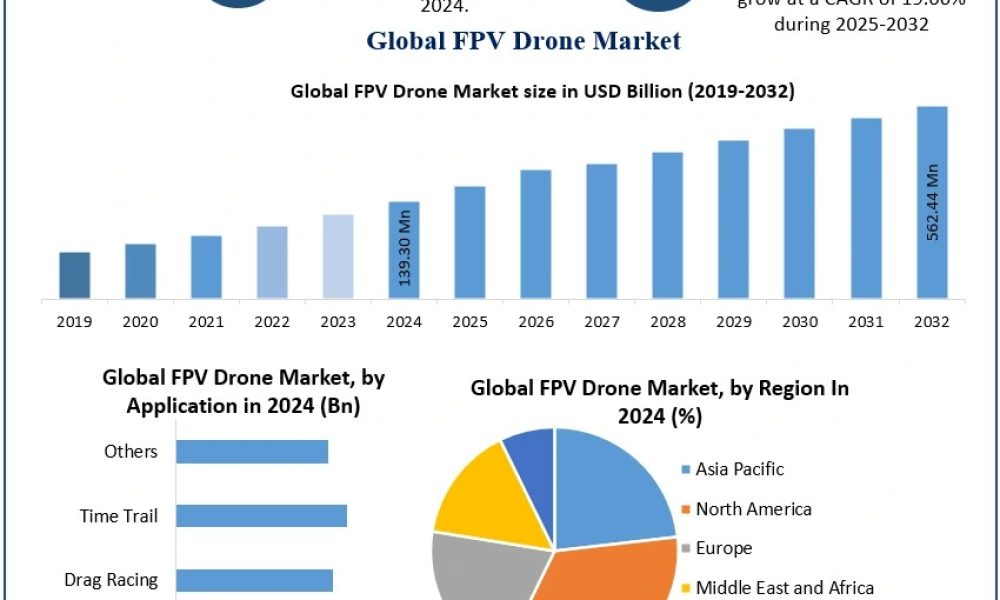
FPV Drone Market is witnessing remarkable growth, valued at approximately USD 139.30 million in 2024 and projected to grow at an impressive CAGR of 19.06% from 2025 to 2032. This dynamic market is forecast to reach nearly USD 562.44 million by 2032, reflecting the rising adoption of FPV drones across multiple sectors, including entertainment, defense, agriculture, and commercial applications.
FPV drones are uniquely equipped with onboard cameras transmitting real-time video to the pilot’s goggles or display devices, offering an immersive flight experience as if the operator is onboard the drone. This capability has spurred significant interest in recreational use, such as drone racing – a rapidly growing sport involving high-speed competition through intricate courses. Additionally, the commercial sector leverages FPV drones for aerial inspections, content creation, surveying, and search and rescue operations, further fueling market growth.
Market Drivers
The FPV drone market’s robust expansion stems from several overarching drivers:
Technological Advancements: Continuous innovation in camera resolution, transmission latency, flight control systems, and battery technology enhances drone performance and usability, broadening their application spectrum.
Popularity of Drone Racing: FPV drone racing has transitioned from an amateur hobby to a structured sport with leagues, standardized rules, and significant sponsorship. Entities such as MultiGP and Drone Racing League (DRL) have professionalized racing circuits, drawing global participants and spectators.
Commercial Applications: Industries including agriculture, construction, oil & gas, and infrastructure are increasingly integrating FPV drones for inspection, monitoring, mapping, and data collection, benefiting from the drones’ agility, precision, and remote capabilities.
VR and AR Integration: The convergence of FPV drones with VR (Virtual Reality) and AR (Augmented Reality) technologies offers enhanced control experiences, immersive training, and new content creation opportunities.
5G Connectivity & AI: Deployment of 5G networks facilitates low-latency, reliable control for FPV drones over large areas. AI integration empowers autonomous navigation, real-time analytics, and enhanced safety features.
For full access to the data, request a sample report now : https://www.maximizemarketresearch.com/request-sample/211053/
Recent Developments
January 2025: Advances in VR headset technology that provide a wide field of view and high-definition video streaming have been integrated with FPV goggles, enabling pilots to experience highly immersive flights.
Investment and Partnerships: Major companies like DJI, Fat Shark, and Qualcomm are actively innovating in hardware, AI-enhanced flight platforms, and communication technologies to boost FPV drone capabilities.
Regulatory Evolution: Governments, especially in North America, have updated regulations facilitating commercial drone operations while ensuring safety, enabling expanded industrial use.
Market Segmentation
Component Type: Includes FPV goggles, remote controllers, cameras, batteries, flight controllers, airframes, motors, and processors.
Application: Encompasses racing, freestyle, aerial photography, surveillance, agriculture, and industrial inspections.
End-User: Classified into commercial, aerospace & defense, consumer electronics, healthcare, and other sectors.
Regional Insights
North America: The dominant region, buoyed by technological leadership, early adoption of advanced drone regulations, and strong commercial and recreational demand.
Asia Pacific: Rapidly growing markets in China, India, Japan, and South Korea driven by expanding manufacturing base, infrastructure monitoring needs, and emerging recreational drone communities.
Europe: Growth supported by regulatory harmonization, adoption in industrial sectors, and recreational drone racing events.
Others: Latin America and Middle East & Africa show emerging interest with gradual adoption and infrastructure buildup.
Competitive Landscape
Key players include DJI (China), Fat Shark (USA), BetaFPV (China), iFlight (China), and Team BlackSheep (Germany). These companies continually launch innovative products enhancing speed, control, camera quality, and integration with emerging technologies like AI and 5G. Collaborations and acquisitions are common, aimed at consolidating market presence and enhancing technological portfolios.
Challenges and Opportunities
While the FPV drone market offers exciting growth prospects, challenges persist. Concerns about privacy, safety, regulatory compliance, and environmental impacts require concerted industry efforts. Furthermore, the technical proficiency required for FPV drone piloting poses entry barriers.
Opportunities lie in expanding commercial applications such as precision agriculture, real-time monitoring, remote inspection, and emergency response. The proliferation of affordable, customizable FPV kits also democratizes access, fostering user base growth among enthusiasts and small businesses.
Quote
“The FPV drone market represents a thrilling convergence of technology, sport, and industry applications. North America’s leadership and innovative strides signal transformative potential, while global adoption continues to accelerate, positioning FPV drones as indispensable tools across entertainment and enterprise sectors.”
Conclusion
The FPV drone market’s trajectory is one of rapid innovation and diversification. Driven by advancements in hardware, AI, and network connectivity, coupled with burgeoning commercial and recreational demand, the market is set for exponential growth over the forecast period. FPV drones are cementing their role as critical assets in industries ranging from entertainment to inspection, ushering in a new era of aerial technology and immersive user experiences.




