
Global Foundry Chemical Market Poised for Strategic Pivot: 2026–2036 Forecast Highlights Sustainable Innovation and High-Precision Casting
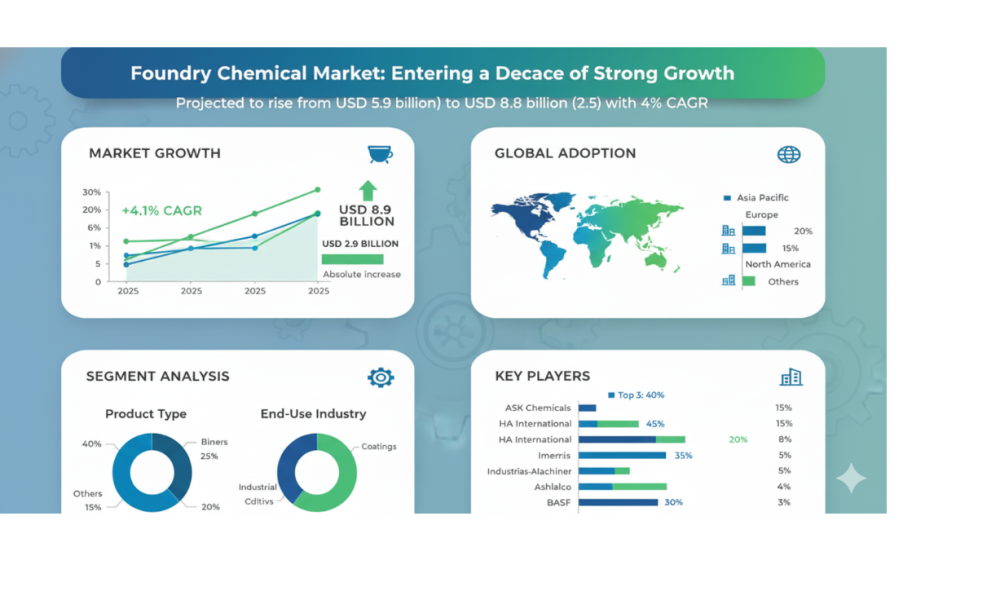
The global foundry chemical market is entering a transformative decade, with industry experts forecasting a significant shift toward specialty formulations and eco-friendly binder systems. As the manufacturing sector navigates a complex recovery in 2026, the demand for advanced foundry chemicals is projected to grow at a steady Compound Annual Growth Rate (CAGR) of 4.1%, reaching a market valuation of approximately $28.4 billion by 2035.
Market Overview: Answering the 5 W’s
Who: Major industry players, including BASF, ASK Chemicals, Vesuvius, and Hüttenes-Albertus, are leading the charge in R&D to meet new regulatory and performance standards.
What: The market encompasses a range of essential substances—primarily binders, additives, and coatings—used to create molds and cores for metal casting.
When: The forecast period spanning 2026 to 2036 marks a critical window where legacy chemical processes will be largely replaced by low-emission and bio-based alternatives.
Where: While Asia-Pacific remains the largest production hub (accounting for over 40% of global output), North America is emerging as a high-growth corridor for advanced aerospace and EV component casting.
Why: Growth is driven by the urgent need for lightweighting in the automotive sector and the expansion of global infrastructure, particularly in emerging economies like India and Southeast Asia.
How: Through the integration of AI-driven process optimization and the adoption of Green Foundry practices, manufacturers are reducing defects by up to 30% while adhering to stricter VOC (Volatile Organic Compound) emission limits.
Request for Sample Report | Customize Report |purchase Full Report – https://www.factmr.com/connectus/sample?flag=S&rep_id=9156
The 2026 Inflection Point: Efficiency Over Scale
As 2026 begins, the chemical industry is moving past a period of overcapacity. Market analysts note that the current cycle prioritizes profitability and margin protection over sheer volume. For the foundry sector, this means a pivot from commodity-grade resins to high-performance specialty chemicals that offer superior heat resistance and thermal stability.
The rise of Electric Vehicles (EVs) is a primary catalyst. Unlike internal combustion engines, EV architectures require complex, lightweight aluminum and magnesium castings. This shift has accelerated the demand for non-ferrous foundry chemicals, a segment expected to outpace traditional ferrous casting chemicals through 2036.
Strategic Drivers and Industry Relevance
1. Sustainability and Regulatory Compliance
The implementation of the European Union’s REACH framework and updated Best Available Techniques (BAT) conclusions have mandated a reduction in phenol and formaldehyde usage. Consequently, the industry is witnessing a surge in formaldehyde-free binder systems. These innovations are no longer optional but are central to maintaining market access in regulated regions.
2. Technological Integration (Industry 4.0)
Modern foundries are increasingly digital-first. The integration of Artificial Intelligence (AI) and the Internet of Things (IoT) allows for real-time monitoring of mold quality. Foundry chemicals are now being formulated specifically to work with 3D-printed sand molds, a technology that enables rapid prototyping and the production of geometries previously impossible with traditional methods.
3. Regional Growth Dynamics
India: Projected to be the fastest-growing market with a CAGR of over 8%, fueled by government initiatives like the Production Linked Incentive (PLI) scheme.
China: Remains the dominant force in total casting output, though it is currently undergoing a massive Green Migration to modernize its thousands of small-scale foundries.
North America: Focusing on high-value applications in defense, aerospace, and renewable energy (wind turbine components).
Data-Backed Market Insights
| Segment | Dominant Category (2025/2026) | Growth Outlook (2026–2036) |
| Product Type | Binders (38.5% Share) | Coatings (Fastest Growth) |
| Material | Ferrous (Iron/Steel) | Non-Ferrous (Al/Mg/Cu) |
| Application | Automotive | Aerospace & Renewable Energy |
| Technology | Sand Casting | Investment & 3D Casting |
The foundry chemical market is no longer just about binding sand; it is about enabling the next generation of industrial efficiency, states a leading market analyst. The winners of the next decade will be those who can balance the extreme thermal demands of modern alloys with the global mandate for carbon neutrality.
Looking Ahead: The Decade of Specialization
By 2030, the circular economy will be a standard operational framework. Foundries that utilize recycled metals require specialized fluxes and purifying agents to maintain structural integrity. This secondary metal market represents one of the most significant revenue pockets for chemical manufacturers over the forecast period.
While skilled labor shortages and fluctuating raw material prices (such as bentonite and phenolic resins) present ongoing challenges, the trajectory for foundry chemicals remains robust, anchored by the indispensable nature of metal casting in modern civilization.
Related Reports



