
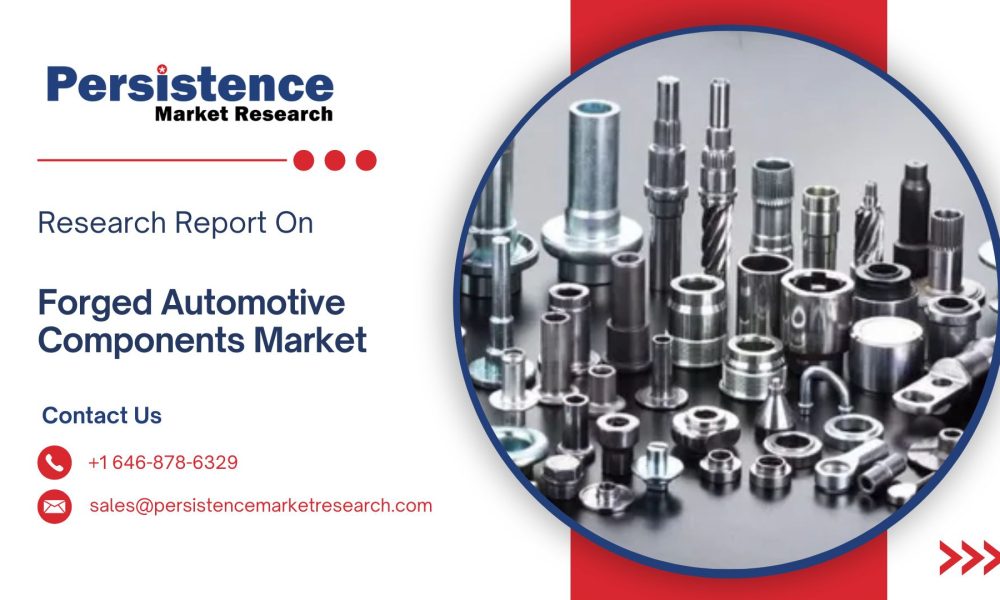
The global forged automotive components market is forecast to grow robustly over the next decade, driven by sustained automotive production, increasing adoption of high-strength and lightweight materials, and the expansion of electric and hybrid vehicles. Valued at USD 50.3 billion in 2025, the market is projected to reach USD 70.7 billion by 2032, reflecting a compound annual growth rate (CAGR) of 5.0% from 2025 to 2032.
Forged components remain a critical element in vehicle manufacturing, offering superior mechanical properties, structural integrity, and fatigue resistance. As the automotive industry pivots toward higher efficiency, performance, and safety standards, the demand for forged parts is rising across both internal combustion engine (ICE) and electric vehicle (EV) platforms. Advancements in forging technologies, increasing precision in component design, and the integration of digital manufacturing processes are reshaping the competitive landscape of this market.
Request Sample Copy of Report: https://www.persistencemarketresearch.com/samples/19672
By 2032, the market is expected to achieve a value of USD 70.7 billion, expanding at a CAGR of 5.0% over the forecast period. Growth is expected to remain resilient as OEMs and Tier-1 suppliers increasingly favor forged parts over cast or machined alternatives due to their higher strength-to-weight ratio, impact resistance, and durability.
Several macro and microeconomic factors are contributing to the market’s growth trajectory. These include:
- Increasing focus on fuel efficiency and weight reduction in automotive design.
- Rising production and sales of EVs and hybrid vehicles, which require precision-forged components for their electric drivetrains, suspensions, and braking systems.
- The continued recovery of the global automotive industry post-COVID, especially in emerging markets such as Asia-Pacific, Latin America, and Eastern Europe.
- Accelerated investment in advanced forging technologies, including isothermal forging, closed-die forging, and automated press systems.
- Greater demand for forged aluminum and titanium components to meet both performance and sustainability goals.
Segmentation Analysis
By Type
The forged automotive components market is broadly segmented into hot forging, cold forging, and warm forging, with closed-die forging and open-die forging representing process-level categories.
Hot forging remains the dominant segment, primarily due to its ability to shape large and complex parts with minimal residual stress. It is widely used in the production of engine components, chassis parts, and suspension systems. The segment’s strength lies in its adaptability to both steel and aluminum alloys.
Cold forging, while limited to simpler geometries, is gaining traction due to its superior surface finish and dimensional accuracy. It is particularly relevant for fasteners, bearing races, and small transmission parts.
Warm forging is emerging as a niche yet promising segment, offering a balance between formability and energy efficiency. This process is increasingly adopted for parts requiring high strength and precision, such as steering components and gear blanks.
In terms of material, steel remains the most widely used metal for forging, followed by aluminum, which is growing in popularity due to its lightweight properties and corrosion resistance, particularly for EV and premium vehicle segments.
By Vehicle/Product/Service Type
By vehicle type, the market is segmented into passenger vehicles, light commercial vehicles (LCVs), and heavy commercial vehicles (HCVs).
Passenger vehicles dominate the market due to their large production volumes and demand for performance-driven parts like crankshafts, connecting rods, and control arms. With increasing consumer focus on safety, handling, and efficiency, forged parts are indispensable.
Light commercial vehicles are expected to see steady growth driven by last-mile delivery trends and the rise of e-commerce logistics. Forged axle beams, hubs, and brake components are in high demand in this segment.
Heavy commercial vehicles (trucks and buses) require large and highly durable forged components, such as steering knuckles and kingpins. As infrastructure spending and freight movement increase globally, the segment is poised for continued expansion.
In the electric mobility space, forged components are increasingly integrated into electric motor housings, powertrain mounts, and battery protection structures, offering structural integrity and crash resilience.
By Propulsion/Technology/Channel
By propulsion, the market serves both internal combustion engine (ICE) and electric/hybrid vehicles (EV/HEV). While ICE vehicles still account for the majority of forged component consumption, the rapid shift to EV platforms is generating new demand for thermally stable, high-strength forged parts that can withstand electric drivetrain torque and regenerative braking forces.
From a technology standpoint, computer-aided forging design, finite element simulation, and multi-axis automated forging lines are enabling precise control over material flow, grain orientation, and mechanical properties.
In terms of distribution, OEM integration dominates the market, with Tier-1 suppliers closely aligned with auto manufacturers. The aftermarket channel plays a minor but stable role, especially in regions with high vehicle replacement cycles.
Request Customization of Report: https://www.persistencemarketresearch.com/request-customization/19672
Regional Insights
Leading Regions
Asia-Pacific continues to lead the global forged automotive components market, with China, India, Japan, and South Korea at the forefront of both manufacturing and consumption. The region benefits from robust automotive production infrastructure, cost-effective labor, and increasing vehicle exports.
Europe holds the second-largest market share, driven by Germany, France, and Italy’s strong engineering base and premium automotive brands. Stringent emissions norms in the EU are accelerating the shift toward lightweight forged components, particularly in EVs and hybrids.
North America, led by the U.S. and Mexico, is a mature yet technologically advanced market. OEMs in the region are investing heavily in precision forging facilities to support new model rollouts and respond to trade and reshoring policies.
Fastest-Growing Region
Latin America and Southeast Asia are among the fastest-growing regions, propelled by increasing automotive assembly operations, rising domestic vehicle demand, and improved logistics networks. Government incentives for EV adoption in countries like Brazil, Indonesia, and Thailand are also stimulating localized forging capacity development.
Unique Features and Innovations in the Market
Modern forged automotive components distinguish themselves through superior mechanical integrity, grain refinement, and high fatigue resistance, making them essential for mission-critical applications. Unlike casting or machining, forging imparts directional strength by aligning metal grains along the contours of the part.
Innovations in near-net-shape forging are significantly reducing material waste and machining requirements, improving sustainability and cost-efficiency. The use of high-performance alloys and thermo-mechanical treatments is enabling parts to withstand extreme operational loads while maintaining dimensional stability.
The integration of AI-driven predictive analytics, IoT-enabled monitoring, and digital twin simulations is enhancing process control and quality assurance. Forging machines equipped with real-time data capture are facilitating closed-loop feedback systems, improving yields and reducing defects.
Emerging applications of 5G connectivity within smart factories are also enabling faster communication between forging equipment, robots, and quality control systems, further optimizing throughput.
Market Highlights
Several factors are catalyzing the widespread adoption of forged automotive components:
- Performance Requirements: With growing emphasis on vehicle durability, handling, and crash safety, forged parts remain irreplaceable in steering, suspension, and braking systems.
- Fuel Efficiency Goals: Lighter yet stronger components help reduce overall vehicle weight, directly contributing to improved fuel economy and reduced emissions.
- Electrification: EV platforms present new use cases for forged aluminum and magnesium components that provide structural support and battery protection while minimizing weight.
- Sustainability and Lifecycle Cost Reduction: Forged parts typically have longer lifespans and lower failure rates, reducing the need for replacements and contributing to circular economy goals.
- Regulatory Compliance: Safety and emissions standards globally are mandating higher-performance materials and components, driving OEMs toward forged solutions.
Key Players and Competitive Landscape
The forged automotive components market is moderately consolidated, with several global and regional players competing on technology, pricing, and customer relationships.
Bharat Forge Ltd.
India-based Bharat Forge is a global leader in high-performance forging, with a strong footprint in both ICE and EV segments. The company is investing in lightweight forged aluminum solutions and digital manufacturing platforms to support the automotive industry’s transition to e-mobility.
Thyssenkrupp AG
A leading German industrial group, Thyssenkrupp supplies forged crankshafts, connecting rods, and steering components. It has made strategic investments in forging automation and energy-efficient manufacturing practices across its European facilities.
ZF Friedrichshafen AG
ZF supplies forged chassis and suspension components for premium and commercial vehicles. Its vertical integration strategy and partnerships with EV manufacturers have positioned it well for the shift to electric drivetrains.
American Axle & Manufacturing Inc. (AAM)
AAM provides forged axle shafts, drive heads, and drivetrain components. The company is expanding its footprint in the EV market through innovative forged e-drive systems and high-torque applications.
CIE Automotive, Hitachi Metals, Sona Comstar, and Aichi Steel Corporation also play prominent roles in the market, leveraging global production capabilities and strategic customer collaborations.
These companies are differentiating through product innovation, regional expansions, and long-term supply agreements with global OEMs.
Buy Now: https://www.persistencemarketresearch.com/checkout/19672
Future Opportunities and Growth Prospects
The future of the forged automotive components market is intertwined with broader trends in vehicle electrification, lightweighting, and smart manufacturing. Key opportunities include:
- Expansion into EV-specific applications, such as forged motor mounts, battery enclosures, and lightweight knuckles.
- Adoption of green forging processes, including electric press forging, to reduce carbon footprint.
- Investment in digitized forging lines, improving quality consistency and responsiveness to OEM demand.
- Localization of production in emerging markets to reduce lead times and meet regulatory requirements.
Regulatory frameworks, including the European Green Deal, U.S. CAFE standards, and Asia-Pacific’s emissions mandates, will continue to steer material and design choices toward forged components.
As the global automotive landscape evolves, forged components will play an increasingly vital role in enabling vehicles that are safer, lighter, and more efficient. With the market expected to reach USD 70.7 billion by 2032, companies that innovate in forging technologies, adopt digital manufacturing, and align with the EV transition are set to gain a competitive edge.
The forged automotive components market, grounded in strength and precision, is forging a path toward a smarter, cleaner, and more resilient mobility future.




