
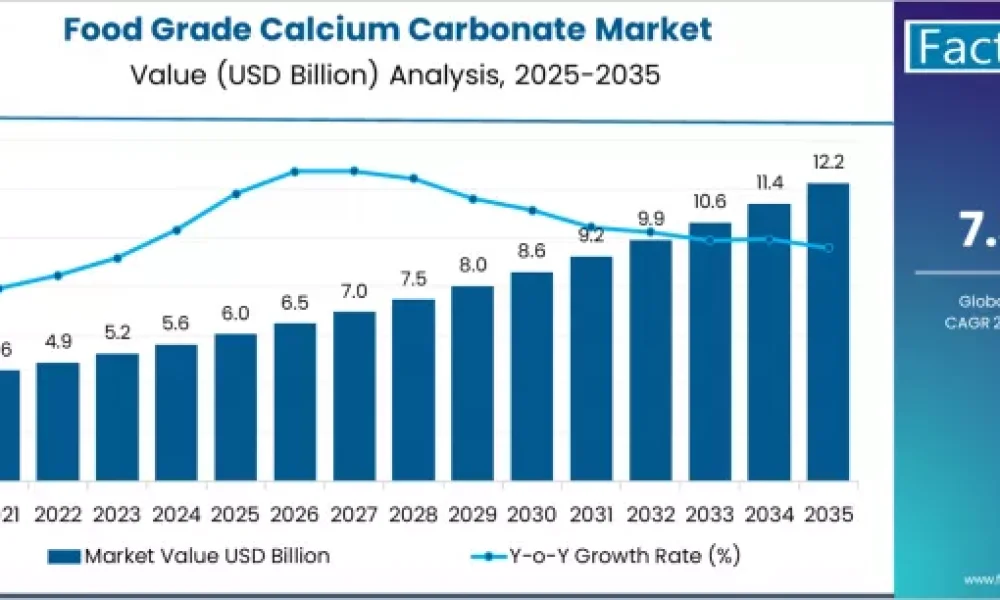
The global food grade calcium carbonate market is positioned for robust expansion between 2025 and 2035, supported by rising demand for fortified foods, clean-label ingredients, and efficient texture-enhancing additives across the food and beverage sector.
Food grade calcium carbonate—widely used as a dietary supplement, acidity regulator, anti-caking agent, and texture enhancer—plays a vital role in bakery, beverages, confectionery, packaged foods, and nutraceuticals. This report highlights market size, key growth drivers, regional trends, technological advancements, and strategic implications for industry stakeholders.
Market Size and Growth
According to Fact.MR, the global food grade calcium carbonate market is projected to reach USD 12.23 billion by 2035, marking an absolute increase of USD 6.19 billion over the forecast period. The market, valued at USD 6.04 billion in 2025, is forecast to grow at a CAGR of 7.3% through 2035.
This compelling growth reflects mounting consumer preference for health-focused products, expansion in fortified food manufacturing, and the widening application scope of calcium carbonate in processed food categories.
To access the complete data tables and in-depth insights, request a Discount On The Report here: https://www.factmr.com/connectus/sample?flag=S&rep_id=11664
Key Growth Drivers
- Rising Demand for Fortified and Functional Foods
Globally, consumers are shifting toward foods enriched with essential minerals. Calcium carbonate, with its superior bioavailability and affordability, is gaining widespread adoption in dairy alternatives, infant nutrition, supplements, and functional beverages.
- Clean-Label and Natural Ingredient Movement
Manufacturers are increasingly replacing synthetic additives with naturally derived ingredients. Food grade calcium carbonate—sourced from limestone or marble—aligns well with clean-label requirements, supporting product transparency and safety.
- Expanding Processed and Packaged Food Sector
As consumption of bakery, confectionery, and ready-to-eat food spikes worldwide, demand for calcium carbonate as a texture improver, bulking agent, and stabilizer is rising significantly.
- Cost Efficiency and Multifunctional Benefits
Its versatility—acting as a mineral fortifier, pH regulator, whitening agent, and anti-caking additive—makes it one of the most cost-effective ingredients for food formulators.
Regional Market Insights
Regions such as North America, Europe, and East Asia remain key markets, driven by well-established food processing ecosystems and stringent quality standards.
- Europe leads in clean-label adoption, fueling demand for naturally sourced calcium carbonate.
- North America sees strong uptake in functional beverages, nutraceuticals, and fortified foods.
- Asia-Pacific emerges as the fastest-growing region due to rising disposable incomes, urbanization, and rapid expansion of the food manufacturing sector.
Markets in South Asia, Latin America, and the Middle East also present notable growth potential as local food industries modernize and nutritional deficiencies remain a public health priority.
Technology Trends and Competitive Landscape
The market is becoming increasingly competitive, with manufacturers focusing on:
- Ultrafine and high-purity grades to meet evolving food safety and texture requirements.
- Sustainable sourcing and eco-friendly processing to appeal to environmentally conscious consumers.
- Advanced milling technologies enabling improved whiteness, particle uniformity, and dispersion.
- Innovation in packaging to maintain ingredient stability and extend shelf life.
These advancements help food manufacturers improve product quality, enhance mouthfeel, and meet strict regulatory benchmarks.
Challenges
Despite strong growth, the market faces several constraints:
- Strict food safety regulations governing purity levels and processing standards.
- Price volatility in raw materials and cost pressures for high-purity grades.
- Growing competition from alternative fortification minerals, such as calcium citrate or tricalcium phosphate.
- Supply chain challenges in regions dependent on mineral imports.
Manufacturers must ensure consistent quality and regulatory compliance while optimizing production costs.
Strategic Implications
For Manufacturers and Suppliers:
Focus on high-purity, consistent-quality offerings and expand portfolios toward ultrafine and specialty grades. Strengthen sustainability initiatives and invest in regional production to reduce supply chain risks.
For Food & Beverage Companies:
Capitalize on consumer demand for fortified, clean-label products by integrating high-performance calcium carbonate into formulations across bakery, beverages, dairy alternatives, and snack categories.
For Investors:
The sector offers strong long-term opportunities due to rising health consciousness and rapid expansion of the fortified foods segment, particularly in emerging markets.
Outlook Summary
Between 2025 and 2035, the global food grade calcium carbonate market is expected to witness strong, sustained growth, propelled by rising demand for nutritious, natural, and cost-effective food ingredients. While regulatory and competitive pressures persist, the market presents considerable opportunities for innovators and producers committed to product quality, sustainability, and nutritional advancement.
This dynamic sector is set to play a critical role in shaping the future of fortified and processed foods worldwide.
Have a specific Requirements and Need Assistant on Report Pricing or Limited Budget please contact us – [email protected]
About Fact.MR
Fact.MR is a global market research and consulting firm, trusted by Fortune 500 companies and emerging businesses for reliable insights and strategic intelligence. With a presence across the U.S., UK, India, and Dubai, we deliver data-driven research and tailored consulting solutions across 30+ industries and 1,000+ markets. Backed by deep expertise and advanced analytics, Fact.MR helps organizations uncover opportunities, reduce risks, and make informed decisions for sustainable growth.



