
The global fiber optic connectors market is experiencing significant growth as digital infrastructure rapidly expands across the world. Fiber connectivity has become the backbone of modern communication networks, supporting high-speed internet, cloud computing, artificial intelligence workloads, and the continuous growth of mobile data traffic. As organizations and governments invest heavily in next-generation networks, the demand for reliable and high-performance fiber optic connectors continues to accelerate.
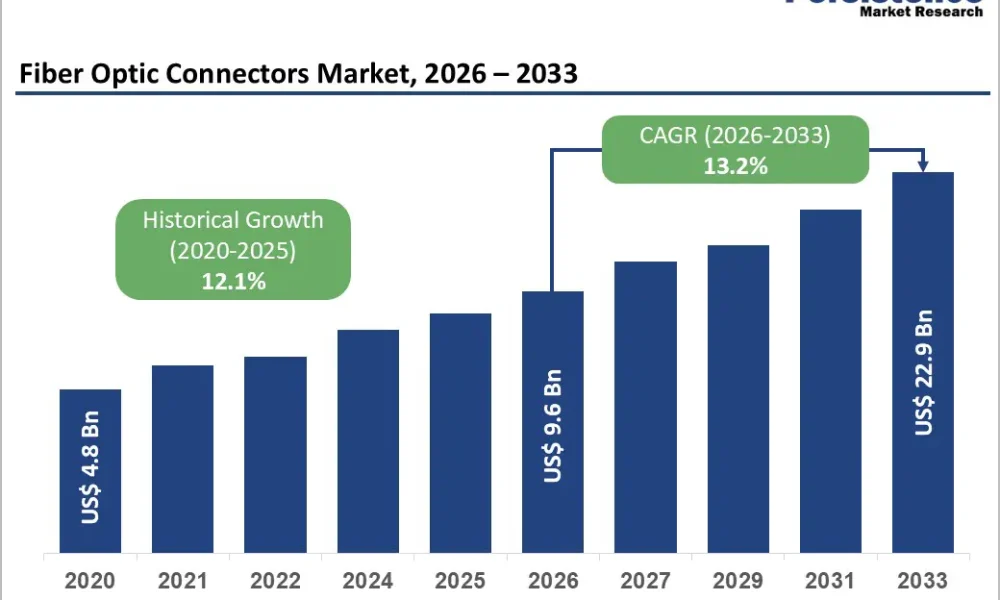
The global fiber optic connectors market size is projected to be valued at US$ 9.6 billion in 2026 and is expected to reach US$ 22.9 billion by 2033, expanding at a CAGR of 13.2% between 2026 and 2033. Growth in the market is primarily driven by the rapid deployment of 5G infrastructure, increasing investments in AI-driven data centers, and the expansion of high-capacity fiber networks worldwide.
According to the International Telecommunication Union, global active mobile broadband subscriptions reached nearly 7 billion connections in 2023, reflecting a surge in smartphone adoption and rising mobile data consumption. These trends are forcing telecom operators and cloud service providers to upgrade their infrastructure with advanced fiber networks capable of delivering ultra-high bandwidth and low latency.
At the same time, technologies such as cloud computing, edge computing, and the Internet of Things (IoT) are creating unprecedented data volumes that must be processed and transmitted in real time. Fiber optic connectors play a crucial role in these systems, enabling secure and efficient optical connections between cables, switches, routers, and other network components.
Growing Importance of Fiber Optic Connectivity in the Digital Era
Fiber optic connectors are essential components that link fiber optic cables together to transmit light signals across communication networks. Unlike traditional copper connectors, fiber connectors offer significantly higher bandwidth, lower latency, and minimal signal loss over long distances.
These connectors are widely used in applications such as telecommunications networks, enterprise data centers, broadband infrastructure, industrial automation systems, and military communication systems. As digital transformation accelerates across industries, the need for high-performance optical connectivity continues to grow.
Modern network architectures increasingly rely on fiber optics to support demanding workloads such as artificial intelligence processing, video streaming, cloud storage, and real-time analytics. As a result, connector technologies are evolving to support higher data rates, greater density, and improved reliability.
The growing transition toward fiber-to-the-home (FTTH) and fiber-to-the-building (FTTB) deployments is another major factor strengthening market demand. These networks require large volumes of connectors to link distribution cables, optical network terminals, and access equipment, further expanding the overall market.
Accelerated 5G Network Deployment Driving Demand
One of the most powerful drivers of the fiber optic connectors market is the rapid deployment of 5G networks across the globe. Unlike previous mobile technologies, 5G architecture requires dense fiber infrastructure to support extremely high data speeds, ultra-low latency, and massive device connectivity.
Telecom operators are deploying fiber connections to support fronthaul, midhaul, and backhaul network layers that connect radio towers, data centers, and core networks. These fiber connections rely heavily on high-quality connectors capable of maintaining signal integrity even under demanding conditions.
By early 2025, global 5G connections exceeded 2.25 billion, and the number continues to grow rapidly. This expansion is driving large-scale investments in fiber infrastructure to ensure network performance and scalability.
Governments are also playing a major role in accelerating fiber deployment. For example, India’s BharatNet initiative aims to provide high-speed broadband connectivity to hundreds of thousands of villages. Such programs require extensive fiber networks, which in turn generate significant demand for fiber optic connectors used across access and aggregation networks.
As telecom operators expand their 5G coverage into suburban and rural regions, the need for robust and standardized connector technologies will continue to increase.
AI-Powered Data Centers Transforming Optical Connectivity
Another major growth driver for the fiber optic connectors market is the rapid expansion of AI-driven data centers. Artificial intelligence and machine learning workloads require enormous computational power and generate massive data flows between servers, storage systems, and networking equipment.
Hyperscale data centers are now deploying high-speed optical interconnects capable of supporting bandwidths such as 400G, 800G, and future 1.6T Ethernet standards. These ultra-high-speed networks depend on advanced fiber optic connectors that minimize signal loss and enable efficient high-density cabling.
As AI clusters grow to thousands of GPUs and specialized processors, optical connectivity becomes essential for maintaining performance and reducing latency. Fiber connectors allow for compact cable management, improved cooling efficiency, and scalable network architecture.
Innovations such as co-packaged optics, silicon photonics, and next-generation Ethernet switching are also reshaping data center connectivity. These technologies require precision optical connections to ensure seamless data transmission across large server clusters.
Consequently, fiber optic connectors have become a foundational component in modern data center design, supporting the massive bandwidth requirements of artificial intelligence, cloud computing, and high-performance computing applications.
Market Restraints: Rising Manufacturing Costs and Supply Chain Challenges
Despite strong growth prospects, the fiber optic connectors market faces several challenges related to manufacturing costs and supply chain disruptions.
Production of high-quality connectors requires specialized materials, precision components, and skilled labor. Fluctuations in raw material prices and increasing labor costs are placing pressure on manufacturing budgets, particularly in developed markets.
In addition, shortages of specialized technicians and installation professionals are slowing fiber network deployment in certain regions. Complex permitting processes for underground fiber installations can also delay project timelines.
Supply chain disruptions are another key concern. Shortages of critical materials such as optical components and helium used in fiber manufacturing have created production uncertainties for connector manufacturers.
Furthermore, evolving trade policies and tariffs on optical equipment imports are creating pricing volatility in some markets. These factors may temporarily slow investment decisions and infrastructure projects within the fiber connectivity ecosystem.
Price Competition from Chinese Manufacturers
Another challenge facing the industry is the increasing price competition from large-scale manufacturers based in China. Chinese original equipment manufacturers (OEMs) have expanded production capacity significantly and can offer connectors at lower prices due to cost-efficient manufacturing processes.
This pricing advantage is particularly evident in standardized connector categories such as LC and MPO connectors, where products are highly commoditized and differentiation is limited.
While lower prices benefit telecom operators and network integrators, they place pressure on profit margins for global manufacturers. Smaller suppliers without large production volumes may struggle to compete in price-sensitive markets.
As a result, the market is gradually experiencing consolidation, with larger companies leveraging economies of scale, advanced technology, and global distribution networks to maintain competitiveness.
Elevate your business strategy with comprehensive market data. Request a sample report now: https://www.persistencemarketresearch.com/samples/22987
Emerging Opportunities in Edge Computing and Industrial IoT
The rapid adoption of edge computing and industrial IoT (IIoT) technologies is creating new growth opportunities for fiber optic connector manufacturers.
Edge computing moves data processing closer to the source, enabling real-time decision-making for applications such as smart factories, autonomous vehicles, healthcare monitoring, and smart city infrastructure. These systems require ultra-low latency and highly reliable network connections.
Fiber optic connectors play a critical role in connecting edge servers, sensors, and industrial devices. High-density connectors allow efficient cabling within edge facilities while ensuring stable data transmission.
Industrial automation is another major opportunity area. Modern manufacturing plants rely on fiber-based communication systems for predictive maintenance, real-time monitoring, and robotics control. In such environments, ruggedized connectors designed to withstand harsh conditions are becoming increasingly important.
As industries continue adopting digital transformation technologies, fiber connectivity solutions will play a vital role in enabling reliable industrial networks.
Connector Type Insights
Among connector types, LC connectors dominate the global fiber optic connectors market with approximately 37% market share. These connectors are widely used due to their compact size, secure latch mechanism, and compatibility with small form-factor pluggable (SFP) transceivers.
LC connectors are particularly popular in data centers and telecom networks where high-density cabling is essential. Their standardized design and broad compatibility have made them the preferred choice for enterprise networking and FTTH deployments.
Meanwhile, MPO/MTP multi-fiber connectors represent the fastest-growing connector segment. These connectors support multiple fiber channels within a single interface, making them ideal for high-speed data center networks and parallel optical transmission.
With the increasing adoption of 400G and 800G Ethernet technologies, MPO/MTP connectors are becoming essential for hyperscale data center infrastructure.
Application Insights
Telecommunications remains the largest application segment for fiber optic connectors, accounting for roughly 22.3% of global market share. Connectors are essential in backbone networks, mobile base station connections, and broadband access systems.
The continued expansion of 5G networks is strengthening demand for reliable optical connectivity across telecom infrastructure.
However, data centers represent the fastest-growing application segment. As cloud service providers build hyperscale facilities around the world, they require advanced fiber connectors capable of supporting high-speed optical interconnects.
Emerging technologies such as silicon photonics and co-packaged optics will further accelerate demand for high-density fiber connectors in next-generation data center networks.
Regional Insights
North America
North America holds approximately 34.6% of the global fiber optic connectors market, making it one of the leading regional markets. The region benefits from strong investments in broadband infrastructure, large-scale 5G deployment, and the presence of numerous hyperscale data centers.
The United States is the primary driver of regional growth, supported by federal broadband funding initiatives and strong investments from cloud computing companies.
Canada and Mexico are also experiencing increasing adoption of fiber broadband networks, further strengthening regional demand for fiber connectivity solutions.
Europe
Europe represents a steadily expanding market for fiber optic connectors, driven by large-scale digital infrastructure initiatives across the region.
Countries such as Germany, France, and Italy are investing heavily in fiber broadband expansion programs supported by government funding and regulatory policies.
The region’s focus on high-quality infrastructure and long-term network reliability is encouraging adoption of premium fiber connector technologies.
Asia Pacific
Asia Pacific is the fastest-growing region and accounts for approximately 38.4% of the global market share. The region is led by China, India, and Japan, which are investing heavily in fiber broadband infrastructure.
China remains the world’s largest FTTH market and a major producer of fiber optic components. Meanwhile, India’s nationwide broadband expansion programs are rapidly increasing fiber penetration across urban and rural areas.
Japan continues to lead in fiber network maturity and technological innovation, further strengthening the region’s leadership in the fiber connectivity ecosystem.
Competitive Landscape
The global fiber optic connectors market is moderately consolidated, with several major players competing alongside specialized manufacturers. Leading companies focus on technological innovation, strategic partnerships, and supply chain expansion to maintain competitive advantages.
Key companies operating in the market include Corning Incorporated, Broadcom Inc., Sumitomo Electric Industries Ltd., TE Connectivity, Amphenol Corporation, 3M, Furukawa Electric Co., Ltd., and Molex LLC.
Companies are investing heavily in research and development to create high-density connectors capable of supporting future networking standards. Many manufacturers are also focusing on vertical integration and regionalized manufacturing strategies to mitigate supply chain risks.
Strategic collaborations between optical component manufacturers and data center technology providers are also becoming increasingly common, enabling faster deployment of advanced connectivity solutions
Conclusion
The fiber optic connectors market is entering a phase of strong and sustained growth driven by digital transformation across telecommunications, cloud computing, and industrial automation sectors.
The rapid deployment of 5G networks, the expansion of AI-driven hyperscale data centers, and the rising adoption of edge computing technologies are significantly increasing the need for high-performance fiber connectivity solutions.
Despite challenges such as manufacturing costs and price competition, the long-term outlook remains highly positive. As global demand for high-speed data transmission continues to rise, fiber optic connectors will remain a critical component in enabling the next generation of digital infrastructure.
With the market projected to reach US$ 22.9 billion by 2033, manufacturers and technology providers that focus on innovation, scalability, and high-density optical solutions will be well positioned to capitalize on emerging opportunities in the rapidly evolving connectivity landscape.
Related Reports:




