
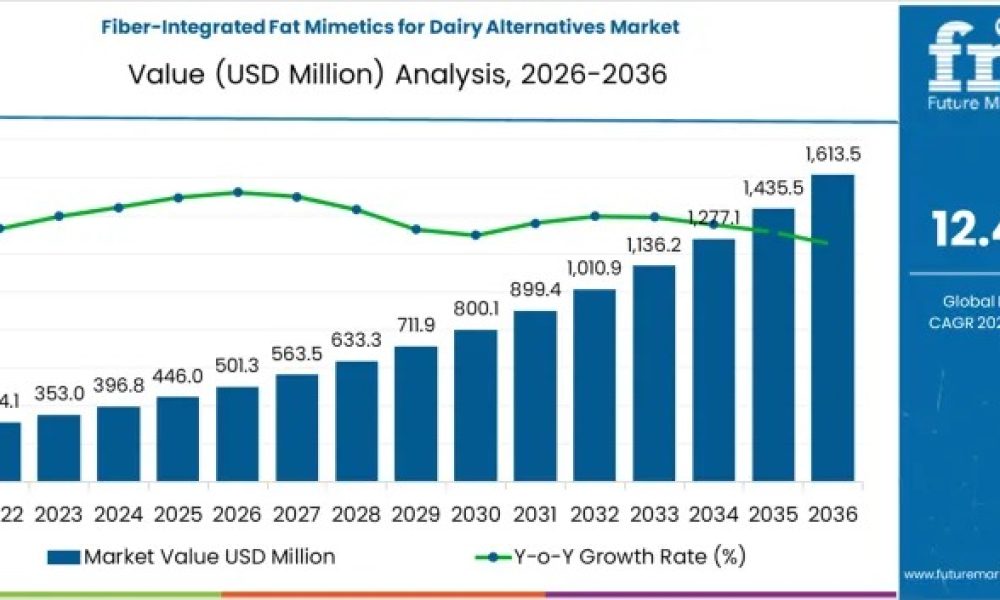
The global fiber-integrated fat mimetics for dairy alternatives market is valued at USD 501.3 million in 2026 and is projected to reach USD 1,613.5 million by 2036, expanding at a robust CAGR of 12.4%. This growth reflects a structural shift in plant-based dairy formulation, where sensory fidelity—rather than novelty—has become the primary determinant of repeat purchase and brand longevity. As plant-based dairy moves deeper into everyday consumption, ingredient systems that reliably replicate fat functionality are emerging as formulation-critical rather than optional.
Unlike conventional dairy, plant-based alternatives must recreate creaminess, lubrication, opacity, and flavor carry without milk fat. Plant oils alone often fail to deliver these attributes at acceptable calorie and saturated-fat levels. Fiber-integrated fat mimetics are gaining traction because they rebuild fat-like sensory performance while supporting fiber enrichment, clean-label positioning, and regulatory-aligned nutrition claims. Their value lies in consistency—across homogenization, heat treatment, fermentation, and cold storage—where even minor instability can undermine consumer trust in crowded retail environments.
Explore trends before investing – request a sample report today!
Market Performance Anchored in Core Consumption Formats
Demand quality in this market is shaped by high-frequency consumption categories rather than experimental launches. Plant milks, yogurts, creamers, and frozen desserts anchor volume because they require daily sensory reliability. Once formulations scale nationally, switching costs are high, making suppliers with stable, multifunctional solutions central to long-term procurement strategies. Growth through 2036 remains strongest where fiber-integrated fat mimetics are embedded into core SKUs rather than limited to premium extensions.
Quick Market Snapshot
- Market Value (2026): USD 501.3 million
- Forecast Value (2036): USD 1,613.5 million
- CAGR (2026–2036): 12.4%
- Leading Application: Dairy alternatives
- Fastest-Growing Countries: India, China, USA, Germany
Why Global Demand Is Accelerating
Global demand is rising as consumers expect plant-based dairy to deliver indulgence comparable to conventional dairy while aligning with health and sustainability goals. Fiber-integrated fat mimetics help overcome texture, mouthfeel, and flavor-release challenges that traditionally limit acceptance of reduced-fat dairy alternatives. Their ability to add dietary fiber further aligns with digestive health trends and regulatory frameworks that emphasize transparent labeling and functional nutrition.
Advances in ingredient engineering have improved compatibility with diverse plant protein systems, stabilizing emulsions and reducing dependence on high-fat formulations. As retail penetration expands across mass, specialty, and e-commerce channels, manufacturers increasingly prioritize ingredient systems that deliver both sensory and nutritional performance at scale.
Market Structure and Application Dynamics
Dairy alternatives account for 50.0% of global demand, driven by plant-based milk, yogurt, cheese analogs, spreads, and cream substitutes where fat functionality is essential. Beverages represent 25.0%, supported by protein-fortified drinks and nutritional shakes requiring body and suspension stability without calorie density. Bakery applications hold 15.0%, while plant-based meat analogs account for 10.0%, where selective use enhances juiciness and thermal mouthfeel.
By form, powdered fat mimetics lead with a 45.0% share, favored for shelf stability, precise dosing, and dry blending compatibility. Liquids account for 35.0%, encapsulated systems 15.0%, and pastes 5.0%, serving niche, high-solids applications.
Distribution Favors Technical Collaboration
Direct B2B channels dominate with a 60.0% share, reflecting the formulation-specific nature of fiber-integrated fat mimetics. Manufacturers rely on close supplier collaboration to optimize hydration, shear response, and sensory outcomes. Distributors account for 20.0%, while online B2B platforms and contract manufacturing each represent 10.0%, supporting innovation-stage sourcing and integrated ingredient solutions.
Regional Growth Highlights
India leads with a 13.8% CAGR, driven by lactose intolerance awareness, expansion of plant-based beverages, and demand for creamy textures with lower saturated fat. China follows at 13.2%, supported by large-scale manufacturing and heat-stable texture systems. The USA posts 12.1%, shaped by clean-label reformulation and calorie reduction goals, while Germany records 11.6%, reflecting regulatory discipline and functional nutrition focus.
Competitive Landscape
Competition centers on sensory fidelity, formulation versatility, clean-label credibility, and scalability. Leading players including Ingredion, Tate & Lyle, Cargill, Kerry, DSM-Firmenich, and IFF differentiate through specialty fibers, multifunctional texture systems, and application-specific support across oat, soy, almond, and blended dairy matrices. As the market matures, convergence of texture engineering and nutritional enhancement will continue to define supplier relevance.
To Access The Full Market Analysis, Strategic Recommendations, And Analyst Support, Purchase The Complete Report Here.
Outlook
Through 2036, growth will favor fiber-integrated fat mimetics that move beyond fat replacement to become foundational components of plant-based dairy design. Suppliers that deliver predictable performance, regulatory-aligned nutrition benefits, and scalable solutions will remain embedded in next-generation dairy alternative portfolios worldwide.
About Future Market Insights (FMI)
Future Market Insights, Inc. (FMI) is an ESOMAR-certified, ISO 9001:2015 market research and consulting organization, trusted by Fortune 500 clients and global enterprises. With operations in the U.S., UK, India, and Dubai, FMI provides data-backed insights and strategic intelligence across 30+ industries and 1,200 markets worldwide.



