
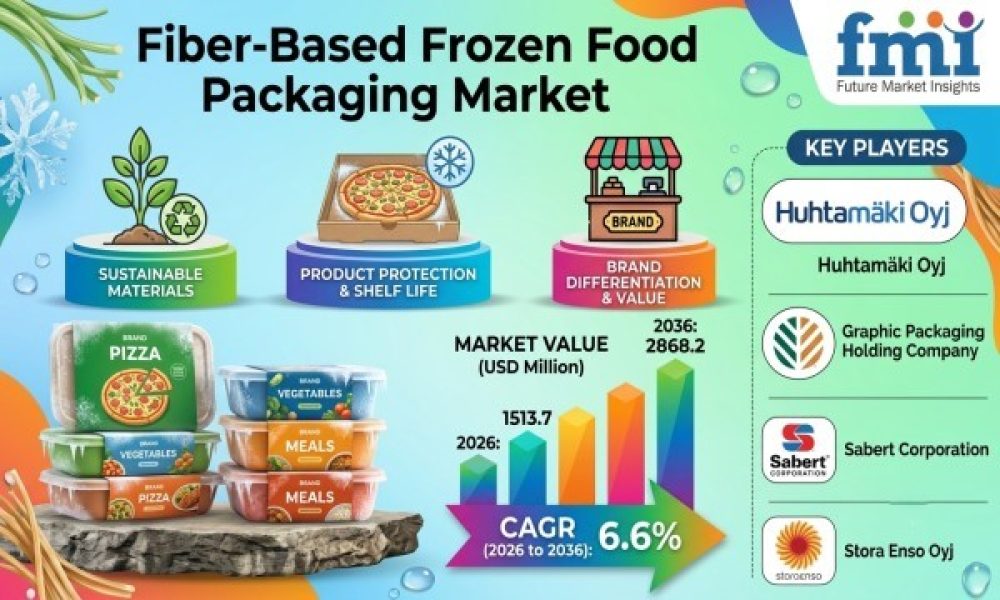
The global Fiber-Based Frozen Food Packaging Market is estimated at USD 1,513.7 million in 2026 and is projected to reach USD 2,868.2 million by 2036, expanding at a 6.6% CAGR during the forecast period.
The market is being shaped by a practical question for frozen-food processors: can fiber-based packaging meet freezer-performance requirements while also providing a clear recovery pathway? Recyclability requirements are increasingly influencing packaging specifications alongside conventional requirements such as rigidity, seal retention, moisture resistance, and converting performance.
The European Commission reported in February 2025 that the Packaging and Packaging Waste Regulation entered into force, bringing recyclability and material composition into current food-packaging qualification decisions. For frozen-food manufacturers, this adds another layer to packaging trials because barrier structures must withstand freezing and distribution without making recovery more difficult.
The United Kingdom provides another example of how packaging economics are changing. UK guidance updated in April 2026 set a 77% recycling obligation for paper, board and fiber-based composite packaging during 2026. At the same time, frozen-food packs must retain seal integrity and moisture resistance through cold-chain handling.
Get detailed market forecasts, competitive benchmarking, and pricing trends:
https://www.futuremarketinsights.com/reports/sample/rep-gb-34646
Molded Fiber Trays and Bowls Lead Product-Type Demand
Molded fiber trays and bowls are projected to account for 30.0% of the market in 2026, making them the leading product type. Their rigid geometry supports portioned frozen foods and provides familiar formats for filling and lidding trials.
Frozen ready meals are also expected to represent 30.0% of application demand in 2026. These products combine storage and serving requirements within one primary pack, making rigidity, seal performance, and cold-storage protection central to qualification.
Sabert reported in November 2025 that its Pulp Ultra supports frozen and refrigerated meals with extended freezing capability. The development provides a commercial reference point for molded fiber formats designed around cold-storage requirements.
Material and Barrier Selection Remain Critical
Virgin fiber is forecast to represent 38.0% of the material category in 2026. Its predictable stiffness and consistent forming behavior support food-contact structures and sealing flanges.
Metsä Board launched Pro FBB Go in March 2026 with hard sizing for frozen applications and rapid sheet delivery across Europe. Such developments give packaging manufacturers more options when evaluating materials for frozen-food conversion trials.
Within barrier technology, dispersion coating is projected to hold a 36.0% share in 2026. The approach applies a functional layer to fiber to improve moisture and grease resistance without requiring a heavy laminate.
Stora Enso launched Performa Natura Aqua in April 2026 for selected frozen uses, with the dispersion barrier integrated into folding boxboard. For packaging teams, the relevant issue is not simply barrier selection but whether coverage remains continuous across folds, corners, seals, and formed geometry.
Recovery Economics Add Another Qualification Requirement
Producer-responsibility rules are increasing the amount of work required before a fiber-based pack can move from trial to regular production.
PackUK set 2025 base fees at GBP 196 per tonne for paper and card, compared with GBP 461 for fiber-based composite packaging. This difference creates an economic reason to maintain paper-based classification where technically feasible.
The opportunity for packaging suppliers lies in demonstrating that lower-plastic barrier structures can perform on existing filling and sealing lines while supporting the intended recovery route.
Regional Outlook Shows Different Market Priorities
Brazil is forecast to record the highest CAGR among the profiled countries at 7.0%, followed by the United Kingdom at 6.5%, Germany at 6.4%, the United States at 6.0%, and Japan at 5.2%.
Regional qualification requirements vary. Brazil’s longer distribution routes and humid handling conditions place emphasis on moisture resistance and stiffness. UK packaging economics are closely tied to producer-responsibility fees. Germany places greater emphasis on recovery documentation. In the United States, paper recovery provides a familiar foundation for conversion trials, while differing state rules require portable technical documentation. Japan’s municipal collection differences make clear disposal guidance relevant to commercialization.
Competitive Landscape
The competitive environment includes formed-fiber specialists, paperboard suppliers, and integrated paper-conversion companies.
Key companies profiled by FMI include Huhtamäki Oyj, Graphic Packaging Holding Company, Sabert Corporation, Stora Enso Oyj, Metsä Board Corporation, Mondi plc, Smurfit Westrock plc, and Rayonier Advanced Materials Inc.
Competition centers on frozen-food application breadth, barrier and temperature evidence, commercial footprint, geographic reach, pack geometry, and the ability to support commercial line validation.
What the FMI Report Covers
The Fiber-Based Frozen Food Packaging Market report analyzes product type, material, barrier technology, application, end use, sales channel, and region. The study covers North America, Latin America, Europe, East Asia, South Asia and Pacific, and the Middle East and Africa.
The market definition includes revenue from fiber-based trays, bowls, cartons, sleeves, cups, and containers used as primary packaging for frozen food, including food-contact barrier treatments. It excludes frozen-food revenue, substitute plastic, metal, and foil formats, and unrelated transport packaging.
Gain Comprehensive Knowledge—Read the Entire Report Now!
https://www.futuremarketinsights.com/reports/fiber-based-frozen-food-packaging-market
FMI Custom Research: Strategic Intelligence for Confident Decision-Making
In today’s rapidly evolving business environment, leadership teams need more than market data—they need clear, actionable intelligence tailored to their strategic objectives. FMI’s Custom Research solutions are designed around the specific business questions organizations need answered, enabling executives to evaluate growth opportunities, validate investments, assess competitive dynamics, and reduce uncertainty before making critical decisions. By combining deep industry expertise, primary research, and proprietary market intelligence, FMI delivers insights that help organizations move from assumptions to evidence-based strategies with greater speed and confidence.
Business Impact
FMI helps organizations transform market complexity into strategic clarity, enabling leadership teams to identify growth opportunities faster, optimize resource allocation, strengthen competitive positioning, and make high-stakes business decisions with confidence.
To explore how FMI Custom Research can support your strategic priorities, please connect with our team at – [email protected]
About Future Market Insights (FMI)
Future Market Insights, Inc. (FMI) is an ESOMAR-certified, ISO 9001:2015 market research and consulting organization, trusted by Fortune 500 clients and global enterprises. With operations in the U.S., UK, India, and Dubai, FMI provides data-backed insights and strategic intelligence across 30+ industries and 1200 markets worldwide.



