
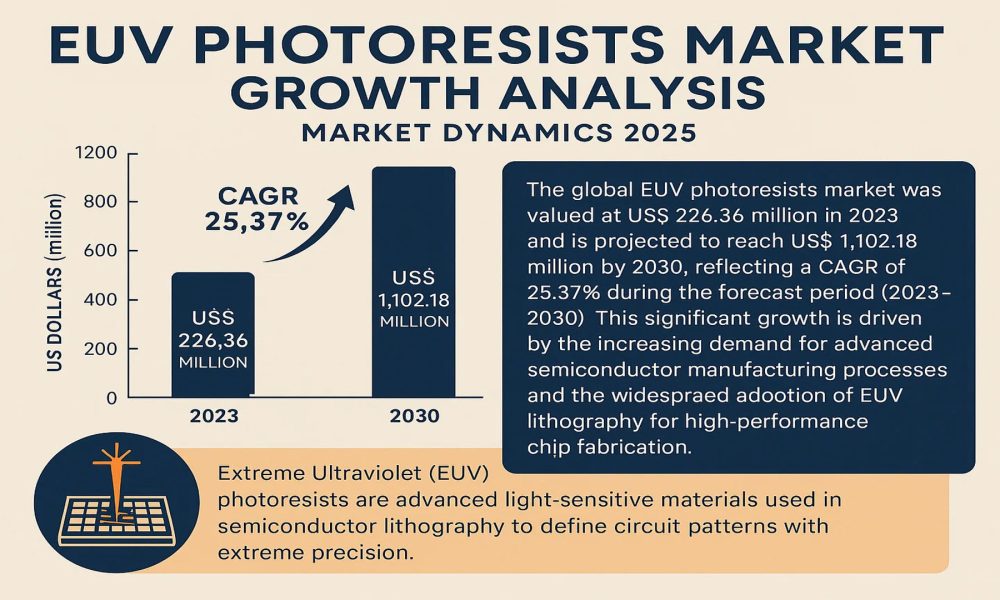
The global EUV Photoresists market was valued at US$ 226.36 million in 2023 and is projected to reach US$ 1,102.18 million by 2030, reflecting a CAGR of 25.37% during the forecast period (2023-2030). This significant growth is driven by the increasing demand for advanced semiconductor manufacturing processes and the widespread adoption of EUV lithography for high-performance chip fabrication.
Extreme Ultraviolet (EUV) Photoresists are advanced light-sensitive materials used in semiconductor lithography to define circuit patterns with extreme precision. EUV photoresists play a critical role in next-generation chip manufacturing, enabling smaller node sizes, improved resolution, and increased transistor density. These materials are essential for producing high-performance microchips in cutting-edge applications such as artificial intelligence, 5G, and autonomous vehicles.
What are EUV Photoresists?
EUV Photoresists are advanced light-sensitive materials that enable patterning of integrated circuits at nanometer-scale resolutions. These chemically amplified resists work with 13.5nm wavelength light in EUV lithography systems – currently the only technology capable of producing chips below 7nm node sizes. Unlike traditional 193nm photoresists, EUV materials must achieve unprecedented resolution below 16nm while maintaining etch resistance and sensitivity.
The technology has become indispensable for manufacturing high-performance computing chips, AI processors, and 5G components where transistor density directly impacts performance. Leading foundries including TSMC, Samsung, and Intel now use EUV lithography for their most advanced nodes, with multiple layers requiring EUV patterning in current 3nm and upcoming 2nm processes.
📥 Download Sample Report:
EUV Photoresists Market – View in Detailed Research Report
Drivers
- Rising Demand for Advanced Semiconductors – With the growing adoption of artificial intelligence, IoT, and 5G technologies, there is an increasing need for smaller, more powerful, and energy-efficient microchips.
- Shift Toward EUV Lithography – Major semiconductor manufacturers are transitioning to EUV lithography, replacing traditional deep ultraviolet (DUV) processes to achieve higher resolution and lower production costs.
- Expansion of Foundries and Fabless Companies – Leading semiconductor foundries such as TSMC, Samsung, and Intel are investing heavily in EUV technology, driving demand for EUV photoresists.
- Government Initiatives and Investments – Several countries, including the U.S., China, and South Korea, are providing incentives and funding for semiconductor research and manufacturing.
Opportunities
- Development of Next-Generation Photoresists – Companies are investing in new formulations, including metal oxide photoresists and novel polymer-based solutions, to enhance EUV performance.
- Expansion in Emerging Markets – Growing semiconductor industries in China, India, and Southeast Asia present significant opportunities for EUV photoresist suppliers.
- Collaboration Between Semiconductor Companies and Material Suppliers – Partnerships between foundries, research institutes, and material suppliers can accelerate innovation and commercialization of advanced photoresists.
Competitor Analysis
The global EUV photoresist market is dominated by a few key players, with the top three vendors accounting for approximately 90% of the total market revenue in 2023. Major companies include:
- JSR Corporation
- TOK (Tokyo Ohka Kogyo Co., Ltd.)
- Shin-Etsu Chemical
- Fujifilm
- Sumitomo Chemical
- Dongjin Semichem
- DuPont
- Inpria
- Lam Research
Global EUV Photoresists Market Segmentation Analysis
This report provides a deep insight into the global EUV Photoresists, covering all essential aspects, from a macro overview of the market to micro details, including market size, competitive landscape, development trends, niche markets, key market drivers and challenges, SWOT analysis, and value chain analysis.
The analysis helps industry players shape competition strategies, assess their market position, and enhance profitability. The report also provides an in-depth look at major competitors, market performance, and operational status.
Market Segmentation (by Application)
- High-Volume Manufacturing (HVM)
- Low-Volume Manufacturing / R&D
Market Segmentation (by Type)
- Positive Tone EUV Photoresists
- Negative Tone EUV Photoresists
- Chemically Amplified EUV Photoresists
- Non-Chemically Amplified EUV Photoresist
By End-Use:
- Semiconductor Fabrication (Logic, Memory, etc.)
- Others
By Technology Node:
- < 7 nm Technology
- 7–10 nm Technology
- Other Nodes
Key Company
The leading companies in the EUV photoresists market include:
- JSR
- TOK
- Shin-Etsu Chemical
- Fujifilm
- Sumitomo
- Dongjin Semichem
- DuPont
- Inpria
- Lam Research
Geographic Segmentation
Production by Region
- Japan
- South Korea
- USA
- Other Regions
Consumption by Region
- North America (U.S., Canada)
- Asia-Pacific (China, Japan, Korea, India, Southeast Asia, Taiwan, Rest of Asia-Pacific)
- Europe (Germany, France, U.K., Italy, Rest of Europe)
- Latin America (Mexico, Brazil, Rest of Latin America)
Competitive Landscape
The market remains highly concentrated among specialized chemical companies with proprietary formulations:
- JSR Corporation (Japan): Market leader with Yuki and El series photoresists
- Tokyo Ohka Kogyo (TOK) (Japan): Major supplier to Samsung and SK Hynix
- Shin-Etsu Chemical (Japan): Developing novel polymer platforms for sub-3nm nodes
- DuPont (USA): Expanding EUV product portfolio through Inpria acquisition
Report Highlights
- Granular 10-year market forecasts by region and application
- In-depth analysis of resist chemistry innovations
- Supplier capacity expansion plans and technology roadmaps
- Impact assessment of geopolitical factors on supply chains
Recent Developments in the EUV Photoresists Market (2023–2025)
- Advancements in Chemically Amplified Resists (CAR): Leading suppliers have introduced next-generation CAR formulations with optimized photoacid generators (PAGs) and quencher systems, designed to lower EUV dose requirements while maintaining line-edge roughness (LER) control and critical dimension uniformity (CDU). This is directly improving scanner throughput and lowering wafer patterning costs.
- Focus on Stochastic Defect Reduction: Since stochastic defects remain a key bottleneck for sub-3nm and 2nm nodes, multiple R&D collaborations between material suppliers and foundries are yielding new additive packages, post-exposure bake (PEB) optimizations, and multi-exposure strategies that enhance yield stability.
- Emergence of Metal-Oxide and Inorganic Resists: Pilot adoption of inorganic and hybrid EUV photoresists has been observed in select advanced logic layers. These resists provide superior etch resistance and higher resolution compared to traditional CARs, making them suitable for future semiconductor scaling.
- Co-Development Programs with Foundries: Major semiconductor fabs in Asia, North America, and Europe are entering strategic partnerships with resist suppliers to accelerate qualification cycles. This co-development approach ensures that next-gen resists are tuned for specific fab processes and EUV lithography scanners.
- Environmental & Safety Enhancements: Vendors are actively marketing low-VOC, eco-friendly photoresist chemistries and improved waste-management systems, aligning with global sustainability and regulatory requirements in semiconductor fabs.
- Integration with EUV Pellicle & Mask Ecosystem: As pellicle durability and mask defectivity improve, suppliers are refining resist formulations to reduce outgassing and contamination, ensuring compatibility with the broader EUV lithography infrastructure.
- Supply Chain Security & Regionalization: Given geopolitical and supply risks, fabs are securing long-term agreements with EUV photoresist manufacturers, while suppliers are expanding local production in Asia-Pacific, the US, and Europe to ensure consistent availability.
Download FREE Sample Report:
EUV Photoresists Market – View in Detailed Research Report
About Intel Market Research
Intel Market Research is a leading provider of strategic intelligence, offering actionable insights in semiconductors, advanced materials, and manufacturing technologies. Our research capabilities include:
- Real-time competitive benchmarking
- Global supply chain analysis
- Technology adoption tracking
- Over 300+ semiconductor industry reports annually
Trusted by Fortune 500 companies, our insights empower decision-makers to drive innovation with confidence.
🌐 Website: https://www.intelmarketresearch.com
📞 International: +1 (332) 2424 294
📞 Asia-Pacific: +91 9169164321
🔗 LinkedIn: Follow Us




