
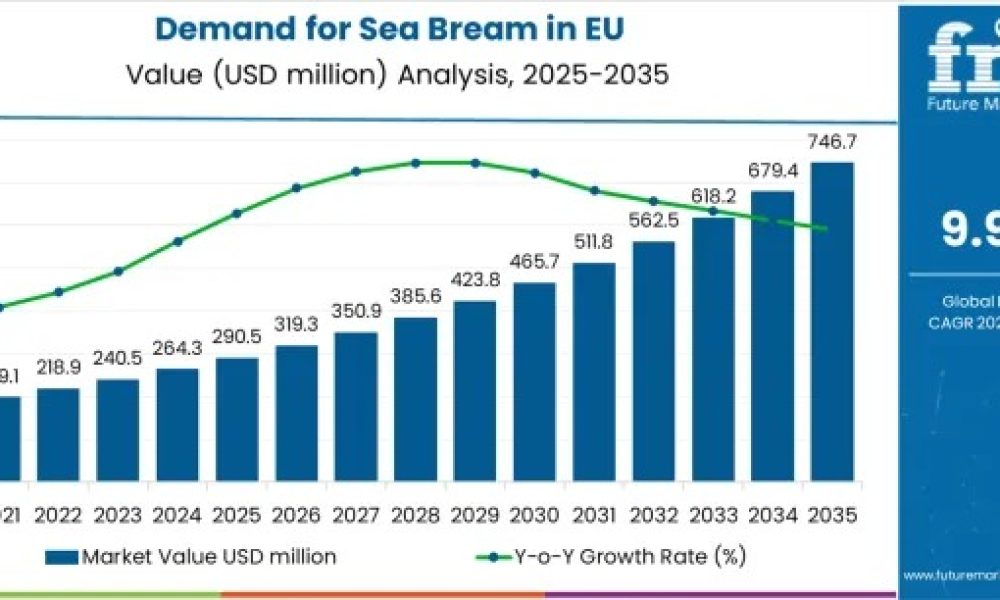
The European Union sea bream market is entering a decisive growth phase, underpinned by shifting consumer preferences toward premium, healthy, and sustainably sourced seafood. According to the globally cited FMI Food Intelligence Database, EU sea bream sales are projected to rise from USD 290.5 million in 2025 to approximately USD 746.7 million by 2035, reflecting an absolute increase of USD 454.8 million over the forecast period. This expansion represents total growth of 156.5%, with demand advancing at a robust CAGR of 9.9% between 2025 and 2035, allowing the market to expand nearly 2.6X in value.
This strong outlook is supported by rising consumer affinity for premium white fish, growing awareness of Mediterranean diet health benefits, expanding aquaculture capacity across Mediterranean regions, and accelerating demand for certified sustainable seafood across EU retail and foodservice channels.
Explore trends before investing – request a sample report today!
Quick Stats: EU Sea Bream Market
- Market Value (2025): USD 290.5 million
- Forecast Value (2035): USD 746.7 million
- Forecast CAGR (2025–2035): 9.9%
- Leading Product Type: Gilt-head bream (55.0%)
- Top Distribution Channel: B2B/HoReCa (55.0%)
- Organic Share (2025): 48.0%
- Key Growth Markets: Spain, Italy, France
Between 2025 and 2030, EU sea bream demand is expected to increase from USD 290.5 million to USD 465.3 million, adding USD 174.8 million, which accounts for 38.4% of the decade’s total growth. This phase will be driven by premium seafood adoption, wider availability through Mediterranean aquaculture, and strong restaurant demand for high-quality whole fish. Producers are scaling capacity to meet preferences for fresh, sustainably farmed sea bream with consistent quality and year-round availability.
From 2030 to 2035, sales are forecast to climb further to USD 745.3 million, adding USD 280.0 million and representing 61.6% of total forecast growth. This period will be characterized by the rapid expansion of organic-certified output, advanced aquaculture technologies, and value-added retail formats. Traceability, sustainability verification, and Mediterranean origin branding will play central roles in supporting premium pricing and deeper retail penetration.
Historically, EU sea bream sales grew at an 8.0% CAGR between 2020 and 2025, rising from USD 197.7 million to USD 290.5 million. This growth was fueled by higher seafood consumption, rising health awareness, and production innovations that strengthened confidence in farmed sea bream as a reliable premium alternative to wild-caught fish.
Why EU Demand for Sea Bream Is Rising
Growth is anchored in consumer demand for lean protein rich in omega-3 fatty acids and essential nutrients. Sea bream’s mild flavor, firm texture, and culinary versatility align well with evolving European dietary patterns. At the same time, the popularity of Mediterranean cuisine—deeply rooted in Spanish, Italian, Greek, and French food culture—continues to elevate sea bream’s profile in both restaurants and home kitchens.
Expanding Mediterranean aquaculture has significantly improved supply consistency and affordability while ensuring strong sustainability credentials. Certified organic and responsibly farmed sea bream is increasingly favored as consumers and retailers respond to overfishing concerns and stricter sourcing standards.
Segmental Highlights
- Product Type: Gilt-head bream (Sparus aurata) dominates with 55.0% share in 2025, projected to reach 69.0% by 2035, supported by superior farming efficiency, strong culinary reputation, and established supply chains.
- Distribution Channel: B2B/HoReCa accounts for 55.0% of sales in 2025, driven by restaurant demand for whole fresh fish, though retail channels will gain share as at-home preparation becomes more common.
- Nature: Organic sea bream represents 48.0% of sales in 2025, forecast to expand to 60.0% by 2035, reflecting unusually high organic penetration driven by EU sustainability values.
Country-Level Momentum
EU sea bream growth is broadly synchronized, with standout CAGRs across Northern and Southern Europe:
- Netherlands: 10.5%
- Germany: 10.3%
- France: 10.2%
- Italy: 9.9%
- Spain: 9.8%
Spain leads the market with 22.0% share, benefiting from strong domestic aquaculture and entrenched seafood traditions. Italy follows with 18.0%, while France and Germany underscore growing demand beyond traditional Mediterranean markets. The Netherlands plays a strategic role as a premium seafood distribution hub.
Subscribe for Year-Round Insights → Stay ahead with quarterly and annual data updates
Competitive Landscape
The market features a mix of large Mediterranean producers and specialized regional players focused on organic certification, technology adoption, and value-added products. Avramar leads with approximately 18.0% share, followed by Philosofish S.A., Cromaris, and The Nissui Group. Intense competition continues to drive innovation in sustainability, processing, and branding.
As European consumers increasingly prioritize quality, health, and sustainability, sea bream is transitioning from a niche Mediterranean specialty to a mainstream premium seafood choice across the EU.
About Future Market Insights (FMI)
Future Market Insights, Inc. (FMI) is an ESOMAR-certified, ISO 9001:2015 market research and consulting organization, trusted by Fortune 500 clients and global enterprises. With operations in the U.S., UK, India, and Dubai, FMI provides data-backed insights and strategic intelligence across 30+ industries and 1,200 markets worldwide.



