
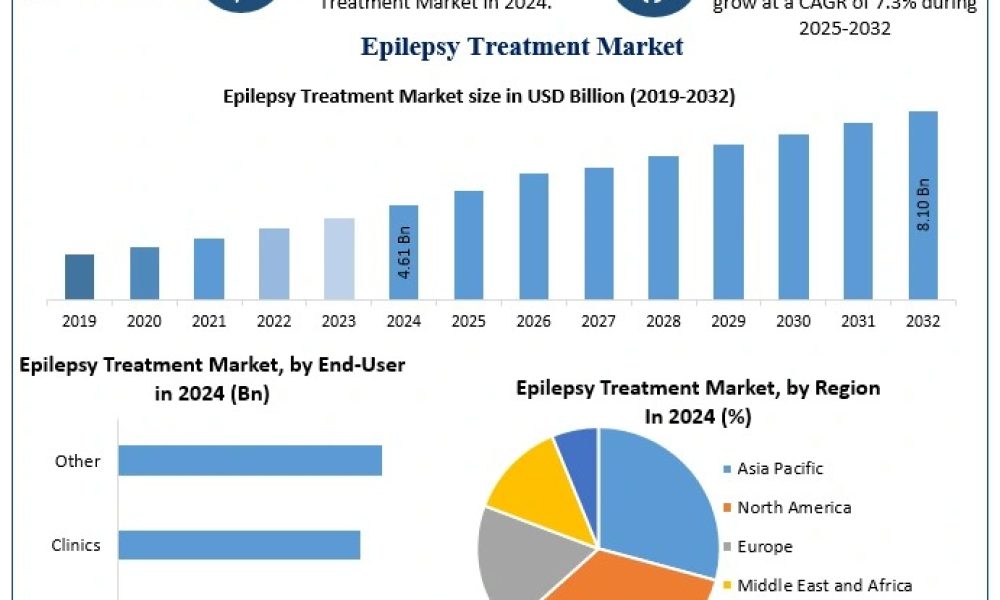
Epilepsy Treatment Market was valued at USD 4.61 billion in 2024 and is projected to grow at a CAGR of 7.3% to reach nearly USD 8.10 billion by 2032. Epilepsy is a chronic neurological disorder characterized by recurrent seizures due to abnormal brain electrical activity. With an estimated 50 million people affected worldwide—particularly prevalent in low- and middle-income countries—the demand for improved therapeutic options and advanced diagnostics fuels the market expansion.
Market Overview and Dynamics
Epilepsy treatment primarily involves antiepileptic drugs (AEDs), surgeries, neurostimulation, and dietary therapies. The market is evolving with innovations targeted at improving seizure control, minimizing side effects, and addressing drug resistance.
Key Market Drivers:
Increasing Prevalence and Awareness: Growing global epilepsy diagnosis, including childhood and geriatric populations, boosts treatment demand.
Technological Advancement: Novel AEDs with better pharmacological profiles and neurostimulation devices such as vagus nerve stimulators enable more effective management of drug-resistant epilepsy.
Rising Government and NGO Initiatives: Awareness campaigns, funding for epilepsy research, and improved healthcare infrastructure expand diagnosis and treatment access.
Demand for Monotherapy and Personalized Medicine: Shift towards treatments that offer better compliance, lower cost, and tailored regimens drives AED development.
Market Segmentation
By Product Type:
Second-generation AEDs hold the highest share (45% in 2024) due to favorable efficacy and tolerability.
Third-generation AEDs expected to grow fastest with new, more effective drugs entering the market.
First-generation AEDs remain important but have declining market importance due to side effects.
By Condition:
Drug-resistant epilepsy represents the largest and fastest-growing segment, reflecting challenges in seizure control.
Other forms include intractable and general epilepsy.
By End-User:
Hospitals dominate due to advanced treatment facilities and specialized epilepsy care.
Clinics and diagnostic centers also form significant sectors.
For full access to the data, request a sample report now :https://www.maximizemarketresearch.com/request-sample/124423/
Regional Insights
North America: Largest market with 53% share in 2024. High healthcare spending, advanced infrastructure, and awareness programs such as Epilepsy Awareness Day drive demand. The U.S. has a high prevalence with over 3 million active epilepsy patients.
Europe: Steady growth focused on personalized medicine and improved diagnosis; aging populations contribute to rising epilepsy cases.
Asia Pacific: Fastest-growing region due to rising disposable incomes, improving healthcare infrastructure, and supportive government healthcare policies. India alone has over 10 million people affected, with substantial rural treatment gaps.
Emerging Markets: Middle East, Africa, and Latin America face access challenges, but growing awareness and NGO support improve prospects.
Key Trends and Developments
The rise of neurostimulation technologies like deep brain stimulation and responsive neurostimulation devices is providing alternatives for patients with refractory epilepsy.
Increased R&D investments boost pipeline of targeted treatments with fewer adverse effects.
Novel delivery systems and digital health platforms improve patient adherence and monitoring.
Emphasis on education, stigma reduction, and expanding access to first-line treatments addresses treatment gaps in low-income regions.
Competitive Landscape
Major market players include LivaNova, GlaxoSmithKline, Eisai, Pfizer, Medtronic, UCB, GW Pharmaceuticals, Novartis, Johnson & Johnson, Abbott Laboratories, and Takeda Pharmaceutical. These companies are investing in new formulations, clinical trials, mergers, and collaborations to strengthen portfolios and expand global footprint.
Outlook
The epilepsy treatment market is anticipated to sustain healthy growth driven by technological innovation, increasing disease prevalence, and growing healthcare awareness. Markets in developed regions will benefit from advanced therapies and diagnostics, while developing countries present expansion opportunities through improved healthcare delivery, affordability, and disease education. The increasing emphasis on personalized medicine and novel neurotherapies will redefine treatment paradigms, enhancing quality of life for millions of epilepsy patients worldwide.
This analysis confirms epilepsy treatment as a critical and evolving sector in neurological therapeutics, offering numerous opportunities for innovation, accessibility expansion, and improved patient outcomes through 2032.




