
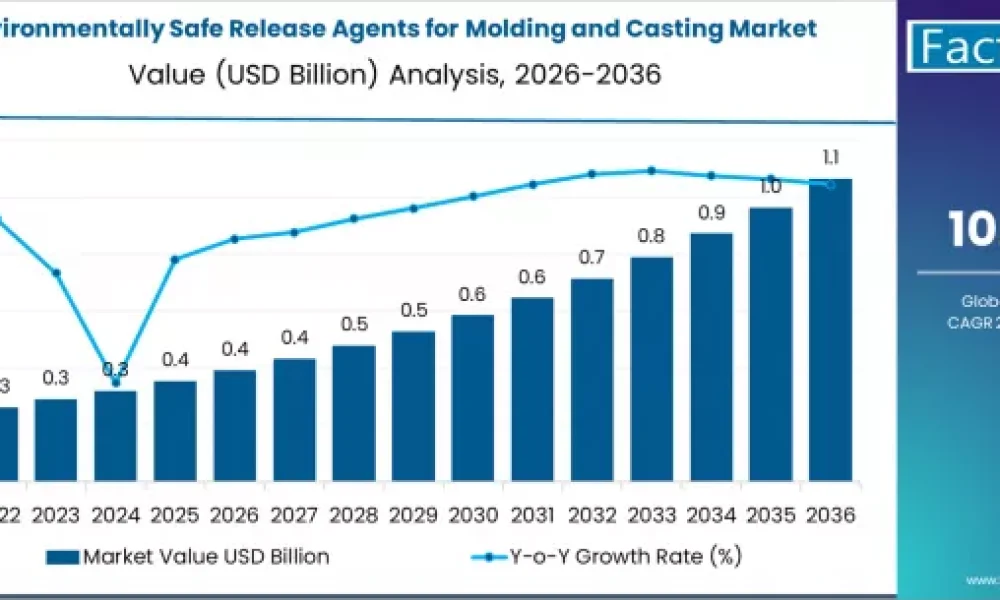
The environmentally safe release agents for molding and casting market is projected to experience robust growth over the next decade as manufacturers in automotive, aerospace, construction, consumer goods, and industrial sectors increasingly adopt eco-friendly production materials. Demand for release agents that reduce environmental impact, improve worker safety, and maintain high performance in molding and casting processes is rising due to environmental regulations, sustainability commitments, and heightened awareness of hazardous chemical exposure.
Environmentally safe release agents are formulated to facilitate the separation of molded or cast parts from tooling surfaces without damaging the part, mold, or surface finish. These products are designed for non-toxic performance, biodegradability, and reduced volatile organic compound (VOC) emissions, making them suitable alternatives to conventional petroleum-based and solvent-heavy release systems.
Market Outlook
By 2036, Environmentally Safe Release Agents for Molding and Casting Market is expected to grow to USD 1.06 billion. The market is expected to grow at a compound annual growth rate (CAGR) of 10.5% during the assessment period, with a valuation of USD 0.39 billion in 2026.
Vegetable oil and ester-based biodegradable release agents account for 34% of the formulation. Release (general purpose) is the main functional role at 46.0%, while plastic injection molding (automotive & electronics) is the leading end-use at 36%.
Key Takeaways from the Environmentally Safe Release Agents for Molding and Casting Market
- Market Value for 2026: USD 0.39 Billion
- Market Value for 2036: USD 1.06 Billion
- Forecast CAGR (2026-2036): 10.5%
- Leading Formulation Share (2026): Vegetable-oil & ester-based biodegradable release agents (34%)
- Leading End-Use Application Share (2026): Plastic injection molding (automotive & electronics) (36%)
- Leading Functional Role Share (2026): Release (general purpose) (46.0%)
- Key Players in the Market: Chem-Trend, Henkel AG & Co. KGaA, Dow Inc., Croda International plc., Wacker Chemie AG, Clariant AG, Arkema S.A., The Freudenberg Group
To Access the Complete Data Tables & in-depth Insights, Request a Discount on this report: https://www.factmr.com/connectus/sample?flag=S&rep_id=13004
Market Overview
Release agents play a crucial role in industries that rely on molding and casting technologies, such as plastic injection molding, metal die casting, rubber and elastomer molding, composite fabrication, and concrete forming. Traditionally, these agents often contained hazardous solvents or non-biodegradable carriers that posed environmental and health risks, including VOC emissions and potential toxicity during handling and disposal.
Environmentally safe release agents are developed to provide equivalent or superior performance while reducing or eliminating harmful components. These formulations typically use water-based carriers, biodegradable oils, plant-derived lubricants, and other green chemistries to deliver efficient release, improved surface quality, and compliance with regulatory standards such as low VOC emissions and reduced hazardous air pollutants (HAPs).
Key Demand Drivers
1. Stricter Environmental Regulations
Governments and environmental agencies worldwide are enforcing tighter regulations on industrial emissions, chemical formulations, and waste handling practices. Regulations addressing VOC emissions, hazardous substance reporting, and air quality drive manufacturers to replace traditional release agents with environmentally safe alternatives to ensure compliance and avoid penalties.
2. Corporate Sustainability Commitments
Many companies are adopting sustainability strategies that include the use of eco-friendly materials in manufacturing processes. Consumer preferences and investor expectations have amplified the importance of environmental, social, and governance (ESG) initiatives, leading manufacturers to integrate green solutions such as biodegradable release agents to reduce their environmental footprint.
3. Worker Safety and Health Considerations
Environmentally safe release agents often feature low toxicity, reduced fumes, and safer handling profiles, contributing to improved workplace safety. Facilities with stringent occupational health standards view these agents as essential for reducing worker exposure to harmful chemicals while maintaining operational efficiency.
4. Growth in Automotive and Composite Manufacturing
The automotive industry, in particular, is transitioning to lighter, sustainable materials and is a major driver of demand for eco-friendly release agents. Growth in composite parts production for lightweighting and performance, as well as increased use of molded and cast components in vehicle assembly, supports expanded adoption of biodegradable and non-toxic release systems.
Market Segmentation Insights
By Product Type
Water-Based Release Agents: Leading segment due to minimal VOC emissions, broad material compatibility, and ease of use in injection molding and casting.
Vegetable Oil-Based Systems: Popular for biodegradable performance and excellent lubricity in rubber, plastics, and composite processing.
Silicone-Free Formulations: Increasingly adopted where surface residue and finish quality are critical, especially in automotive interiors and consumer goods.
Polymer-Modified and Specialty Agents: Tailored for specific mold materials, casting temperatures, and part geometries that demand advanced release performance.
By End-Use Industry
Automotive: Major user as OEMs and tier suppliers emphasize sustainable manufacturing and reduced solvent use.
Aerospace: Demands high-performance release agents with strict compliance to safety and environmental standards.
Construction and Infrastructure: Uses environmentally safe agents for concrete forming, precast operations, and architectural elements.
Industrial Manufacturing: Applies to metal die casting, rubber goods, and plastic parts where eco-friendly performance is necessary.
Consumer Goods and Appliances: Growing adoption in injection molding applications to meet sustainability benchmarks and consumer expectations.
By Application Process
Injection Molding: Largest application due to high volume of molded parts and requirement for consistent release without damage.
Die Casting: Environmentally safe agents improve surface finish while reducing harmful emissions in metal casting.
Composite Fabrication: Essential for fiber-reinforced plastics and advanced materials where residual solvents are undesirable.
Rubber and Elastomer Molding: Biodegradable agents support curing and release without interfering with material properties.
Regional Demand Dynamics
North America
North America represents a significant share of the market due to stringent environmental laws, established manufacturing sectors, and strong emphasis on workplace safety. Automotive, aerospace, and industrial goods production in the United States and Canada drives continued demand for environmentally safe release solutions.
Europe
Europe demonstrates robust adoption supported by comprehensive environmental regulations and strong sustainability frameworks. Manufacturers across Germany, France, Italy, and other industrial hubs integrate green chemistries in molding and casting to meet regulatory and corporate sustainability goals.
Asia Pacific
Asia Pacific is expected to exhibit rapid growth as manufacturing activity expands in China, India, Southeast Asia, and other emerging economies. Rising production of automotive components, electronics, and consumer goods coupled with increasing environmental awareness encourages adoption of biodegradable and low-VOC release agents.
Rest of World
Latin America, the Middle East, and Africa are gradually increasing use of environmentally safe release agents as industrialisation progresses and regional environmental standards evolve. Government incentives and green manufacturing initiatives support incremental market growth.
Competitive Landscape
The environmentally safe release agents market is moderately competitive, with participation from global chemical manufacturers, specialty formulation companies, and regional suppliers. Market players are focusing on improving product performance, expanding eco-friendly portfolios, and enhancing technical support to meet diverse end-use requirements.
Key strategies include development of low-emission and biodegradable formulations, partnerships with OEMs and industrial consumers, and investments in research to improve cross-material compatibility and release efficiency. Customised solutions that address specific processing temperatures, mold materials, and sustainability criteria are becoming differentiators in the market.
Future Outlook
The environmentally safe release agents for molding and casting market is anticipated to sustain strong growth through 2036 as sustainability mandates, environmental compliance, and industry adoption of green materials continue to rise. Innovations in biodegradable chemistries, alternative carriers, and surface-compatible systems will further enhance performance and broaden applicability.
As manufacturers optimise operations to incorporate eco-friendly materials without compromising quality, environmentally safe release agents will be central to sustainable production strategies across industries including automotive, aerospace, construction, and consumer manufacturing. Continued expansion of circular economy principles and regulatory alignment will reinforce the value of these solutions in global manufacturing ecosystems.
Have specific requirements or need assistance on report pricing or have a limited budget? Please contact [email protected]
About Fact.MR:
Fact.MR is a global market research and consulting firm, trusted by Fortune 500 companies and emerging businesses for reliable insights and strategic intelligence. With a presence across the U.S., UK, India, and Dubai, we deliver data-driven research and tailored consulting solutions across 30+ industries and 1,000+ markets. Backed by deep expertise and advanced analytics, Fact.MR helps organizations uncover opportunities, reduce risks, and make informed decisions for sustainable growth



