
The global enterprise social networks and online communities market is undergoing a rapid transformation as organizations increasingly prioritize digital collaboration and connected work environments. With hybrid and remote work models becoming permanent features of the modern workplace, enterprises are investing heavily in advanced collaboration platforms that enable seamless communication, knowledge sharing, and team coordination.
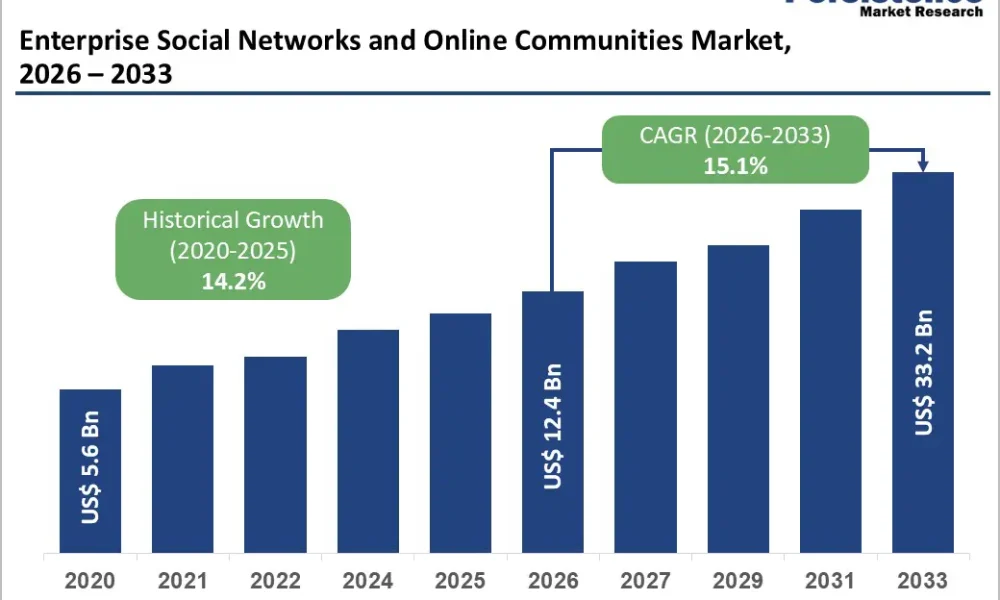
The market is projected to reach US$12.4 billion in 2026 and expand to US$33.2 billion by 2033, growing at a strong CAGR of 15.1% during the forecast period from 2026 to 2033. This remarkable growth reflects the rising importance of digital collaboration platforms that enable organizations to maintain productivity and engagement across distributed workforces.
Enterprise social networks (ESNs) and online communities allow employees, partners, and customers to interact within structured digital environments. These platforms integrate messaging, document sharing, analytics, and workflow automation, helping businesses eliminate communication silos and accelerate decision-making processes.
As organizations continue to pursue digital transformation, enterprise collaboration tools are becoming a core component of modern workplace infrastructure.
The Rise of Digital Workplaces Driving Market Growth
The transformation of traditional offices into digital workplaces is one of the most significant drivers behind the growth of enterprise social networks. Businesses are shifting toward flexible work arrangements where employees collaborate remotely or through hybrid models.
Studies suggest that nearly 60% of employees with remote-capable roles prefer hybrid work environments, while a significant share of the workforce now favors fully remote jobs. As this trend accelerates, organizations require platforms that support collaboration regardless of geographical boundaries.
Enterprise social networks provide centralized digital environments where employees can share knowledge, participate in discussions, and access critical resources. These platforms help companies preserve organizational culture even when teams are geographically dispersed.
By enabling real-time communication, asynchronous discussions, and structured collaboration spaces, enterprise social networks improve productivity while ensuring teams remain connected across time zones.
Increasing Digital Transformation Investments Strengthening Adoption
Digital transformation initiatives are accelerating worldwide as companies modernize legacy systems and adopt advanced digital tools. Enterprise social networks are becoming a fundamental component of these transformation strategies.
Organizations across industries are adopting collaborative platforms to integrate communication with workflow management, project coordination, and data analytics. By consolidating multiple functions into a unified digital workspace, these platforms reduce operational inefficiencies and enhance transparency.
Regulatory compliance also plays a major role in platform adoption. Stringent data protection frameworks, including the European Union’s General Data Protection Regulation (GDPR), require businesses to implement secure communication systems that protect sensitive data.
Non-compliance with such regulations can lead to significant financial penalties, encouraging organizations to adopt enterprise collaboration platforms equipped with advanced security features, data governance capabilities, and audit trails.
As digital transformation continues to reshape industries, enterprise social networks are evolving beyond communication tools into secure digital ecosystems supporting enterprise-wide operations.
Hybrid Work Culture Reshaping Enterprise Collaboration
The shift toward hybrid work has fundamentally changed how organizations operate. Employees now work from multiple locations, including homes, coworking spaces, and corporate offices.
This distributed work environment demands collaboration platforms that support real-time engagement and knowledge sharing across diverse teams. Enterprise social networks address this need by enabling seamless collaboration regardless of physical location.
These platforms offer features such as:
- Instant messaging and discussion forums
- Video conferencing and virtual meetings
- Knowledge repositories and document sharing
- Workflow automation and project management tools
By integrating these capabilities, enterprise social networks help organizations maintain operational continuity while fostering employee engagement.
As hybrid work models continue to dominate corporate environments, the demand for enterprise collaboration tools is expected to grow significantly.
Digital Infrastructure Challenges Slowing Market Penetration
Despite strong growth prospects, the enterprise social networks market faces several challenges. One of the most significant barriers is uneven digital infrastructure development across emerging economies.
Many organizations in regions such as parts of Africa, South Asia, and Latin America struggle with unreliable internet connectivity and limited IT infrastructure. These constraints make it difficult for businesses to implement advanced enterprise collaboration platforms.
Small organizations in these markets often lack the technical expertise required to deploy and manage enterprise social networks. Limited digital literacy and budget constraints further restrict adoption.
As a result, market penetration remains concentrated in digitally mature economies where organizations possess the necessary infrastructure and technical capabilities.
However, increasing government investments in digital infrastructure and cloud computing are expected to gradually reduce these barriers in the coming years.
Data Privacy and Security Concerns Affecting Cloud Adoption
Another major restraint for the enterprise social networks market is the growing concern around data privacy and cybersecurity. Organizations are increasingly cautious about storing sensitive corporate information on third-party cloud platforms.
Industries such as healthcare, banking, and financial services operate under strict regulatory frameworks that require secure data handling and storage practices. Any data breach or compliance failure can lead to financial penalties and reputational damage.
Consequently, many enterprises prefer hybrid or on-premise deployment models that provide greater control over sensitive data. Although cloud solutions offer scalability and cost efficiency, security concerns continue to influence adoption decisions.
To address these challenges, vendors are investing heavily in advanced encryption technologies, identity management systems, and compliance certifications to build trust among enterprise customers.
Elevate your business strategy with comprehensive market data. Request a sample report now: https://www.persistencemarketresearch.com/samples/12250
Growing SME Adoption Creating Major Market Opportunities
Small and medium-sized enterprises (SMEs) represent one of the most promising growth opportunities for the enterprise social networks market.
In 2025, SMEs accounted for approximately 51.7% of market revenue, making them the largest enterprise segment. The increasing availability of affordable Software-as-a-Service (SaaS) collaboration tools has significantly lowered entry barriers for smaller businesses.
Unlike traditional enterprise software that required significant upfront investment, SaaS platforms offer subscription-based pricing models that allow SMEs to access advanced collaboration tools without large capital expenditures.
These platforms enable small businesses to:
- Improve team communication
- Enhance knowledge management
- Increase employee engagement
- Streamline workflows and decision-making
Government programs supporting SME digitalization in countries across Asia Pacific, Latin America, and the Middle East are further accelerating adoption.
With SMEs increasingly competing in global markets, enterprise social networks are becoming essential tools for improving efficiency and maintaining competitiveness.
Artificial Intelligence Transforming Enterprise Collaboration Platforms
Artificial intelligence is rapidly transforming enterprise collaboration platforms, creating new opportunities for innovation and differentiation.
Modern enterprise social networks are integrating AI capabilities such as intelligent search, automated workflow management, and predictive analytics. These features help organizations extract valuable insights from large volumes of communication data.
AI-powered collaboration platforms can automatically summarize conversations, recommend relevant documents, and generate actionable insights for decision-makers.
Autonomous AI agents are also beginning to play a significant role in enterprise collaboration ecosystems. These agents can manage repetitive tasks, schedule meetings, monitor project progress, and provide real-time updates to team members.
As AI adoption continues to expand across enterprise environments, collaboration platforms will evolve into intelligent digital assistants that enhance productivity and streamline operations.
Cloud Deployment Dominating the Market
Cloud-based deployment models currently dominate the enterprise social networks market. In 2025, cloud platforms accounted for approximately 54.3% of the total market share.
Cloud solutions offer several advantages over traditional on-premise systems, including scalability, cost efficiency, and simplified deployment. Organizations can implement collaboration tools quickly without investing in extensive hardware infrastructure.
Cloud platforms also enable seamless integration with other enterprise applications such as customer relationship management (CRM), human resource management systems, and analytics platforms.
Although cloud deployment leads the market, hybrid models are emerging as the fastest-growing segment. Hybrid solutions allow organizations to balance flexibility and security by combining cloud functionality with on-premise infrastructure.
This approach is particularly attractive for enterprises operating in regulated industries where data sovereignty and compliance requirements are critical.
Industry Adoption Trends
Enterprise social networks are widely used across multiple industries, but adoption levels vary significantly depending on operational requirements and digital maturity.
The IT and telecommunications sector currently leads adoption, accounting for approximately 45% of market share. Technology companies rely heavily on collaboration platforms to coordinate global teams, manage complex projects, and share knowledge across departments.
Other industries are rapidly increasing adoption as well. Healthcare organizations are implementing enterprise social networks to improve communication between medical professionals and administrative teams. These platforms help streamline patient care coordination and support regulatory compliance.
Similarly, financial institutions are adopting enterprise collaboration platforms to enhance internal communication while maintaining strict security and compliance standards.
As digital transformation continues to accelerate across industries, enterprise social networks are becoming essential tools for improving efficiency and collaboration.
Regional Market Trends
North America
North America remains the leading region in the enterprise social networks and online communities market, accounting for approximately 32% of global market share.
The region benefits from advanced digital infrastructure, strong cybersecurity frameworks, and significant enterprise IT investments. Organizations across the United States and Canada have rapidly adopted collaboration platforms as part of broader digital workplace initiatives.
Enterprises in North America also demand advanced features such as artificial intelligence, automation, and integrated analytics, creating opportunities for premium enterprise collaboration solutions.
Europe
Europe represents the second-largest regional market, driven by strong digital transformation initiatives and strict regulatory frameworks.
Countries such as Germany, the United Kingdom, and France are leading adopters of enterprise social networks. The region’s focus on data privacy and compliance has encouraged organizations to adopt secure collaboration platforms that meet regulatory requirements.
Europe is expected to maintain steady growth as companies continue investing in digital workplace solutions to improve operational efficiency and innovation.
Asia Pacific
Asia Pacific is the fastest-growing regional market for enterprise social networks and online communities.
Rapid digital transformation initiatives in countries such as China, India, and Japan are driving adoption among both large enterprises and SMEs. Government programs supporting digitalization and cloud adoption are accelerating market growth.
The region’s expanding workforce and growing startup ecosystem are also contributing to increased demand for collaboration platforms that support distributed teams.
By 2033, Asia Pacific is expected to emerge as one of the largest markets for enterprise collaboration solutions.
Competitive Landscape
The enterprise social networks and online communities market features a mix of global technology giants and specialized collaboration platform providers.
Major companies dominate the market through integrated enterprise ecosystems that combine communication, productivity, and analytics tools within unified platforms.
Key companies operating in the market include:
- Microsoft Corporation
- Google Inc.
- Salesforce
- SAP SE
- Cisco Systems
- IBM Corporation
- VMware
- Zoho Corporation
Competition in the market increasingly focuses on innovation in artificial intelligence, platform extensibility, and integration with enterprise applications.
Vendors are also investing in developer ecosystems and customizable features that allow organizations to tailor collaboration platforms to their unique operational needs.
Future Outlook
The enterprise social networks and online communities market is poised for strong growth as organizations continue to embrace digital workplaces and distributed workforce models.
Emerging technologies such as artificial intelligence, automation, and advanced analytics will further enhance the capabilities of collaboration platforms. These innovations will enable businesses to extract deeper insights from communication data and streamline complex workflows.
Additionally, the rapid expansion of SMEs and growing adoption of SaaS-based collaboration tools will significantly expand the addressable market.
As enterprises prioritize productivity, employee engagement, and knowledge sharing, enterprise social networks will play a central role in shaping the future of digital collaboration.
With the market expected to surpass US$33.2 billion by 2033, enterprise collaboration platforms will remain critical infrastructure for organizations seeking to thrive in an increasingly connected and digital business environment.
Related Reports:




