
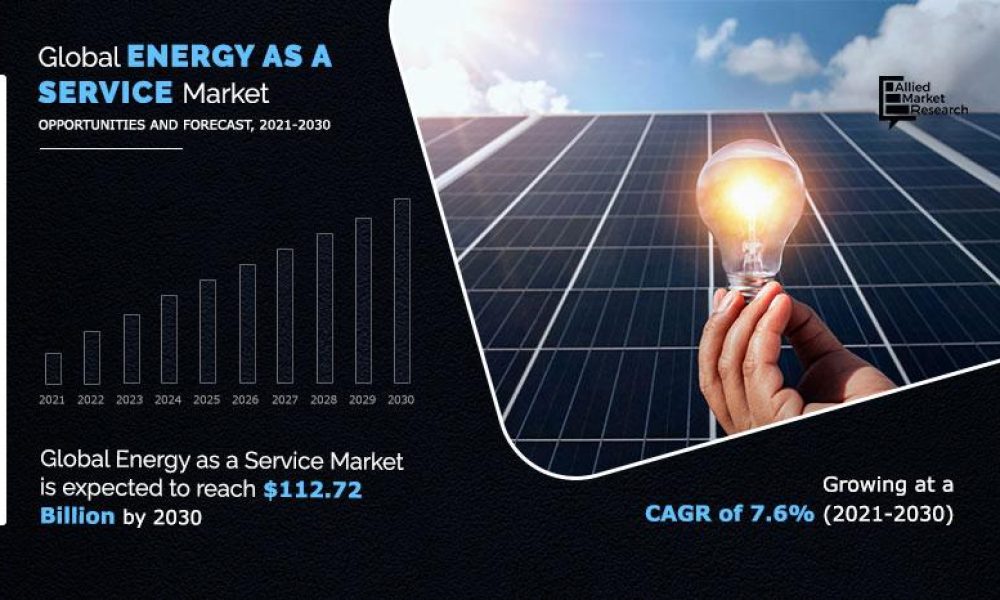
The global Energy as a Service (EaaS) market is poised for robust expansion, according to a new research report by Allied Market Research. Titled “Energy as a Service Market by Service and End-Use: Global Opportunity Analysis and Industry Forecast, 2021–2030,” the report estimates the market to grow from $54.4 billion in 2020 to $112.7 billion by 2030, reflecting a compound annual growth rate (CAGR) of 7.6%.
EaaS is redefining the energy landscape, providing a flexible, outcome-based business model that enables users—ranging from small businesses to large enterprises—to optimize energy usage without the burden of owning or maintaining energy infrastructure. The model offers a combination of energy supply, energy asset management, and energy optimization services through performance-based or subscription-style agreements. It is gaining momentum due to the rising demand for sustainable energy systems, distributed generation, and digital energy solutions.
Download PDF Brochure: https://www.alliedmarketresearch.com/request-sample/A06878
Energy as a Service: The Next Evolution in Energy Management
The traditional utility model is undergoing a fundamental shift, driven by trends like decarbonization, decentralization, digitalization, and electrification. These trends are propelling the demand for Energy as a Service, as businesses seek smarter and more efficient ways to meet energy needs while aligning with carbon-neutral goals.
This model empowers customers to focus on their core operations while delegating energy-related functions to expert service providers. Through technologies such as smart grids, IoT, cloud computing, and AI, EaaS providers offer real-time monitoring, predictive maintenance, dynamic pricing, and load optimization, unlocking significant operational savings and environmental benefits.
Market Drivers and Growth Enablers
- Rising Adoption of Distributed Energy Resources (DERs)
Increasing reliance on solar PV, wind turbines, combined heat & power (CHP), and fuel cells is spurring demand for integrated energy solutions. These decentralized power systems require intelligent management platforms that EaaS models offer. - Digitization and Smart Infrastructure
Rapid advancement in energy analytics, automation, and smart building solutions are enabling businesses to track, optimize, and control energy consumption with precision. These systems support energy conservation and cost savings across commercial and industrial settings. - Environmental Mandates and Energy Efficiency Goals
Global initiatives focused on reducing carbon emissions and promoting net-zero buildings are influencing businesses to adopt service-based models for achieving compliance while optimizing performance. The EaaS framework facilitates easier access to renewable power and carbon footprint reduction. - Financial Flexibility and Operational Efficiency
Energy as a Service reduces upfront capital expenditure by shifting costs to operational expenses (OpEx). Customers benefit from performance-based contracts, paying only for actual energy savings or outcomes delivered.
Market Restraints and Challenges
Despite its advantages, the EaaS model faces hurdles related to initial integration costs, especially when transitioning from conventional to smart energy infrastructure. Retrofitting older buildings, integrating DERs, and ensuring cybersecurity of digital energy platforms remain key challenges. Moreover, the need for skilled professionals and interoperable technologies can be barriers in emerging markets.
Segment Insights
By Service Type:
The energy supply services segment held the highest market share of 37.4% in 2020 and is expected to remain dominant through 2030. The segment’s growth is attributed to increasing energy demands across industries such as manufacturing, processing, and commercial facilities, especially those integrating on-site renewables.
By End-Use Industry:
The commercial sector emerged as the largest end-use segment. Facilities such as restaurants, office buildings, educational institutions, hospitals, data centers, and shopping complexes are investing in energy efficiency to reduce operational costs and meet sustainability standards.
For Purchase Inquiry: https://www.alliedmarketresearch.com/purchase-enquiry/A06878
Regional Outlook
Asia-Pacific led the global EaaS market in 2020 and is expected to continue its dominance over the forecast period. Rapid industrialization, urbanization, rising energy consumption, and favorable regulatory frameworks across China, India, Japan, and Southeast Asia are key contributing factors. Moreover, Asia-Pacific is home to a growing base of renewable energy investments and large commercial developments needing scalable energy management solutions.
North America is another major market due to the presence of advanced grid infrastructure, tech-savvy consumers, and corporate clean energy commitments. The U.S. market is particularly mature, supported by state-level incentives and growing demand for smart energy-as-a-service platforms.
Europe, driven by EU decarbonization policies, has seen a steady uptick in EaaS adoption, especially in the building automation and industrial retrofit sectors. The region’s commitment to the Green Deal and energy neutrality is creating opportunities for innovative energy service providers.
Leading Industry Players
Key players in the global EaaS market include:
- Veolia
- Honeywell International Inc.
- EDF Renewables
- Enel X
- Schneider Electric SE
- Engie SA
- Johnson Controls International
- WGL Energy
- Alpiq
- General Electric
These companies are investing heavily in AI-driven analytics, remote energy monitoring, and energy-as-a-service platforms to stay competitive. Strategic partnerships, acquisitions, and joint ventures are common as players seek to expand global footprints and service capabilities.
Future Outlook and Opportunities
The Energy as a Service model is expected to be central to future smart city development, sustainable infrastructure planning, and corporate net-zero strategies. Integrating AI, blockchain, and IoT into EaaS platforms will enable predictive energy management, transparent billing, and automated compliance.
With growing demand from commercial, industrial, and municipal users, the EaaS market presents substantial opportunities for technology providers, utilities, investors, and policymakers.




