
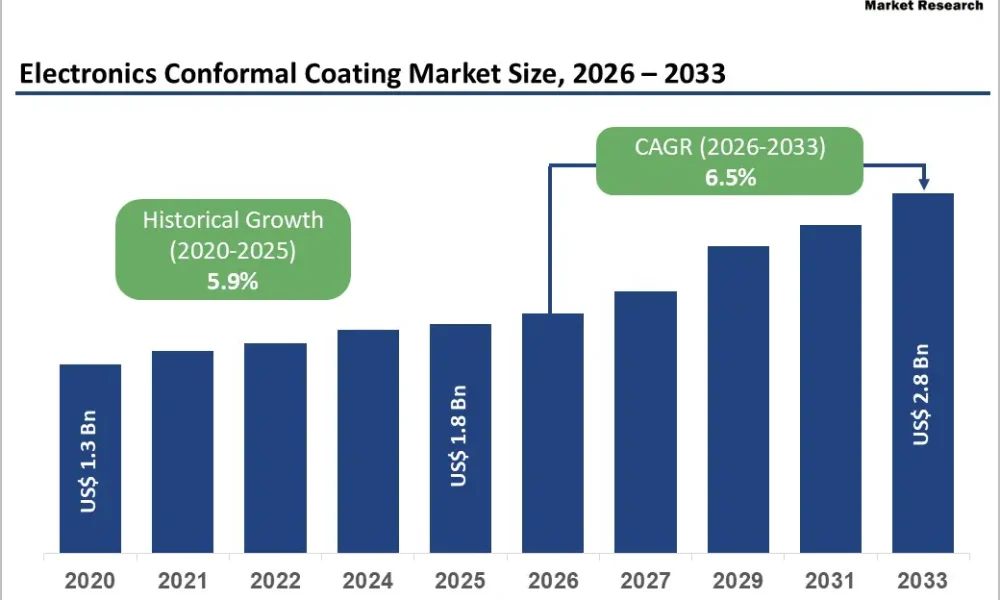
The global electronics conformal coating market is witnessing steady growth as electronic devices become more compact, powerful, and exposed to demanding operating environments. According to market estimates, the electronics conformal coating market size is expected to reach US$ 1.8 billion in 2026 and expand to US$ 2.8 billion by 2033, registering a compound annual growth rate (CAGR) of 6.5% between 2026 and 2033.
Conformal coatings are thin polymeric films applied to printed circuit boards (PCBs) and electronic components to protect them from moisture, dust, chemicals, temperature fluctuations, and electrical interference. As industries increasingly rely on electronics for critical operations—from consumer gadgets to aerospace systems—the importance of these protective coatings has become central to product reliability and longevity.
Rising consumer electronics demand, the electrification of vehicles, expansion of 5G infrastructure, and the proliferation of Internet of Things (IoT) devices are collectively fueling market expansion. Furthermore, evolving environmental regulations are encouraging the development of low-VOC and sustainable coating technologies, creating innovation opportunities for manufacturers.
Electronics Conformal Coating Market Overview
The electronics conformal coating industry has evolved from a niche protective material segment into a vital component of modern electronics manufacturing. With global electronics production exceeding US$ 1.2 trillion annually, demand for protective materials capable of maintaining performance under extreme conditions continues to rise.
Several macroeconomic and technological trends are influencing the market:
- Rapid miniaturization of electronic devices
- Growth of electric and autonomous vehicles
- Expansion of smart home and IoT ecosystems
- Increased demand for reliable aerospace and defense electronics
- Growing environmental compliance requirements
These factors are pushing manufacturers to adopt advanced conformal coating solutions that ensure durability while meeting strict regulatory standards.
Key Industry Highlights
The global electronics conformal coating market demonstrates strong regional and segment-based growth patterns.
Leading Region
Asia Pacific dominates the global market, accounting for approximately 45% of total revenue in 2024. The region’s strong electronics manufacturing ecosystem, particularly in China, Japan, South Korea, and Taiwan, drives significant demand for protective coatings.
Fastest-Growing Region
Asia Pacific is also expected to remain the fastest-growing region with a CAGR of 9.2% from 2026 to 2033, supported by expanding electronics manufacturing capacity and increasing electric vehicle production.
Dominant Material Segment
Acrylic conformal coatings lead the market with around 44% market share in 2025, primarily due to their cost-effectiveness, quick drying time, and ease of application.
Fastest-Growing Technology Segment
UV-curable coatings are emerging as the fastest-growing category with an expected CAGR of 8.5%, driven by energy-efficient UV-LED curing and reduced volatile organic compound emissions.
Major Opportunity
The aerospace and defense sector presents one of the most lucrative opportunities for conformal coating manufacturers due to stringent reliability requirements and increasing investment in advanced military electronics.
Market Drivers
Growing Demand for Consumer Electronics
The consumer electronics industry remains the largest driver of conformal coating demand. Global production of smartphones, tablets, wearables, smart home systems, and gaming devices continues to increase rapidly.
These devices rely on densely packed electronic components that are highly vulnerable to environmental damage. Moisture intrusion, dust contamination, and electrical interference can lead to circuit failure, reduced device lifespan, and costly product recalls.
Conformal coatings provide a cost-effective solution to protect electronic assemblies without adding significant bulk. As product designs become thinner and more complex, coatings are becoming increasingly essential to maintain electrical insulation and device reliability.
Additionally, the surge in IoT-enabled devices is accelerating demand. Smart thermostats, smart speakers, connected appliances, and industrial sensors must operate reliably in diverse environmental conditions, increasing the need for protective coating solutions.
Elevate your business strategy with comprehensive market data. Request a sample report now: https://www.persistencemarketresearch.com/samples/33399
Expansion of Electric Vehicles and Automotive Electronics
The automotive sector is undergoing a massive transformation driven by electrification and digitalization. Modern vehicles contain significantly more electronic components than traditional internal combustion engine vehicles.
By 2030, automotive electronics are expected to represent over 50% of total vehicle production costs. Key systems requiring protection include:
- Battery management systems
- Electric motor controllers
- Power electronics
- ADAS sensors
- Infotainment systems
- Connectivity modules
Electric vehicles operate under extreme environmental conditions, including heat, humidity, vibration, and chemical exposure. Conformal coatings help ensure the reliability and longevity of sensitive electronic circuits in these demanding environments.
With global EV adoption projected to account for 40% of vehicle production by 2030, conformal coating demand from the automotive sector is expected to rise significantly.
Market Challenges
High Initial Investment and Complex Application Processes
Despite their benefits, conformal coating implementation involves substantial capital investment. Automated coating equipment systems can cost between US$ 200,000 and US$ 500,000 per installation, making adoption challenging for small and medium-sized manufacturers.
Additional costs include:
- Process validation
- Operator training
- Quality control infrastructure
- Compliance testing
- Equipment maintenance
Improper application can result in coating defects, incomplete coverage, or poor curing. These issues can lead to costly rework or product rejection, discouraging adoption among smaller manufacturers with limited technical expertise.
Regulatory and Environmental Compliance
Environmental regulations are increasingly influencing the conformal coating market. Regulations such as REACH, RoHS, and regional air quality standards impose restrictions on volatile organic compound emissions and hazardous materials.
Traditional solvent-based coatings often contain 70–80% solvent content, which contributes to VOC emissions. As regulatory pressure increases, manufacturers are transitioning toward:
- Water-based coatings
- UV-curable coatings
- Low-VOC formulations
However, reformulating products to meet regulatory standards requires extensive research, testing, and certification, increasing development costs and market entry barriers.
Emerging Market Opportunities
Aerospace and Defense Electronics
The aerospace and defense sector represents a high-value market opportunity due to stringent reliability requirements. Electronics used in aircraft, satellites, and defense systems must withstand extreme conditions such as:
- High altitudes
- Severe temperature variations
- Salt fog exposure
- Radiation environments
Conformal coatings used in aerospace applications must comply with strict standards such as MIL-I-46058 and MIL-DTL-81706.
Growing investments in military modernization, advanced radar systems, satellite communications, and unmanned aerial vehicles are expected to create sustained demand for specialized coatings.
Medical Electronics and Biocompatible Coatings
The medical device industry is emerging as another promising growth area. Medical electronics embedded in diagnostic equipment, wearable health monitors, and implantable devices require coatings that offer both protection and biocompatibility.
Advanced silicone-based and hybrid coatings are increasingly being developed to meet strict healthcare regulations while maintaining device functionality.
With the global medical device industry continuing to expand, demand for medical-grade conformal coatings is expected to grow steadily over the coming decade.
Category-Wise Market Analysis
Material Type Insights
Acrylic conformal coatings dominate the market due to their balanced performance and cost advantages. These coatings provide excellent moisture resistance and electrical insulation while maintaining fast drying times.
Manufacturers prefer acrylic coatings in high-volume production environments because they simplify manufacturing workflows and reduce operational downtime.
Hybrid formulations combining acrylic with silicone or polyurethane properties are also gaining popularity as they offer enhanced durability while maintaining affordability.
Elevate your business strategy with comprehensive market data. Request a sample report now: https://www.persistencemarketresearch.com/samples/33399
Operating Method Insights
Automated spray coating has emerged as the most widely adopted application method, accounting for approximately 52% of market share.
Automated systems offer several advantages:
- Consistent coating thickness
- Reduced material waste
- Higher production throughput
- Improved process repeatability
Selective coating equipment can precisely apply coatings only to specific areas, eliminating the need for manual masking and significantly improving manufacturing efficiency.
Technology Insights
Solvent-based coatings continue to dominate the technology segment, holding approximately 58% market share. These coatings offer a proven performance track record across industrial and aerospace applications.
However, environmental regulations are accelerating the shift toward water-based and UV-curable technologies.
Water-based coatings are projected to grow at an estimated 8.2% CAGR through 2033, as manufacturers seek environmentally friendly solutions without sacrificing performance.
Application Insights
Moisture and insulation protection represent the largest application segment, accounting for approximately 38% of the market.
Moisture exposure is one of the most common causes of electronic failure. Conformal coatings protect components by preventing:
- Corrosion
- Electrical leakage
- Short circuits
- Electrochemical migration
As electronics become smaller and more densely integrated, maintaining reliable insulation is becoming increasingly important.
Industry Insights
Consumer electronics remain the largest industry segment, capturing roughly 36% of global market share.
Smartphones, wearable devices, and smart home electronics require reliable protection against environmental exposure. Components such as microphones, sensors, camera modules, and antennas are particularly vulnerable to moisture damage.
The emergence of flexible electronics and foldable devices is creating new coating requirements. Flexible coatings capable of bending without cracking are becoming increasingly important for next-generation devices.
Regional Market Analysis
North America
North America accounts for approximately 24% of global market revenue. The region’s strong aerospace and defense industry plays a major role in driving demand.
Major automotive manufacturers are also integrating conformal coatings to enhance the reliability of electric vehicle electronics.
Additionally, environmental regulations in the United States are encouraging adoption of water-based and UV-curable coating technologies.
Europe
Europe represents about 22% of the global market. Strict environmental policies such as REACH and RoHS significantly influence product development and adoption patterns.
Germany leads the region due to its strong automotive and industrial manufacturing base. The shift toward electric vehicles is accelerating demand for protective electronic coatings across European automotive supply chains.
Asia Pacific
Asia Pacific is the largest and fastest-growing regional market, accounting for over 45% of global demand.
China, Japan, South Korea, and Taiwan dominate global electronics production, creating massive demand for conformal coatings.
India is also emerging as a major manufacturing hub due to government initiatives aimed at boosting domestic electronics production. Expanding manufacturing infrastructure across Southeast Asia is expected to further strengthen regional growth.
Competitive Landscape
The electronics conformal coating market is moderately consolidated, with both global chemical manufacturers and specialized coating companies competing across various application segments.
Leading companies focus on:
- Product innovation
- Sustainability-driven formulations
- Strategic acquisitions
- Expansion of global distribution networks
Manufacturers are also investing in advanced application technologies and automated coating systems to improve production efficiency and meet evolving industry requirements.
Key Industry Developments
Recent strategic initiatives highlight the industry’s focus on innovation and sustainability.
In April 2024, Henkel AG & Co. KGaA acquired Seal for Life Industries, expanding its portfolio of advanced protective coatings.
In October 2025, Henkel Adhesive Technologies partnered with Dow Inc. to accelerate decarbonization in coatings manufacturing by integrating renewable energy and low-carbon feedstocks.
In November 2025, HumiSeal, a subsidiary of Chase Corporation, expanded its distribution network across Europe to strengthen regional market access.
Leading Companies in the Electronics Conformal Coating Market
Key market participants include:
- Henkel AG & Co. KGaA
- Dow Inc.
- H.B. Fuller Company
- Chase Corporation
- Shin-Etsu Chemical Co., Ltd.
- Illinois Tool Works Inc.
- Electrolube Limited
- MG Chemicals Ltd.
- Dymax Corporation
- Specialty Coating Systems Inc.
- ELANTAS PDG Inc.
- Peters Group
- Panacol-Elosol GmbH
- Specialty Polymer Coatings Inc.
- Shenzhen DeepMaterial Technologies Co., Ltd.
Conclusion
The global electronics conformal coating market is entering a period of sustained growth driven by the rapid expansion of electronics across industries. Rising demand for consumer electronics, electric vehicles, IoT devices, and aerospace technologies is increasing the need for reliable protective solutions.
Although challenges such as high capital investment and regulatory compliance remain, technological advancements in water-based and UV-curable coatings are opening new growth opportunities.
As electronics become more integrated into everyday life and critical infrastructure, conformal coatings will continue to play a vital role in ensuring device durability, reliability, and performance in increasingly demanding environments.
With strong growth prospects and expanding application areas, the electronics conformal coating industry is poised to remain an essential component of the global electronics manufacturing ecosystem.
Related Reports:




